Shivraj Singh Chouhan: India Sets New Foodgrain Record
Synopsis
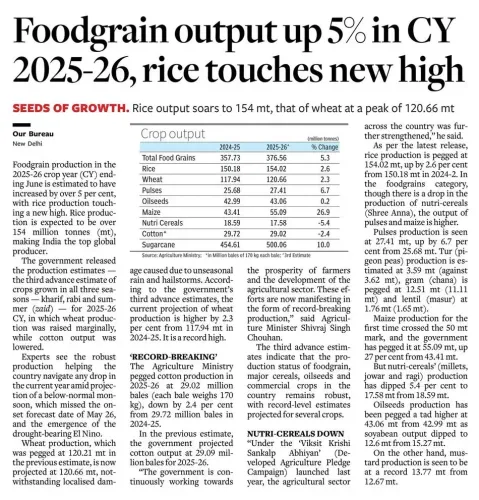
India has set a new foodgrain production record at 3,765.63 lakh tonnes as per third advance estimates for 2025-26, an increase of 188 lakh tonnes over the previous year. Union Agriculture Minister Shivraj Singh Chouhan credited PM Modi's leadership and the collective effort of farmers, scientists, and state governments.
Key Takeaways
India's total foodgrain production is estimated at 3,765.63 lakh tonnes per the third advance estimates.
Output is up by 188 lakh tonnes compared to the previous year, marking a significant single-year absolute gain.
Union Agriculture Minister Shivraj Singh Chouhan made the announcement on 29 May 2026 .
The minister credited PM Narendra Modi 's leadership, farmers, agricultural scientists, and state governments for the achievement.
Final production figures and kharif sowing data post-monsoon will be the next key milestones to watch.
The gains build on decades of policy support including PM-KISAN , MSP procurement, and climate-resilient seed development.
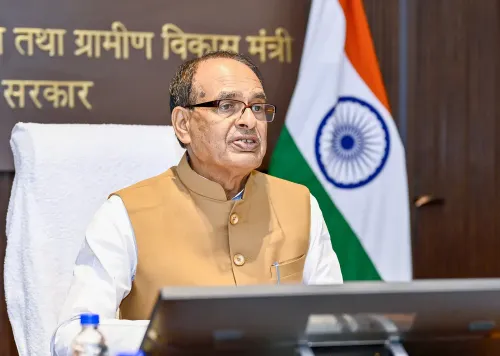
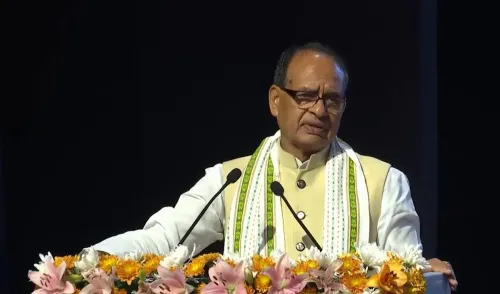
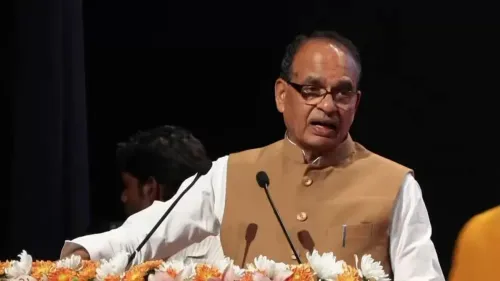
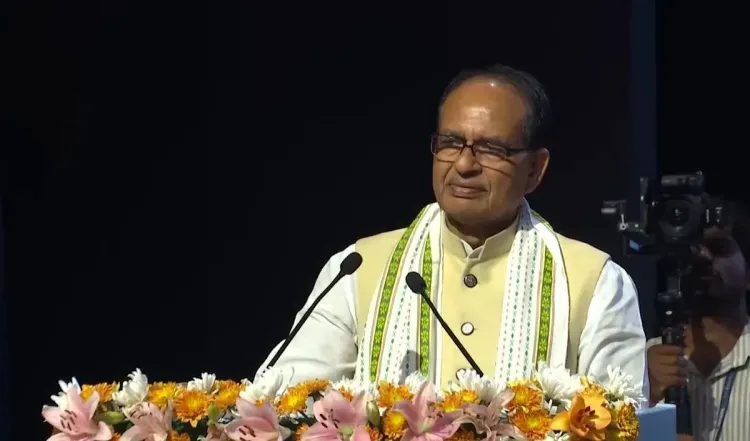
Union Agriculture Minister Shivraj Singh Chouhan announced on Friday, 29 May 2026 that India has set a new foodgrain production record, citing the third advance estimates for the current crop year. The minister credited Prime Minister Narendra Modi's leadership and the relentless hard work of the country's farmers for the milestone.
Posting on X, Chouhan wrote: 'Aadaraniya Pradhanmantri Shri @narendramodi ji ke netritva aur kisanon ki athak mehnat se Bharat ne khadyann utpadan mein naya itihas racha hai' — 'Under the respected Prime Minister Shri Narendra Modi's leadership and the tireless hard work of farmers, India has created new history in foodgrain production.'
The Numbers
According to the third advance estimates, India's total foodgrain production is projected at 3,765.63 lakh tonnes for the current year — an increase of 188 lakh tonnes over the previous year's output. If confirmed by final estimates, this would represent one of the largest single-year absolute gains in the country's agricultural history.
The minister described the achievement as the result of the 'collective effort of India's annadata [food providers — farmers], scientists, and states.'
Context
India's foodgrain output trajectory stretches back to the Green Revolution of the late 1960s, when high-yielding seed varieties and expanded irrigation transformed the country from a chronic food-deficit nation into a surplus producer. Successive governments have tracked annual advance estimates — typically released in three rounds — as a key indicator of agricultural sector health.
The current NDA government under Prime Minister Modi has layered additional policy instruments onto that foundation, including the PM-KISAN direct income-support scheme launched in 2019, which provides cash transfers to landholding farmer families, alongside minimum support price procurement and input subsidies aimed at sustaining production incentives.
Policy Backdrop
The third advance estimate is the penultimate official projection before final production figures are released, and carries significant weight for procurement planning, export policy, and food security assessments. A jump of 188 lakh tonnes year-on-year would signal strong performance across both the rabi (winter) and kharif (summer) crop seasons.
The government has in recent years emphasised crop diversification, expansion of micro-irrigation, and the deployment of climate-resilient seed varieties developed by national agricultural research institutions as drivers of sustained output growth. State governments play a direct role in seed distribution, procurement logistics, and farmer outreach, making inter-governmental coordination central to the numbers.
Stakeholders and Impact
The primary beneficiaries of higher production are India's approximately 140 million farm households, for whom a larger marketed surplus can translate into better income — provided market prices hold and procurement infrastructure is adequate. Agricultural scientists at institutions under the Indian Council of Agricultural Research have contributed improved varieties that underpin yield gains.
Higher foodgrain stocks also strengthen India's buffer reserves, providing the government greater flexibility in managing domestic food inflation and humanitarian commitments under the National Food Security Act.
What's Next
The third advance estimates will eventually be superseded by final production figures expected later in 2026. Attention will also turn to kharif sowing data once the southwest monsoon makes its onset, as the rains determine the scale of the summer crop that forms the second half of the annual foodgrain tally. Any significant deviation between the advance and final estimates could reshape the policy conversation around procurement volumes and export decisions.
Point of View
765.63 lakh tonne foodgrain estimate fits squarely into the BJP government's political-communication strategy of framing agricultural milestones as validation of PM Modi's governance model. By invoking both the Prime Minister's leadership and the collective labour of farmers and scientists, Chouhan threads a needle between top-down credit and grassroots acknowledgement — a formula refined across multiple budget cycles. The 188 lakh tonne year-on-year jump, if sustained in final estimates, would be a substantive data point, not merely rhetorical, and could bolster the government's position ahead of kharif season policy decisions on MSP and procurement. The emphasis on 'collective effort' of states also signals an intent to share political credit broadly, useful at a time when Centre-state relations on agriculture remain a live tension.
NationPress
13 Oct 2026
Frequently Asked Questions
What is India's total foodgrain production in 2025-26?
According to the third advance estimates cited by Union Agriculture Minister Shivraj Singh Chouhan, India's total foodgrain production for 2025-26 is estimated at 3,765.63 lakh tonnes.
By how much has India's foodgrain production increased this year?
India's foodgrain production has increased by 188 lakh tonnes compared to the previous year, according to the third advance estimates.
What are third advance estimates in Indian agriculture?
Third advance estimates are the penultimate official projection of annual foodgrain output released by the government before final figures are confirmed; they are widely used for procurement planning and food security assessments.
What schemes support India's foodgrain production growth?
Key government interventions include the PM-KISAN direct income-transfer scheme, minimum support price procurement, input subsidies, micro-irrigation expansion, and deployment of climate-resilient seed varieties developed by national research institutions.
When will final foodgrain production figures for 2025-26 be released?
Final foodgrain production estimates are expected to be released later in 2026, after the kharif crop season concludes and data from all states is consolidated.