Joshi Hails Record 357.73 MMT Foodgrain Output Under Modi
Synopsis
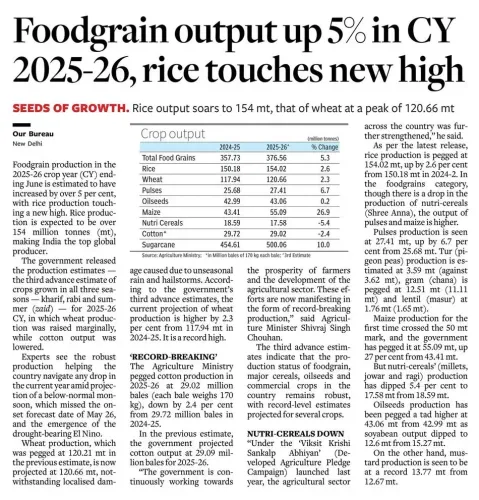
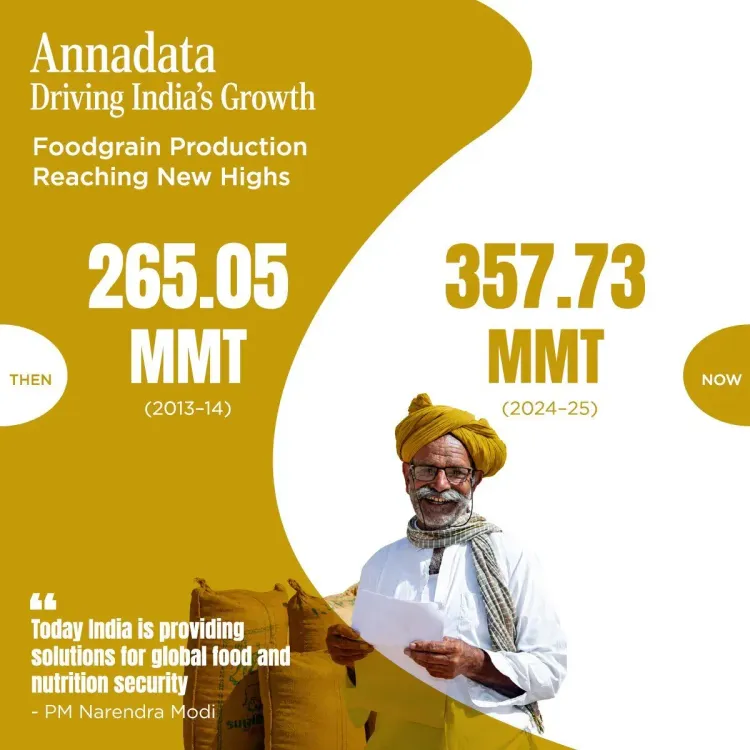
Union Minister Pralhad Joshi on June 11, 2026, cited official data showing India's foodgrain production reached a record 357.73 MMT in 2024-25, up from 265.05 MMT in 2013-14, marking 12 years of the Modi government's agricultural policy under the #12YearsOfKisanSamriddhi campaign.
Key Takeaways
Union Consumer Affairs Minister Pralhad Joshi posted on June 11, 2026 , highlighting India's foodgrain output milestone.
Foodgrain production rose from 265.05 MMT in 2013-14 to a record 357.73 MMT in 2024-25 — a gain of over 92 MMT .
The post is tagged #12YearsOfKisanSamriddhi , marking 12 years of the Modi government's agricultural policy.
PM-KISAN , launched in February 2019 , provides Rs 6,000 per year in direct income support to eligible farmer families.
The National Food Security Act underpins subsidised grain distribution to roughly two-thirds of India's population.
Final 2024-25 production estimates from the Directorate of Economics and Statistics are awaited to confirm the record figure.
Union Consumer Affairs Minister Pralhad Joshi on Thursday, June 11, 2026, highlighted India's agricultural growth under Prime Minister Narendra Modi, citing a rise in foodgrain production from 265.05 million metric tonnes (MMT) in 2013-14 to a record 357.73 MMT in 2024-25 — an increase of over 92 MMT in a decade.
Context
Joshi's post, shared under the hashtag #12YearsOfKisanSamriddhi (12 Years of Farmer Prosperity), marks what the ruling Bharatiya Janata Party (BJP) is framing as a milestone anniversary of agricultural policy under the Modi government, which came to power in May 2014. The minister credited both farmer effort and government policy for the output surge, stating the figures reflect 'the hard work of our farmers and the government's unwavering commitment to their prosperity.'
The production data cited by Joshi is drawn from official estimates compiled by the Directorate of Economics and Statistics under the Ministry of Agriculture. The 2024-25 figure of 357.73 MMT is presented as a record high for the country.
Policy Backdrop
India's foodgrain output has trended upward over multiple decades, driven by expanded irrigation coverage, adoption of high-yielding seed varieties, and sustained procurement operations by government agencies. The National Food Security Act, 2013, which expanded subsidised grain access to roughly two-thirds of the population, was already in place when the Modi government took office.
A key policy addition in the post-2014 period was the Pradhan Mantri Kisan Samman Nidhi (PM-KISAN), launched in February 2019, which provides direct income support of Rs 6,000 per year to eligible landholding farmer families. The government had also announced, in February 2016, a target to double farmers' income by 2022, spurring renewed focus on irrigation, crop insurance, and market-linkage reforms.
Ministers across successive governments have regularly cited official production statistics to underscore national food self-sufficiency, particularly in wheat and rice — the two dominant cereals in the public distribution system.
Stakeholders and Impact
The figures carry direct relevance for India's approximately 140 million farm households, whose livelihoods are tied to both output volumes and the prices at which produce is procured. Higher production underpins the National Food Security Act pipeline, which subsidises grain for hundreds of millions of beneficiaries under the Public Distribution System (PDS).
However, farmer organisations and policy analysts have noted that rising output does not automatically translate to higher incomes, pointing to persistent debates around Minimum Support Price (MSP) legislation, post-harvest losses, and climate-related risks to crop yields. The coexistence of record production figures and ongoing farmer agitation on MSP guarantees has been a recurring feature of the policy landscape.
What's Next
The Directorate of Economics and Statistics is expected to release final 2024-25 production estimates and early advance estimates for 2025-26 in the coming months, which will either confirm or revise the record figure cited by the minister. Agriculture allocations in the next Union Budget will be closely watched for signals on whether the government plans to build on the production gains with additional investment in storage, market infrastructure, or income-support schemes. The #12YearsOfKisanSamriddhi campaign also suggests the BJP intends to make agricultural performance a central plank of its political messaging in the near term.
Point of View
Using official production statistics to anchor the BJP's 12-year governance narrative on farmer welfare ahead of what appears to be a coordinated campaign under #12YearsOfKisanSamriddhi. The jump from 265.05 MMT to 357.73 MMT is a substantial headline figure, but the framing sidesteps the more contested questions of farmer income, MSP legislation, and the proportion of gains reaching smallholders. Placing a Consumer Affairs and Food Distribution minister — rather than the Agriculture Minister — at the front of this messaging underscores the government's intent to link production growth directly to food security outcomes and PDS delivery. The campaign's timing, well into the government's third term, suggests an effort to consolidate the rural narrative before the next budget cycle.
NationPress
26 Oct 2026
Frequently Asked Questions
What is India's total foodgrain production in 2024-25?
According to Union Minister Pralhad Joshi, India's foodgrain production reached a record 357.73 MMT in 2024-25 , as cited in official government data. Final confirmation is pending the Directorate of Economics and Statistics' published estimates.
What was India's foodgrain production in 2013-14?
India's foodgrain production stood at 265.05 MMT in 2013-14 , the year before the Modi government took office, according to the figures cited by Minister Joshi.
What is PM-KISAN and how much do farmers get?
PM-KISAN (Pradhan Mantri Kisan Samman Nidhi) is a direct income support scheme launched in February 2019 that provides Rs 6,000 per year in three equal instalments to eligible landholding farmer families across India.
What is #12YearsOfKisanSamriddhi?
#12YearsOfKisanSamriddhi is a BJP campaign hashtag marking 12 years of the Modi government's agricultural and farmer welfare policies since coming to power in May 2014 .
Who is Pralhad Joshi and what ministry does he head?
Pralhad Joshi is a senior BJP leader from Karnataka and currently serves as Union Minister of Consumer Affairs, Food and Public Distribution, and Minister of New and Renewable Energy in the Modi government.