Joshi Highlights 12-Year MSP Procurement Surge Under Modi
Synopsis
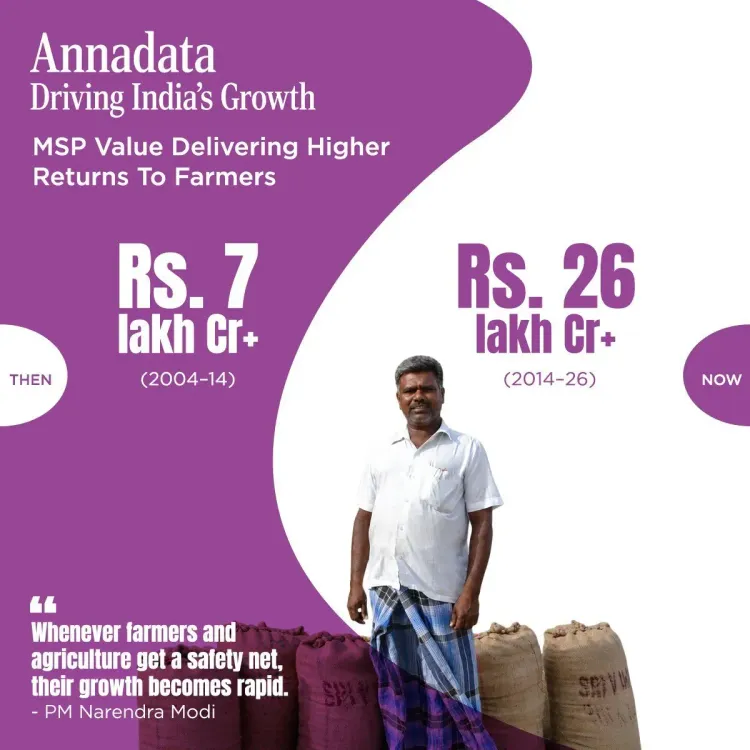
Union Consumer Affairs Minister Pralhad Joshi, marking 12 years of the Modi government, says MSP procurement value has surged from ₹7 lakh crore (2004–14) to over ₹26 lakh crore since 2014, crediting enhanced support and assured procurement for greater farmer prosperity.
Key Takeaways
Minister Pralhad Joshi posted on June 11, 2026 , under #12YearsOfKisanSamriddhi to mark 12 years of the Modi government.
The government claims MSP procurement value rose from ₹7 lakh crore (2004–14) to over ₹26 lakh crore post-2014.
The 2018 Union Cabinet decision fixed MSP at a minimum of 1.5 times the cost of production for 22 crops .
The Food Corporation of India is the central agency executing MSP procurement for the national food pool.
The Commission for Agricultural Costs and Prices (CACP) recommends MSP levels each season based on production costs.
Upcoming CCEA kharif and rabi MSP announcements will be the next key indicator of farm-support policy direction.
Union Consumer Affairs Minister Pralhad Joshi on Thursday, June 11, 2026, highlighted a sharp rise in Minimum Support Price (MSP) procurement value under the Narendra Modi-led government, stating that the total value of MSP procurement has grown from approximately ₹7 lakh crore during the 2004–14 period to over ₹26 lakh crore since 2014. The post, shared under the hashtag #12YearsOfKisanSamriddhi, marked what the ruling Bharatiya Janata Party is framing as a milestone in agrarian welfare.
Context
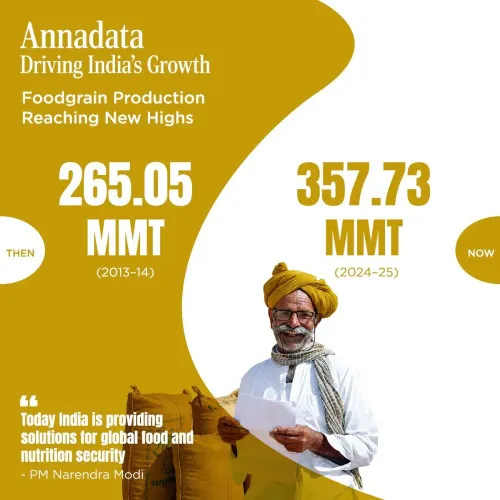
In his post, Joshi wrote that 'India's farmers have witnessed unprecedented support through enhanced MSP and assured procurement' under Prime Minister Modi, referring to farmers as 'Annadatas' — a term meaning 'providers of food' that has become standard in government communication about the agricultural community. The hashtag #12YearsOfKisanSamriddhi (12 Years of Farmer Prosperity) signals a coordinated messaging push by the ruling party to mark the completion of twelve years of the Modi government.
MSP is a floor-price mechanism through which the government announces remunerative prices for selected agricultural commodities each season, based on recommendations from the Commission for Agricultural Costs and Prices (CACP). Procurement at these prices is carried out primarily by the Food Corporation of India (FCI) and state agencies for the central pool.
Policy Backdrop
The MSP system has its roots in the mid-1960s but has undergone significant expansion in scope and budgetary scale over successive decades. A landmark decision in 2018 by the Union Cabinet fixed MSP for 22 mandated crops at a minimum of 1.5 times the all-India weighted average cost of production — a formula long demanded by farmer organisations.
The National Food Security Act, 2013, separately mandated the procurement and distribution of food grains at subsidised prices, creating a legal architecture that underpins large-scale government buying. Since 2014, the central government has also expanded the geographic reach of MSP-based procurement and integrated digital payment systems to transfer money directly into farmers' bank accounts, reducing intermediary delays.
The comparison between the 2004–14 decade — corresponding to the UPA government — and the post-2014 period is a recurring feature of ruling-party communication on agriculture. The specific procurement value figures cited by Joshi — ₹7 lakh crore and ₹26 lakh crore — reflect official government data as presented in ministerial statements; independent verification of these aggregates against audited procurement records is ongoing.
Stakeholders and Impact
India's farming population — estimated at hundreds of millions of households, predominantly wheat and paddy growers in states such as Punjab, Haryana, Uttar Pradesh, and Madhya Pradesh — is the primary constituency this messaging addresses. MSP procurement directly affects the income floor available to growers who sell to government agencies, though economists note that the share of farmers who actually access MSP procurement varies significantly by state and crop.
The FCI remains the central operational agency, managing storage, logistics, and offtake for the public distribution system. State procurement agencies supplement FCI operations, particularly for pulses and oilseeds under price-support schemes. The scale of procurement also has downstream implications for food inflation and buffer-stock management.
What's Next
Attention will now turn to the Cabinet Committee on Economic Affairs (CCEA) announcements of MSP for the forthcoming kharif and rabi seasons, which typically serve as the government's most concrete annual signal of its commitment to farm-income support. The Department of Food and Public Distribution is expected to release updated procurement progress reports that will provide the next data point in the trajectory Joshi has highlighted. With farm-sector politics remaining central to electoral calculations in several key states, the #12YearsOfKisanSamriddhi campaign is likely to intensify ahead of any upcoming state assembly polls.
Point of View
The government sidesteps more contested metrics — such as the share of farmers actually accessing MSP or real income growth — in favour of a headline figure that is large and easy to communicate. The framing also implicitly targets the opposition's record during the 2004–14 UPA period, a standard BJP rhetorical device. Whether the numbers translate into perceived prosperity on the ground will depend on how procurement reach, storage infrastructure, and price realisation have evolved for smallholder farmers beyond the wheat-and-rice belt.
NationPress
26 Oct 2026
Frequently Asked Questions
What is MSP and how does it help Indian farmers?
MSP, or Minimum Support Price, is a government-announced floor price for selected crops that guarantees farmers a minimum return regardless of market fluctuations. The government, through agencies like the Food Corporation of India, procures crops at this price, protecting growers from distress sales.
What is the #12YearsOfKisanSamriddhi campaign about?
#12YearsOfKisanSamriddhi (12 Years of Farmer Prosperity) is a BJP-led social-media campaign marking the completion of 12 years of the Narendra Modi government, highlighting agricultural welfare measures including MSP hikes and expanded procurement.
How much has MSP procurement increased under Modi government?
According to the government's own figures cited by Minister Pralhad Joshi, the total value of MSP procurement rose from around ₹7 lakh crore during 2004–14 to over ₹26 lakh crore since 2014, representing a nearly four-fold increase in value.
Who is Pralhad Joshi and what ministry does he head?
Pralhad Joshi is a senior BJP leader from Karnataka who serves as Union Minister of Consumer Affairs, Food and Public Distribution, and Minister of New and Renewable Energy in the Modi cabinet.
What is the role of the Food Corporation of India in MSP procurement?
The Food Corporation of India (FCI) is the central nodal agency that procures wheat and rice at MSP on behalf of the government, manages buffer stocks, and supplies grain to the public distribution system across India.