Giriraj Singh: India-UK FTA Opens Textiles Export Path
Synopsis
Union Textiles Minister Giriraj Singh announced on 25 July 2026 that Indian exporters have begun utilising tariff benefits under the India-UK FTA, opening stronger market access for textiles, apparel, leather, and gems and jewellery, with the deal seen as a driver of exports, investment, and employment.
Key Takeaways
Union Textiles Minister Giriraj Singh stated on 25 July 2026 that Indian exporters are actively using new tariff benefits under the India-UK FTA .
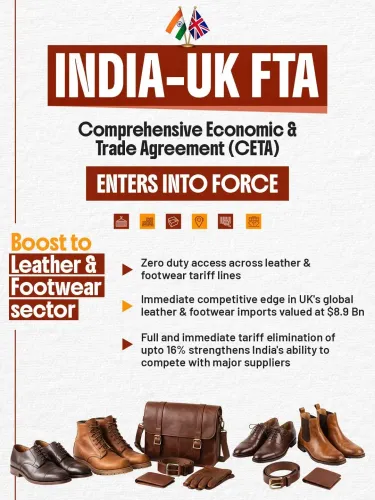
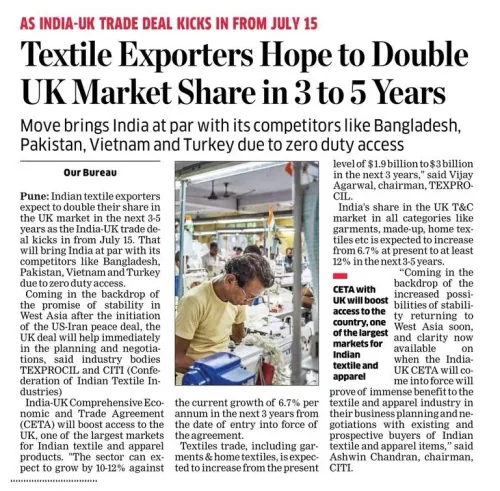
Sectors identified as key beneficiaries include textiles, apparel, leather, and gems and jewellery .
The minister framed the FTA as an opportunity to generate growth in exports, investment, and employment .
India-UK FTA negotiations were formally launched in January 2022 after the UK's Brexit transition period ended.
The India-UK deal is part of India's broader post-2021 FTA push that also included agreements with the UAE and Australia .
Official bilateral trade data in the coming months will be the key indicator of whether the FTA is translating into measurable export growth.
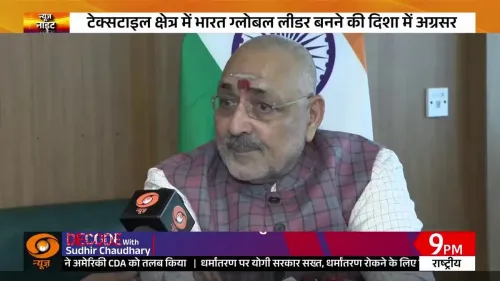
Union Textiles Minister Giriraj Singh on Saturday, 25 July 2026 said Indian exporters have begun leveraging new tariff benefits under the India-UK Free Trade Agreement (FTA), describing the deal as a catalyst for growth in textiles, apparel, leather, and gems and jewellery sectors.
Context
Posting on X, Minister Singh wrote — 'भारत-ब्रिटेन मुक्त व्यापार समझौते (FTA) के लागू होने के बाद भारतीय निर्यातकों ने नए शुल्क लाभों का उपयोग करना शुरू कर दिया है' — ('After the India-UK Free Trade Agreement came into force, Indian exporters have begun utilising the new tariff benefits'). He added that sectors including textiles, apparel, leather, and gems and jewellery now have a 'stronger pathway' to new opportunities in the United Kingdom market.
Singh further noted that Indian industry, advancing on the pillars of quality, innovation, and global standards, is moving to convert the agreement into fresh opportunities for exports, investment, and employment.
Policy Backdrop
India and the United Kingdom formally launched FTA negotiations in January 2022, following the conclusion of the Brexit transition period, with the goal of deepening bilateral trade ties through tariff reductions and improved market access across goods and services.
The India-UK FTA fits within a broader pattern of India's accelerated trade diplomacy since 2021. New Delhi concluded agreements with the UAE and Australia in 2022 as part of a strategy to diversify export destinations and integrate Indian industry deeper into global value chains. Labour-intensive sectors such as textiles and gems and jewellery have consistently been prioritised in these negotiations given their large employment footprint.
Stakeholders and Impact
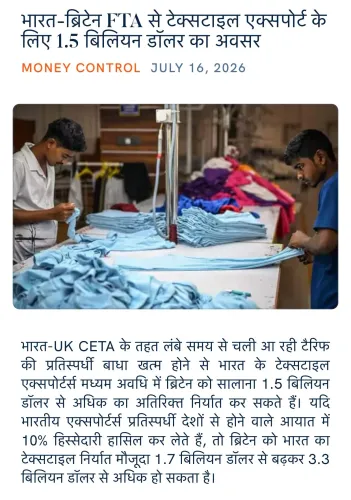
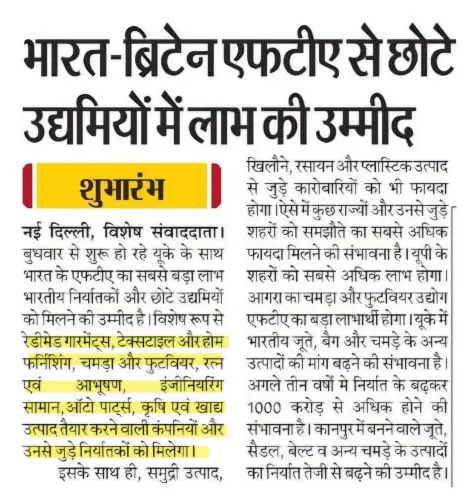
The sectors cited by Minister Singh — textiles, apparel, leather, and gems and jewellery — collectively employ tens of millions of workers across India, with significant clusters in states such as Gujarat, Tamil Nadu, Maharashtra, West Bengal, and Uttar Pradesh. Preferential tariff access to the UK, one of the world's major developed consumer economies, is expected to improve price competitiveness for Indian goods against rivals from other exporting nations.
For the gems and jewellery segment, the UK represents a high-value discretionary market. For apparel and leather manufacturers, reduced duties could translate into expanded order books and, by extension, more jobs on the factory floor.
What's Next
The key metric to watch will be official bilateral trade statistics showing whether UK-bound shipments in textiles and allied sectors register measurable growth in the months following the FTA's entry into force. Any joint review mechanisms built into the agreement will also shape how quickly outstanding market-access issues are resolved.
As Indian industry moves to align with global quality standards and ramp up capacity, the government's ability to provide complementary support — through infrastructure, skilling, and technology upgradation schemes — will determine how fully the FTA's potential is realised for exporters and workers alike.
Point of View
Particularly in labour-intensive export sectors that carry significant electoral weight. Highlighting textiles, apparel, leather, and gems and jewellery is a deliberate choice — these industries are concentrated in politically consequential states and represent a direct jobs story. The statement fits a broader pattern in which the BJP-led government has used trade agreements as proof points of its 'Make in India' and export-diversification agenda. The real test, however, will come when hard export numbers are published, at which point the FTA's actual tariff utilisation rate — not ministerial optimism — will define the policy narrative.
NationPress
25 Jul 2026
Frequently Asked Questions
What is the India-UK Free Trade Agreement?
The India-UK Free Trade Agreement is a bilateral trade deal between India and the United Kingdom aimed at reducing tariffs and improving market access for goods and services. Negotiations were formally launched in January 2022 following the conclusion of the UK's Brexit transition period.
Which Indian sectors benefit from the India-UK FTA?
Union Textiles Minister Giriraj Singh has specifically cited textiles, apparel, leather, and gems and jewellery as sectors that now have stronger access to the UK market under the FTA's tariff benefits.
What did Giriraj Singh say about the India-UK FTA?
Singh said that after the India-UK FTA came into force, Indian exporters have begun utilising new tariff benefits, and that Indian industry — advancing on quality, innovation, and global standards — is moving to convert the agreement into new opportunities for exports, investment, and employment.
How does the India-UK FTA fit into India's broader trade strategy?
The India-UK FTA is part of India's accelerated trade diplomacy since 2021, which also produced agreements with the UAE and Australia in 2022, aimed at diversifying export destinations and integrating Indian industry into global value chains.
What should be watched after the India-UK FTA comes into force?
Key indicators include official bilateral trade statistics showing growth in UK-bound shipments from textiles and allied sectors, as well as the functioning of any joint review mechanisms built into the agreement to address ongoing market-access issues.