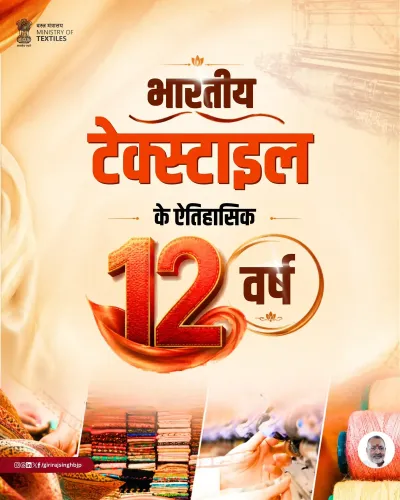
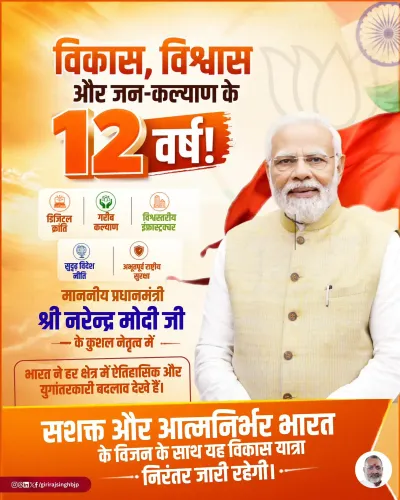
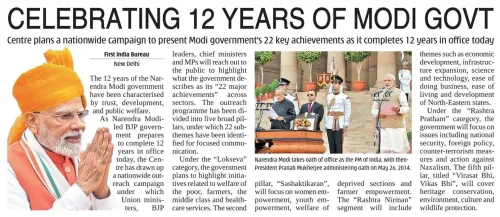
Giriraj Singh Hails Khadi's 12-Year Growth Under PM Modi
Synopsis
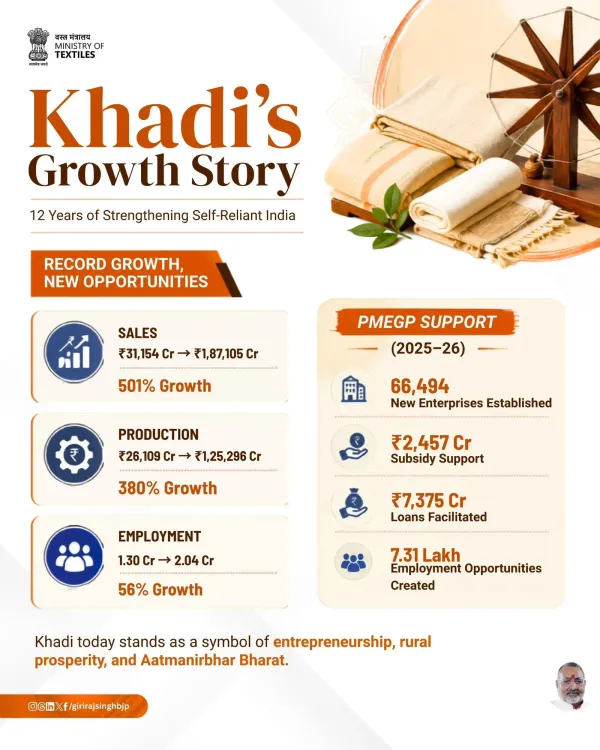
Union Textiles Minister Giriraj Singh said khadi has scaled new heights under PM Narendra Modi, citing 12 years of record gains in sales, production and employment. He credited PMEGP with thousands of new enterprises and lakhs of jobs, calling khadi a symbol of Aatmanirbhar Bharat, entrepreneurship and rural prosperity.
Key Takeaways
Union Textiles Minister Giriraj Singh hailed 12 years of growth in khadi under PM Narendra Modi.
He cited record increases in sales, production and employment in the sector.
PMEGP, he said, has enabled thousands of new enterprises and lakhs of jobs.
The minister called khadi a symbol of Aatmanirbhar Bharat and rural prosperity.
Post carried hashtags #Khadi, #PMEGP, #AatmanirbharBharat, #VocalForLocal, #NewIndia.
Attention now turns to upcoming KVIC and PMEGP performance disclosures.
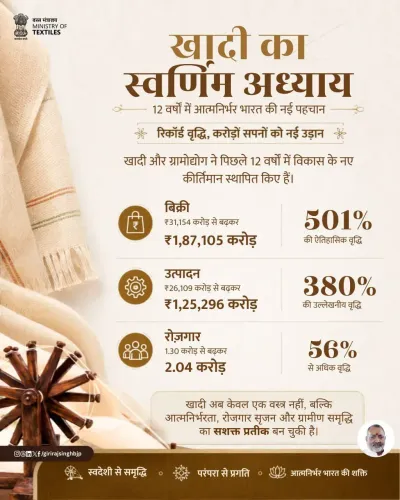
Union Textiles Minister Giriraj Singh on Wednesday credited Prime Minister Narendra Modi's leadership for what he described as a record expansion of the khadi sector over the past 12 years, citing gains in sales, production and employment. In a post on X, the minister linked the trajectory to the Prime Minister's Employment Generation Programme (PMEGP) and positioned khadi as a flagship symbol of the Aatmanirbhar Bharat push.
'Under the leadership of respected Prime Minister Shri Narendra Modi ji, khadi has touched new heights of growth,' the minister wrote in Hindi, adding that bikri, utpadan aur rozgar (sales, production and employment) had registered record increases over the period. He said thousands of new enterprises had been set up and lakhs of employment opportunities created through PMEGP.
Context
The minister's message frames khadi not merely as a heritage textile but as a contemporary instrument of rural enterprise. He described the sector as a 'powerful symbol of self-reliant India, entrepreneurship and rural prosperity', closing the post with hashtags including #Khadi, #PMEGP, #AatmanirbharBharat, #VocalForLocal and #NewIndia.
The intervention from Giriraj Singh, the Lok Sabha member from Begusarai in Bihar and a senior BJP leader, comes as the textiles ministry continues to spotlight handloom and village-industry performance as part of its broader self-reliance narrative.
Policy backdrop
PMEGP is a central sector credit-linked subsidy scheme launched in 2008 through the merger of the Prime Minister's Rozgar Yojana and the Rural Employment Generation Programme. It is implemented by the Khadi and Village Industries Commission and targets micro-enterprises in non-farm sectors, with margin-money support to first-generation entrepreneurs.
The Aatmanirbhar Bharat initiative, announced in May 2020, set out to deepen domestic manufacturing and shorten supply chains across sectors. Since 2014, successive Union Budgets have stepped up support for khadi marketing and production infrastructure, repositioning the fabric — long associated with the freedom movement — as an entrepreneurial vehicle for village industries.
Stakeholders and impact
The constituency the minister is addressing spans rural artisans, khadi spinners and weavers, and MSME entrepreneurs who draw credit and subsidy support through PMEGP. For these stakeholders, sustained budgetary backing and procurement demand have a direct bearing on household incomes in spinning clusters and weaving belts.
The minister's framing also folds into the government's Vocal for Local messaging, which encourages consumption of domestically produced goods. Khadi outlets in metros and tier-two cities have been a visible part of that campaign, with seasonal discount drives traditionally pegged to 2 October, Gandhi Jayanti.
What's next
Attention will turn to the next set of performance disclosures from the Khadi and Village Industries Commission and PMEGP, which typically map enterprise sanctions, margin-money disbursal and estimated employment generation. Any fresh budgetary allocation for khadi marketing or weaver welfare in the coming fiscal cycle will test how far the government extends the sector's runway.
For Giriraj Singh, the post sets a continuing political marker: positioning the textiles portfolio as a measurable contributor to the wider self-reliance agenda, and pushing khadi as both cultural emblem and rural-jobs engine ahead of upcoming policy announcements.
Point of View
Using khadi — a fabric with deep symbolic value — to bridge cultural nostalgia and contemporary jobs messaging. By anchoring the claim to a 12-year window, the minister explicitly frames the sector's trajectory as a Modi-era story, with PMEGP as the delivery vehicle. The framing aligns with a longer pattern of treating village industries as politically resonant economic indicators. Watch for whether quantified KVIC and PMEGP disclosures follow to substantiate the headline claim.
NationPress
19 Sept 2026
Frequently Asked Questions
What did Giriraj Singh say about khadi?
Union Textiles Minister Giriraj Singh said khadi has touched new heights under PM Narendra Modi's leadership, with record growth in sales, production and employment over the past 12 years.
What is the PMEGP scheme?
PMEGP is the Prime Minister's Employment Generation Programme, a central sector credit-linked subsidy scheme launched in 2008 to promote micro-enterprises in non-farm sectors and generate self-employment.
How is khadi linked to Aatmanirbhar Bharat?
The government has positioned khadi as a flagship example of Aatmanirbhar Bharat, treating its expansion as evidence of self-reliant production, rural entrepreneurship and decentralised job creation.
Who implements PMEGP in India?
PMEGP is implemented at the national level by the Khadi and Village Industries Commission, in coordination with state KVIC offices, state Khadi boards and district industries centres.
Why is khadi politically important for the BJP?
Khadi carries strong cultural symbolism from the freedom movement and doubles as a rural-jobs platform, allowing the BJP-led government to combine heritage messaging with entrepreneurship and Vocal for Local advocacy.