Giriraj Singh: KVIC Hits ₹1.87 Lakh Cr Sales in FY26
Synopsis
Union Textiles Minister Giriraj Singh announced that KVIC achieved record sales of ₹1,87,105 crore in FY26 and PMEGP created over 7.31 lakh new jobs, attributing the milestones to PM Modi's Vocal for Local and Atmanirbhar Bharat policies.
Key Takeaways
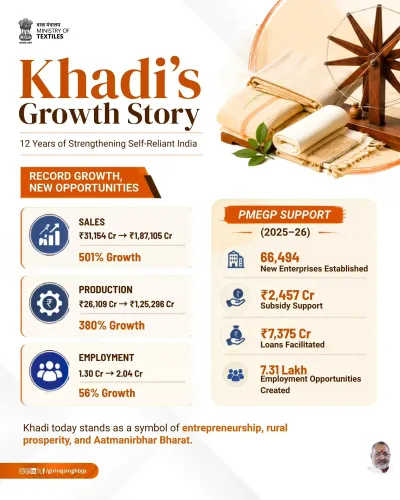
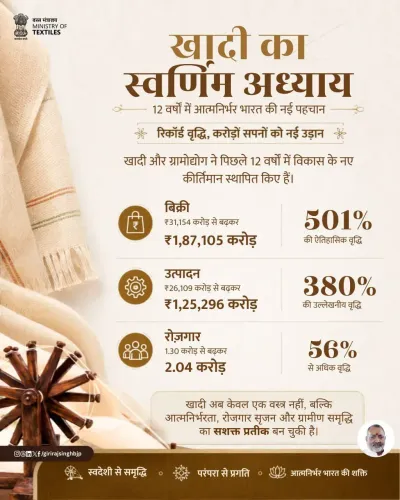
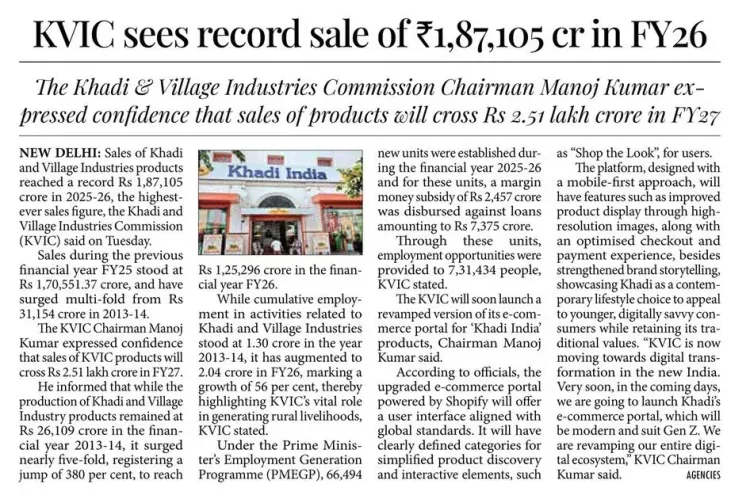
KVIC recorded a historic ₹1,87,105 crore in sales during financial year 2025-26 , as cited by Union Textiles Minister Giriraj Singh .
Under PMEGP in FY26, ₹2,457 crore in margin money subsidies were disbursed against loans of ₹7,375 crore .
The PMEGP figures cited correspond to the opening of 66,494 new micro-enterprises in a single financial year.
More than 7.31 lakh people reportedly gained employment through PMEGP-backed enterprises in FY26.
The minister attributed the performance to PM Narendra Modi 's 'Vocal for Local' campaign and the Atmanirbhar Bharat framework launched in 2020.
KVIC has been a statutory pillar of rural industrial policy since 1957 , with renewed focus and higher allocations post-2014.
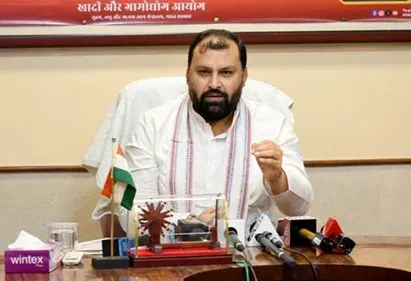
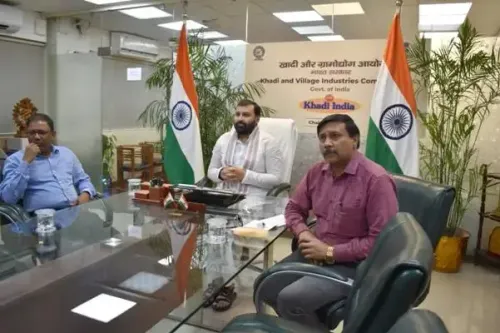
Union Textiles Minister Giriraj Singh on Wednesday, 27 May 2026, highlighted record-breaking performance by the Khadi and Village Industries Commission (KVIC), citing a historic sales figure of ₹1,87,105 crore in financial year 2025-26 and crediting the government's 'Vocal for Local' and 'Atmanirbhar Bharat' push for the milestone.
Context
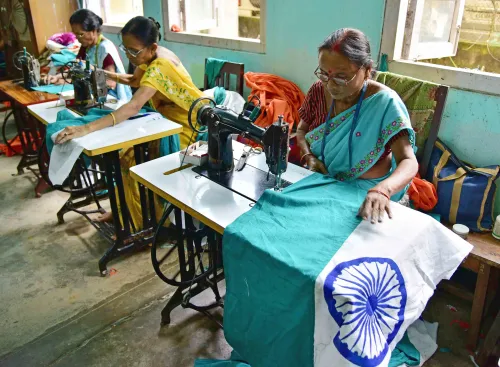
In his post, the minister stated — 'Vocal for Local ke badhte prabhav se khadi aaj gramin samridhi ka naya pratik ban chuki hai' ('With the growing influence of Vocal for Local, khadi has today become a new symbol of rural prosperity'). He pointed to the KVIC's ₹1,87,105 crore sales figure as an 'historic milestone' for the statutory body, which has been the nodal agency for promoting khadi and village industries since 1957.
The minister also highlighted performance under the Prime Minister's Employment Generation Programme (PMEGP), noting that in FY26, margin money subsidies of ₹2,457 crore were disbursed against loans worth ₹7,375 crore, facilitating the opening of 66,494 new enterprises and generating employment for more than 7.31 lakh people.
Policy Backdrop
KVIC, a statutory body under the Ministry of MSME, has been a central instrument of rural industrial policy since its establishment under the Khadi and Village Industries Commission Act. After 2014, the body received renewed budgetary and policy attention, with marketing campaigns and higher allocations aimed at scaling khadi's commercial footprint.
PMEGP was launched in August 2008 by merging two earlier schemes — the Rural Employment Generation Programme (REGP) and the Prime Minister's Rozgar Yojana (PMRY) — to provide credit-linked margin money subsidies for micro-enterprise creation in both rural and urban areas. The 'Vocal for Local' call, championed by Prime Minister Narendra Modi from 2020 onward as part of the broader Atmanirbhar Bharat economic framework, gave renewed cultural and policy impetus to domestic products including khadi.
The Atmanirbhar Bharat package, announced in May 2020 amid pandemic disruptions, sought to strengthen domestic supply chains and reduce import dependence — with village industries and micro-enterprises positioned as key beneficiaries.
Stakeholders and Impact
The primary beneficiaries of the figures cited are rural artisans, micro-entrepreneurs, and unemployed youth — the target demographics of both KVIC's production ecosystem and PMEGP's credit-subsidy architecture. If the employment figure of 7.31 lakh new jobs in a single financial year is borne out, it would represent a significant contribution to non-farm rural livelihoods.
For the khadi sector specifically, a sales figure of ₹1,87,105 crore would mark a dramatic scaling from the levels seen in the early years of the current policy push, underscoring the cumulative effect of sustained government marketing, institutional procurement mandates, and rising consumer preference for handloom and artisan products.
What's Next
Attention will now turn to the next Union Budget allocation for both KVIC and PMEGP, as well as any parliamentary committee scrutiny of the scheme performance data underlying these figures. Sustained growth in KVIC sales and PMEGP disbursements would likely inform the government's broader narrative on rural employment ahead of state assembly cycles. The minister's framing of these numbers within the 'Atmanirbhar Bharat' and 'Vocal for Local' vocabulary signals that the government intends to keep village industries central to its economic messaging through 2026 and beyond.
Point of View
The Textiles Ministry is building an evidence-based case for the rural economy plank of the BJP's governance story. KVIC and PMEGP have historically been low-visibility schemes; their elevation to headline statistics signals a strategic rebranding of village industries as modern economic engines rather than legacy welfare instruments. Whether independent audits corroborate the scale of these figures will determine how durable this narrative proves to be.
NationPress
23 Sept 2026
Frequently Asked Questions
What is KVIC and why is its sales record significant?
KVIC, the Khadi and Village Industries Commission, is a statutory body established in 1957 to promote khadi and village industries across India. A sales figure of ₹1,87,105 crore in FY26, as cited by Union Textiles Minister Giriraj Singh, would represent a landmark commercial milestone for a body historically associated with artisan welfare rather than large-scale trade.
What is PMEGP and how does the margin money subsidy work?
PMEGP, the Prime Minister's Employment Generation Programme, was launched in 2008 to help individuals set up micro-enterprises by providing a credit-linked margin money subsidy — meaning the government subsidises a portion of the bank loan taken to start a business. In FY26, the government reportedly disbursed ₹2,457 crore in such subsidies against ₹7,375 crore in loans.
How many jobs did PMEGP create in FY26?
According to Union Textiles Minister Giriraj Singh's post on 27 May 2026, PMEGP facilitated the creation of 66,494 new enterprises and generated employment for more than 7.31 lakh people during financial year 2025-26.
What is 'Vocal for Local' and how is it linked to khadi's growth?
'Vocal for Local' is a campaign championed by Prime Minister Narendra Modi from 2020 as part of the Atmanirbhar Bharat initiative, urging Indians to prefer domestically made products. The campaign gave renewed cultural momentum to khadi and village-industry products, which the government credits as a driver of KVIC's rising sales figures.
What should one watch for next regarding KVIC and PMEGP?
The next Union Budget's allocation for KVIC and PMEGP will be a key indicator of the government's commitment to scaling these programmes. Parliamentary committee reviews of the FY26 scheme performance data will also be important for independently assessing the employment and sales figures cited by the minister.