Giriraj Singh Greets Taxpayers on National Income Tax Day
Synopsis
Union Textiles Minister Giriraj Singh marked National Income Tax Day on 24 July 2026 by saluting honest taxpayers, linking their compliance to India's infrastructure growth and the vision of a self-reliant, developed nation.
Key Takeaways
National Income Tax Day is observed on 24 July each year, marking the enactment of India's first income-tax legislation in 1860 .
Union Textiles Minister Giriraj Singh greeted taxpayers on 24 July 2026 , calling their contribution the 'primary foundation' of a strong and self-reliant India.
Singh's message explicitly invokes the Atmanirbhar Bharat and Viksit Bharat by 2047 frameworks, linking tax compliance to long-term national development goals.
The Faceless Assessment Scheme (2019) and the new tax regime (2020) are key recent reforms aimed at widening the direct-tax base and simplifying compliance.
The government's messaging around honest taxpayers reflects a broader political and fiscal strategy to expand formal-sector participation and fund capital expenditure.
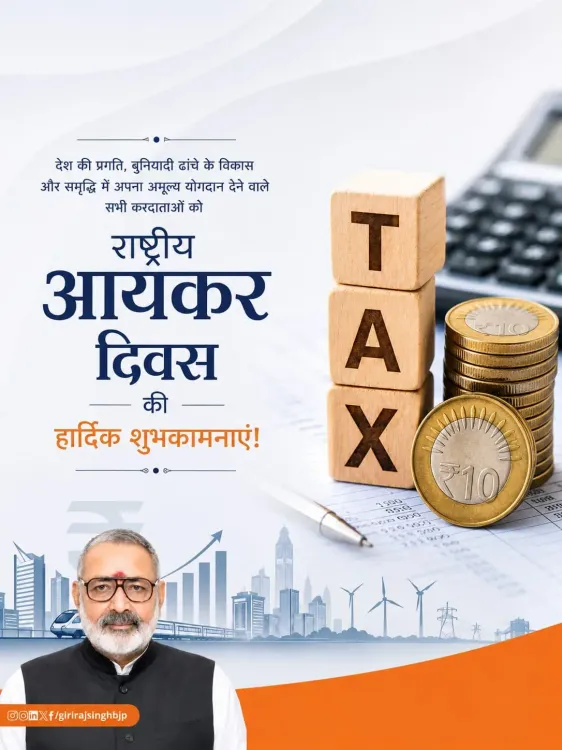
Union Textiles Minister Giriraj Singh on Friday, 24 July 2026 extended greetings to honest taxpayers across India on the occasion of National Income Tax Day, calling their contribution the 'primary foundation of a strong, self-reliant and developed India.'
Posting in Hindi on X, Singh wrote: 'देश की प्रगति, बुनियादी ढांचे के सुदृढ़ीकरण और आर्थिक समृद्धि में अपना बहुमूल्य योगदान देने वाले सभी ईमानदार करदाताओं को राष्ट्रीय आयकर दिवस की हार्दिक शुभकामनाएं!' — translated: 'Heartfelt greetings on National Income Tax Day to all honest taxpayers who contribute invaluably to the nation's progress, strengthening of infrastructure, and economic prosperity!'
Context
National Income Tax Day is observed every year on 24 July to mark the anniversary of the introduction of income tax in India. The levy was first enacted on 24 July 1860 through legislation introduced by James Wilson, then Finance Member of the Council of India, to help the British administration recover from the financial strain of the 1857 uprising. The day has since been adopted as an occasion for the government and public figures to acknowledge the role of taxpayers in nation-building.
Policy Backdrop
Over the past several years, successive administrations have moved to widen the direct-tax base and simplify compliance. Key milestones include the launch of the Faceless Assessment Scheme in 2019, which eliminated physical interface between tax officers and assessees, and the introduction of a new optional tax regime in 2020 offering lower slab rates in exchange for fewer exemptions.
These reforms sit within the broader Atmanirbhar Bharat framework — the self-reliance initiative launched in 2020 — which links enhanced domestic revenue mobilisation to capital expenditure on infrastructure, manufacturing incentives, and social welfare. Singh's message explicitly invokes this connection, framing taxpayer compliance as the 'main foundation' of a 'Viksit Bharat' (developed India).
Stakeholders and Impact
The message is directed at India's honest taxpayers — a constituency the government has repeatedly sought to acknowledge and reassure, particularly amid ongoing efforts to bring more citizens into the formal tax net. Direct-tax collections have grown steadily as digitisation of filings and third-party data matching have improved compliance detection.
For the ruling BJP, messaging around taxpayer recognition serves a dual political purpose: it affirms the party's governance credentials and reinforces the narrative linking fiscal discipline to the Viksit Bharat by 2047 goal — a central plank of the government's long-term vision.
What's Next
The annual observance of National Income Tax Day typically precedes parliamentary and policy discussions around tax administration. The next Union Budget may carry further revisions to tax slabs or compliance mechanisms, and any progress on a revised Income Tax Bill could draw renewed attention to the framework governing direct taxation in India.
Point of View
But it carries deliberate policy signalling: by tying taxpayer compliance to the Viksit Bharat and Atmanirbhar Bharat frameworks, the BJP reinforces a narrative that positions fiscal citizenship as a patriotic act. This kind of messaging has become a standard instrument for the ruling dispensation to build political goodwill among the salaried middle class and formal-sector earners — a constituency sensitive to tax burden and governance quality. Against the backdrop of potential Union Budget revisions and a pending Income Tax Bill, such public acknowledgements also serve to pre-empt criticism about compliance pressure by foregrounding appreciation rather than enforcement. The broader arc points to a government keen to sustain direct-tax momentum while managing the optics of an expanding tax net.
NationPress
22 Oct 2026
Frequently Asked Questions
Why is National Income Tax Day celebrated on 24 July?
National Income Tax Day is observed on 24 July to commemorate the introduction of income tax in India on that date in 1860, when James Wilson enacted the first Indian Income Tax Act to help stabilise British India's finances after the 1857 uprising.
What did Giriraj Singh say on Income Tax Day 2026?
Giriraj Singh extended greetings to all honest taxpayers on 24 July 2026, saying their contribution to national progress, infrastructure strengthening, and economic prosperity is the 'primary foundation of a strong, self-reliant and developed India.'
What is the connection between Income Tax Day and Atmanirbhar Bharat?
The government links taxpayer compliance to the Atmanirbhar Bharat initiative by arguing that robust direct-tax revenues fund the capital expenditure on infrastructure and manufacturing incentives that underpin India's self-reliance goals.
What tax reforms has India introduced in recent years?
Key recent reforms include the Faceless Assessment Scheme launched in 2019, which removed physical interaction between taxpayers and officers, and a new optional tax regime introduced in 2020 offering lower slab rates with fewer exemptions.
What is Viksit Bharat and how does it relate to taxation?
Viksit Bharat is the government's vision of a fully developed India by 2047. Tax compliance is central to this goal because direct-tax revenues fund the large-scale infrastructure investment and social programmes the government considers essential to achieving that target.