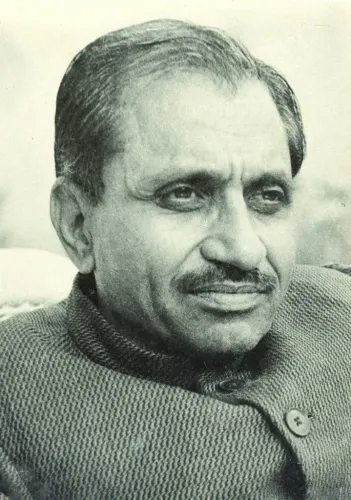
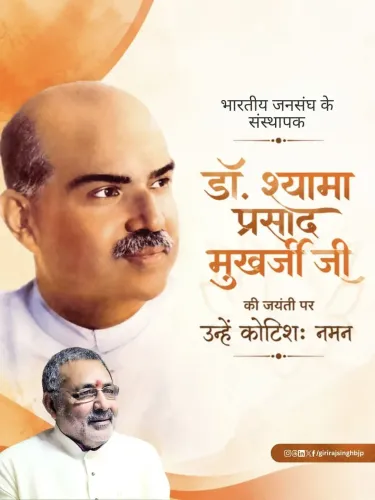
Giriraj Singh marks Jan Sangh Foundation Day, honours its founders
Synopsis
Union Textiles Minister Giriraj Singh marked the Bharatiya Jan Sangh's Foundation Day on 21 October 2026, paying tribute to founders Mookerjee, Upadhyay, and Vajpayee and reaffirming the BJP's ideological continuity with the 1951 nationalist party.
Key Takeaways
The Bharatiya Jan Sangh was founded on 21 October 1951 by Dr.
Shyama Prasad Mookerjee .
Union Textiles Minister Giriraj Singh greeted the occasion on X, invoking nationalism, cultural renaissance, and public service as the party's founding pillars.
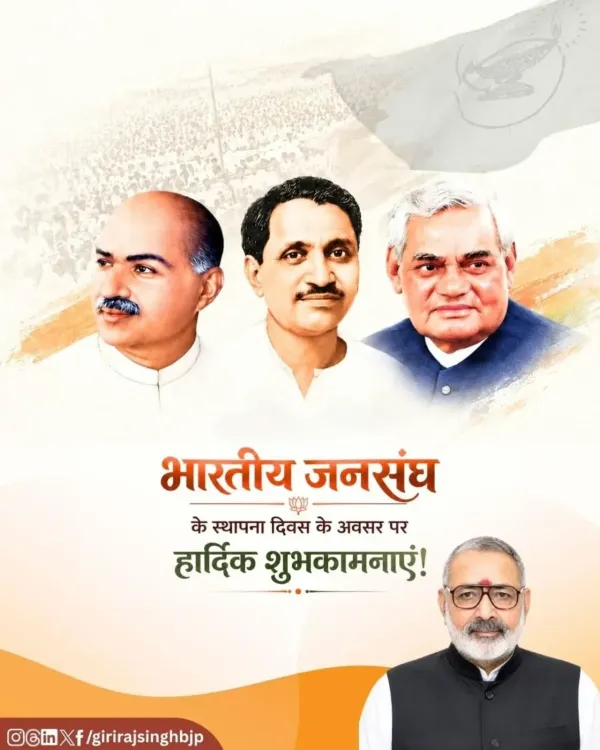
Singh paid tribute to Pandit Deendayal Upadhyay , the architect of Integral Humanism, and Atal Bihari Vajpayee , who rose from Jan Sangh ranks to become Prime Minister.
The Bharatiya Janata Party was formally constituted in April 1980 as the Jan Sangh's declared successor after the Emergency period.
Annual Foundation Day commemorations are a routine part of the BJP's ideological calendar, reaffirming the party's claimed continuity with its 1951 origins.
Seventy-five years after a small but determined group of nationalists gathered to birth a new political movement, Union Textiles Minister Giriraj Singh paused on Wednesday, 21 October 2026 to mark the founding anniversary of the Bharatiya Jan Sangh — and to invoke the three towering figures who shaped its soul.
Posting in Hindi on X, the senior BJP leader extended warm greetings on the occasion, writing: 'Rashtravaad, saanskritik punarutthan aur jan-seva ke siddhanton par aadhaarit Bharatiya Jan Sangh ke sthapna divas par aap sabhi ko haardik shubhkaamnaen!' — 'Heartfelt greetings to all on the Foundation Day of the Bharatiya Jan Sangh, founded on the principles of nationalism, cultural renaissance, and public service!' He offered his naman (salute) to Dr. Shyama Prasad Mookerjee, Pandit Deendayal Upadhyay, and Atal Bihari Vajpayee — three men who, in his words, 'placed national interest above all else and sowed the seeds of this ideological journey.'
The party that became the BJP
The Bharatiya Jan Sangh was founded on 21 October 1951 by Dr. Shyama Prasad Mookerjee, a towering opposition figure who had fiercely contested the partition of Bengal and carved out space for nationalist politics in the early years of independent India. It was a party built on conviction before it was ever built on numbers. Pandit Deendayal Upadhyay gave the Jan Sangh its philosophical spine: the doctrine of Integral Humanism, which argued for a uniquely Indian model of political economy rooted in cultural identity rather than imported ideologies. That doctrine remains officially central to the BJP's stated philosophy today. Atal Bihari Vajpayee, who began his political life inside the Jan Sangh, eventually became the bridge between the party's ideological origins and the reality of governance — serving as Prime Minister of India and demonstrating that the tradition Mookerjee had started could reach the highest office in the land.From Jan Sangh to Janata to BJP
The Jan Sangh's trajectory was not a straight line. The Emergency of 1975-77 forced a political merger, and in April 1980 its members reconstituted themselves as the Bharatiya Janata Party — explicitly positioning the new formation as the Jan Sangh's ideological heir. That lineage is not merely historical footnote; it is the living argument BJP leaders make every time they invoke Mookerjee or Upadhyay. Annual Foundation Day messages like Singh's are a deliberate ritual in the BJP calendar — a way of anchoring a mass governing party to its origins as a principled opposition movement. For a party now in power at the Centre, the act of looking back at 1951 is also a statement about what it claims to stand for going forward.Point of View
Upadhyay, and Vajpayee in a single breath, Singh threads together the party's anti-partition origins, its philosophical framework, and its first experience of national governance. For a ruling party often attacked as having drifted from its stated principles, the ritualistic return to 1951 is a reminder to its own base of what it claims to be. The consistency of these annual tributes also signals that the BJP treats ideological memory as active political capital, not archival sentiment.
NationPress
21 Oct 2026
Frequently Asked Questions
When was the Bharatiya Jan Sangh founded?
The Bharatiya Jan Sangh was founded on 21 October 1951 by Dr. Shyama Prasad Mookerjee as a nationalist political party in post-independence India.
What is the connection between the Jan Sangh and the BJP?
The Bharatiya Janata Party was formed in April 1980 by former Jan Sangh members after the Emergency period, explicitly positioning itself as the Jan Sangh's ideological successor.
Who was Pandit Deendayal Upadhyay?
Pandit Deendayal Upadhyay was the Jan Sangh's principal ideologue, best known for developing the doctrine of Integral Humanism , which remains a stated philosophical foundation of the BJP.
Why do BJP leaders mark Jan Sangh Foundation Day every year?
It is part of the BJP's annual ideological calendar, used to reaffirm the party's continuity with its 1951 nationalist origins and honour its founding figures.
What did Giriraj Singh post on Jan Sangh Foundation Day 2026?
Union Textiles Minister Giriraj Singh posted greetings on X, describing the Jan Sangh as founded on nationalism, cultural renaissance, and public service, and paid tribute to Mookerjee, Upadhyay, and Vajpayee.