Giriraj Singh Highlights May GST Collection at ₹1.94 Lakh Crore
Synopsis
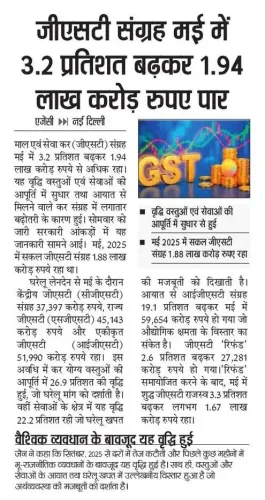
Union Textiles Minister Giriraj Singh on 2 June 2026 shared government data showing India's GST revenue for May 2026 reached ₹1.94 lakh crore, a 3.2% year-on-year rise, highlighting steady fiscal momentum under the unified indirect tax framework introduced in 2017.
Key Takeaways
India's GST collection for May 2026 stood at ₹1.94 lakh crore , according to data shared by Union Textiles Minister Giriraj Singh.
The figure represents a 3.2% increase year-on-year , indicating continued growth in tax compliance and consumption.
The data was shared via the NaMo App on 2 June 2026 , reflecting the ruling party's coordinated fiscal communication strategy.
GST , implemented on 1 July 2017 , unified India's indirect tax structure and is governed by the GST Council .
Strong collections benefit both central and state governments through the revenue-sharing formula, supporting public expenditure.
The June 2026 GST data and any upcoming GST Council meeting will be the next key markers for India's indirect tax trajectory.
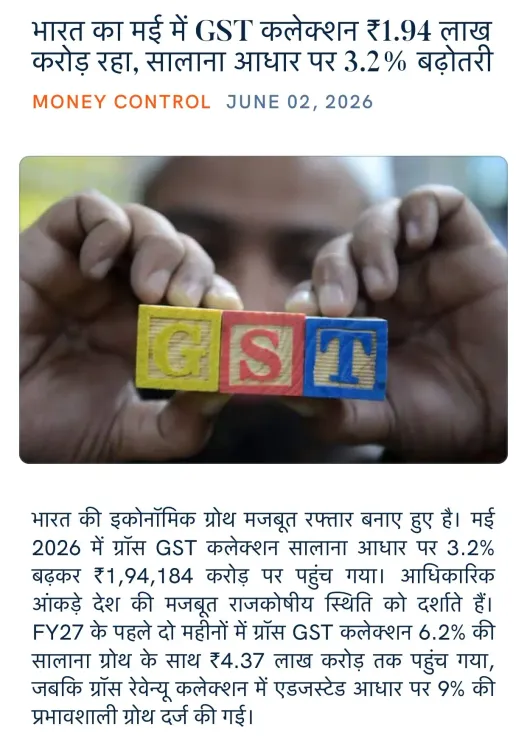
Union Textiles Minister Giriraj Singh on Tuesday, 2 June 2026, shared data showing India's GST revenue for May 2026 stood at ₹1.94 lakh crore, marking a 3.2% year-on-year increase, amplifying the Ministry of Finance's monthly fiscal update via the NaMo App.
Context
The post, shared in Hindi, reads: 'Bharat ka Maai mein GST collection ₹1.94 lakh crore raha, saalana aadhar par 3.2% badhotari' — 'India's GST collection in May stood at ₹1.94 lakh crore, a 3.2% increase on a year-on-year basis.' Giriraj Singh, who represents Begusarai constituency in Bihar as a Lok Sabha MP and serves as a senior leader of the Bharatiya Janata Party (BJP), shared the figure alongside a linked report and an image, underlining the ruling party's broader effort to communicate fiscal milestones across ministerial portfolios.
Monthly GST data is officially released by the Ministry of Finance and serves as one of the most closely watched real-time indicators of domestic economic activity, tax compliance, and the formalisation of India's economy since the unified tax regime came into force on 1 July 2017.
Policy Backdrop
India's Goods and Services Tax (GST), implemented on 1 July 2017, replaced a fragmented web of central and state levies — including excise duty, service tax, and value-added tax — with a single destination-based indirect tax framework. The GST Council, comprising the Union Finance Minister and state counterparts, governs rate structures and compliance reforms. Since its rollout, the monthly collection figures have become a key barometer of economic momentum and the effectiveness of anti-evasion measures.
A 3.2% year-on-year growth to ₹1.94 lakh crore in May 2026 continues the trend of collections broadly holding above the ₹1.7–1.9 lakh crore band that has characterised recent fiscal years, reflecting steady consumption demand and improved compliance infrastructure including e-invoicing and the GST Network (GSTN).
Stakeholders and Impact
The central government and state governments are the primary beneficiaries of GST revenues, which are shared through an established devolution formula. Strong monthly collections ease fiscal pressure on both tiers of government, providing headroom for capital expenditure and social spending. For the textiles sector — the portfolio Giriraj Singh directly oversees — robust GST receipts signal sustained consumer demand for apparel and fabric, which feeds into industry confidence and employment in labour-intensive textile clusters across states such as Gujarat, Tamil Nadu, Maharashtra, and Uttar Pradesh.
For businesses, consistent revenue growth at the GST level typically precedes a stable compliance and rate environment, reducing the likelihood of disruptive rate changes in the near term. Small and medium enterprises, which form the backbone of India's textile and manufacturing ecosystem, are particularly sensitive to GST rate and threshold decisions made by the Council.
What's Next
Attention will now turn to the June 2026 GST collection data, typically released in the first week of July, which will indicate whether the growth trajectory is sustained into the first quarter of the new fiscal year. Any scheduled GST Council meeting on rate rationalisation or compliance reforms will be closely watched by industry bodies and state finance ministers alike.
The broader pattern of non-finance ministers amplifying fiscal data points to a coordinated government communication strategy ahead of potential policy announcements, making subsequent ministerial statements and Council deliberations worth monitoring for signals on the direction of indirect tax policy.
Point of View
While positive, is a moderate uptick that the government frames as steady resilience rather than a breakout surge. The move also signals that ministers across portfolios are being mobilised to reinforce the fiscal narrative on citizen-facing platforms like the NaMo App. Sustained collections above ₹1.9 lakh crore will be critical to maintaining this messaging momentum through the remainder of the fiscal year.
NationPress
20 Sept 2026
Frequently Asked Questions
What was India's GST collection in May 2026?
India's GST collection in May 2026 was ₹1.94 lakh crore , representing a 3.2% increase year-on-year , as shared by Union Textiles Minister Giriraj Singh on 2 June 2026.
Who is Giriraj Singh and why did he share GST data?
Giriraj Singh is India's Union Minister of Textiles and a senior BJP leader representing Begusarai, Bihar in the Lok Sabha. He shared the GST figures via the NaMo App as part of the government's broader effort to communicate fiscal performance across ministerial portfolios.
What is India's GST and when was it introduced?
India's Goods and Services Tax (GST) is a unified destination-based indirect tax that replaced multiple central and state levies. It was implemented on 1 July 2017 and is governed by the GST Council comprising the Union Finance Minister and state representatives.
How does monthly GST collection data affect state governments?
Monthly GST revenues are shared between the central and state governments through a devolution formula. Higher collections provide both tiers of government with greater fiscal headroom for capital expenditure, infrastructure, and social welfare spending.
When will June 2026 GST collection data be released?
June 2026 GST collection data is typically released by the Ministry of Finance in the first week of July 2026, and will be the next key indicator of India's indirect tax and economic trajectory.