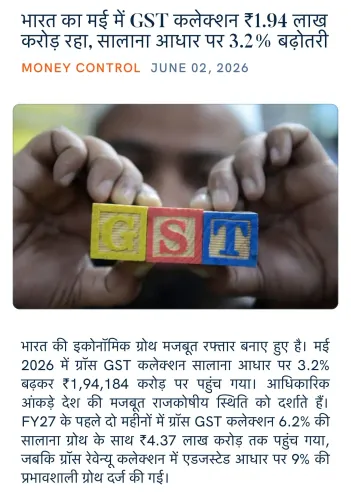
Giriraj Singh Hails May GST Collection Crossing ₹1.94 Lakh Crore
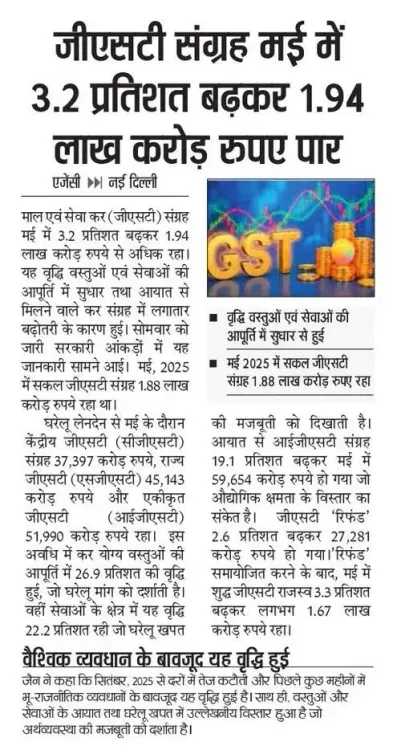
Synopsis
Union Textiles Minister Giriraj Singh on 2 June 2026 highlighted India's May GST collections crossing ₹1.94 lakh crore — a 3.2% annual rise — calling it proof of strong domestic demand and sound governance under PM Modi's Atmanirbhar Bharat vision.
Key Takeaways
India's gross GST collection for May 2026 crossed ₹1.94 lakh crore , a 3.2% year-on-year increase .
Union Textiles Minister Giriraj Singh attributed the figure to strong domestic demand and the Atmanirbhar Bharat programme.
GST was introduced on 1 July 2017 , replacing multiple central and state levies under a unified indirect tax framework.
The Atmanirbhar Bharat Abhiyan , launched in May 2020 , came with a ₹20 lakh crore economic package focused on domestic manufacturing.
Monthly GST data has been used by the government since 2017 as a real-time indicator of economic formalisation and consumption trends.
The next GST Council meeting and the June 2026 collection figure will be key markers of whether this revenue momentum is sustained.
Union Textiles Minister Giriraj Singh on Tuesday, 2 June 2026, cited India's May 2026 gross GST collection crossing ₹1.94 lakh crore — a 3.2% year-on-year rise — as evidence of robust domestic demand and effective governance under Prime Minister Narendra Modi.
Context
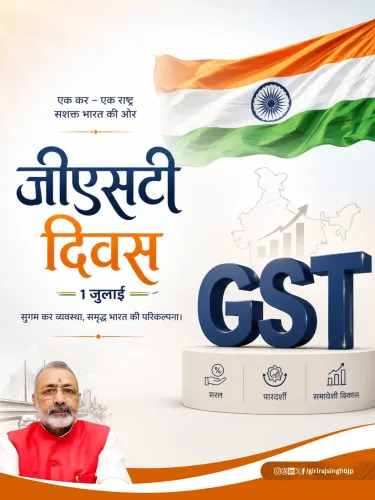
Posting on X, Giriraj Singh wrote that under PM Modi's leadership, the country is continuously setting new benchmarks of economic progress and prosperity. He described the monthly GST figure as 'मजबूत घरेलू मांग, आत्मनिर्भर अर्थव्यवस्था और सुदृढ़ शासन का जीवंत प्रमाण' — 'living proof of strong domestic demand, a self-reliant economy, and sound governance.' The post was accompanied by an image and tagged under #ViksitBharat, #AtmanirbharBharat, and #GoodGovernance.
The minister's remarks follow the routine monthly release of GST collection data, which the government has used since the tax's rollout as a real-time indicator of economic formalisation and consumption health. Singh, a senior BJP leader and Lok Sabha MP from Begusarai, Bihar, is among the party's prominent voices on macroeconomic messaging.
Policy Backdrop
GST was rolled out on 1 July 2017, subsuming central excise duty, service tax, and state-level VAT into a single nationwide indirect tax framework. The reform was positioned as the most significant overhaul of India's tax architecture in decades, aimed at eliminating the 'tax on tax' cascading effect and broadening the formal economy.
The Atmanirbhar Bharat Abhiyan, invoked in Singh's post, was announced in May 2020 alongside a ₹20 lakh crore economic package designed to boost domestic manufacturing, reduce import dependence, and strengthen supply chains. Since then, monthly GST data has been routinely cited by government spokespersons as a proxy for the programme's success in expanding the formal production and consumption base.
Stakeholders and Impact
Strong GST collections are closely watched by domestic manufacturers, exporters, and taxpayers as a gauge of consumption sentiment and compliance levels. A sustained uptick in collections signals higher volumes of taxable transactions, which in turn supports government capital expenditure commitments in infrastructure and social welfare.
For state governments, which receive a constitutionally guaranteed share of GST revenues, a healthy monthly figure eases fiscal pressures and reduces dependence on central devolution. The 3.2% growth figure, if sustained across subsequent months, would broadly support the Centre's revenue arithmetic for the current fiscal year.
What's Next
Attention will now turn to the next GST Council meeting, where decisions on rate rationalisation and compliance measures could further influence the collection trajectory. The June 2026 monthly data release will be the immediate test of whether the momentum reflected in May's numbers is holding.
With the government anchoring its economic narrative around Viksit Bharat — the vision of a developed India by 2047 — monthly fiscal indicators such as GST collections are likely to remain central to official communication as the country heads deeper into the second half of the decade.
Point of View
The minister is stitching short-term revenue data into a longer arc of national self-reliance, signalling that economic messaging will remain central to the party's political positioning. The invocation of 'sound governance' is also a subtle contrast draw ahead of any state electoral cycles where economic performance is contested terrain. As GST collections have broadly trended upward over the past several years, the government has accumulated a credible data record to underpin such claims — though critics periodically flag that headline collection growth does not always translate to equivalent gains in taxpayer welfare or equitable state-level distribution.
NationPress
20 Sept 2026
Frequently Asked Questions
What was India's GST collection in May 2026?
According to Union Textiles Minister Giriraj Singh's post on 2 June 2026 , India's gross GST collection in May 2026 crossed ₹1.94 lakh crore , representing a 3.2% year-on-year increase .
What is Atmanirbhar Bharat and how does it relate to GST?
Atmanirbhar Bharat Abhiyan is a self-reliance programme launched in May 2020 with a ₹20 lakh crore package to boost domestic manufacturing. The government cites rising GST collections as evidence that the programme is expanding India's formal production and consumption base.
When was GST introduced in India?
GST was introduced on 1 July 2017 , replacing central excise duty, service tax, and state VAT with a single nationwide indirect tax framework to eliminate cascading taxes and widen the formal economy.
Why does the government highlight monthly GST figures?
Since GST's rollout in 2017, the government has used monthly collection data as a real-time indicator of economic formalisation, consumption health, and compliance levels — making the figures a standard part of official economic communication.
What is Viksit Bharat?
Viksit Bharat is the government's vision of transforming India into a fully developed nation by 2047 , the centenary of independence. It serves as an overarching framework under which economic milestones such as GST growth are presented as progress markers.