Giriraj Singh meets Petroleum Minister Puri, discusses energy security
Synopsis
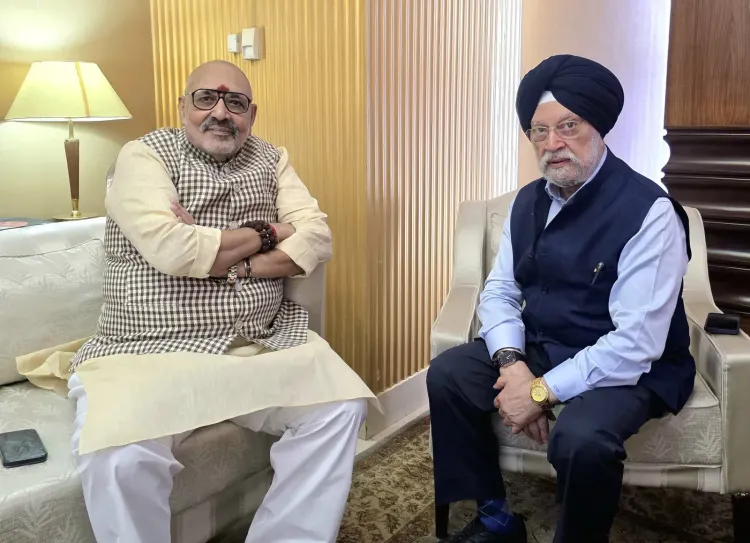
Union Textiles Minister Giriraj Singh met Petroleum and Natural Gas Minister Hardeep Singh Puri on 1 August 2026 to discuss energy security, Atmanirbhar Bharat and the Viksit Bharat vision, signalling inter-ministerial coordination on cross-cutting national development goals.
Key Takeaways
Giriraj Singh met Hardeep Singh Puri on 1 August 2026 for discussions on energy security and national development.
Topics covered included Atmanirbhar Bharat , Viksit Bharat , public welfare and overall economic growth.
The meeting was framed as a step toward strengthening inter-ministerial coordination under PM Narendra Modi's leadership.
Textiles and petroleum share policy overlap through petrochemical feedstocks that feed synthetic fibre manufacturing.
Atmanirbhar Bharat Abhiyan , launched in May 2020 , provides the common policy framework for both ministries.
No specific joint outcomes or follow-up initiatives have been announced yet.
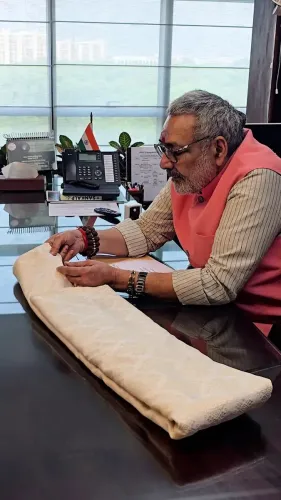
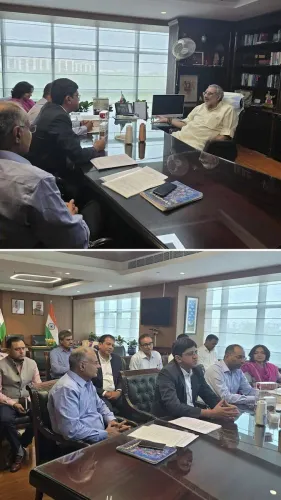
Two senior Cabinet ministers sat down on Saturday, 1 August 2026 to talk about the country's energy future — and the conversation stretched well beyond their individual portfolios. Union Textiles Minister Giriraj Singh met Union Petroleum and Natural Gas Minister Hardeep Singh Puri in what Singh described as a warm and productive exchange on several contemporary issues of national importance.
Posting on X, Singh wrote: 'आत्मीय भेंट कर विभिन्न समसामयिक विषयों पर सार्थक चर्चा हुई' — 'a cordial meeting in which meaningful discussions were held on various current issues.' He listed the broad themes: India's overall development, energy security, the Atmanirbhar Bharat resolve, and public welfare. The meeting, he said, was aimed at strengthening mutual coordination to accelerate the goal of a Viksit Bharat (Developed India) under Prime Minister Narendra Modi's leadership.
Where textiles and petroleum find common ground
At first glance, textiles and petroleum look like distant neighbours in the Cabinet. Look closer and the overlap is real. Synthetic fibres — polyester, nylon, viscose — are petrochemical derivatives, making the Petroleum Ministry a direct upstream partner for large sections of India's textile manufacturing chain. Energy costs also weigh heavily on spinning mills and processing units across Gujarat, Tamil Nadu, Maharashtra and Uttar Pradesh. Any coordinated push on domestic energy pricing or feedstock availability has an immediate knock-on effect on textile competitiveness.Atmanirbhar Bharat as the shared policy frame
Both ministries operate under the broader Atmanirbhar Bharat Abhiyan, the self-reliance initiative Prime Minister Modi launched in May 2020 to reduce import dependence across sectors — from crude oil and petrochemicals to technical textiles and machinery. Singh's explicit invocation of the initiative signals that the conversation was framed not as routine inter-departmental housekeeping but as part of a larger, coordinated national mission. Inter-ministerial alignment of this kind is standard operating procedure in the current government's execution model, where cross-cutting goals are meant to be driven collectively rather than in silos. The specific outcomes of the meeting have not been announced. What to watch: any joint initiative or aligned policy statement from the Ministries of Textiles and Petroleum and Natural Gas in the weeks ahead — particularly on petrochemical feedstock supply chains or energy cost relief for the manufacturing sector. Two ministers, one shared ambition — and the details, when they emerge, will tell the real story.Point of View
Associating the Textiles Ministry with energy security conversations elevates the portfolio's strategic profile beyond apparel and handlooms. The real test will be whether this coordination produces concrete policy — on petrochemical feedstock pricing or energy tariffs for mills — or remains at the level of stated intent. Watch for joint announcements in the run-up to any textile or energy policy review.
NationPress
1 Aug 2026
Frequently Asked Questions
Why did Giriraj Singh meet Hardeep Singh Puri?
Giriraj Singh met Hardeep Singh Puri on 1 August 2026 to discuss energy security, Atmanirbhar Bharat, Viksit Bharat and public welfare, with the aim of strengthening coordination between their ministries.
What is the connection between textiles and petroleum in India?
Synthetic fibres such as polyester and nylon are petrochemical derivatives, making the Petroleum Ministry a key upstream partner for large parts of India's textile industry. Energy costs also directly affect spinning mills and processing units.
What is Atmanirbhar Bharat Abhiyan?
Atmanirbhar Bharat Abhiyan is a self-reliance initiative launched by Prime Minister Narendra Modi in May 2020 to reduce India's import dependence in sectors including energy, manufacturing and technology.
What is Viksit Bharat?
Viksit Bharat, meaning 'Developed India', is PM Modi's long-term vision to transform India into a fully developed nation, used as a guiding goal for policy coordination across Cabinet ministries.
What outcomes came from the Giriraj Singh and Hardeep Puri meeting?
No specific joint outcomes or policy announcements have been made public following the meeting. Any follow-up initiatives from the Ministries of Textiles and Petroleum and Natural Gas are yet to be announced.