Giriraj Singh warns: no place for divisive extremism in India
Synopsis
Union Textiles Minister Giriraj Singh issued a public warning on November 9, 2026, stating there is no place for divisive extremism in India and that the country's aware citizens and youth will collectively defeat every anti-national intent.
Key Takeaways
Union Textiles Minister Giriraj Singh posted a strongly worded warning on November 9, 2026 , targeting those with 'divisive thinking.' He declared there is 'no place for such extremism' in India.
The minister invoked India's youth and aware citizens as the primary force against anti-national designs.
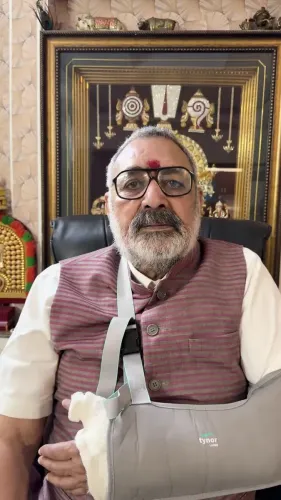
The post was in Hindi and accompanied by a video, amplifying reach into the Hindi heartland.
No specific triggering event has been independently verified for this statement.
The message aligns with BJP 's broader political emphasis on civic nationalism and social cohesion.
India's awareness and unity are its strongest shields — and Union Textiles Minister Giriraj Singh invoked both on Monday, November 9, 2026, posting a sharp warning to those he called 'divisive thinkers,' declaring that the country's citizens and youth would together defeat every anti-national design.
In his post, the BJP leader wrote in Hindi: 'विभाजनकारी सोच रखने वाले समझ लें कि इस देश में ऐसी कट्टरता के लिए कोई जगह नहीं है।' — 'Those who harbour divisive thinking must understand that there is no place for such extremism in this country.' He added that 'India's aware citizens and youth, united as one, will completely defeat every anti-national intent.'
A direct address to 'divisive thinkers'
The message is unambiguous in its target. Rather than addressing a legislative body or a specific policy audience, Giriraj Singh spoke directly to those he sees as a threat — framing India's informed, mobilised youth as the definitive counter-force. It is a rhetorical move that places civic consciousness at the centre of national security, not just institutional machinery.
The post accompanied a video — the contents of which are not independently verified — suggesting the statement was timed to amplify a specific moment or visual. The choice of Hindi ensures the message travels deep into the heartland, particularly Bihar, where Singh holds his Begusarai Lok Sabha seat and commands a significant political base.
Where this fits India's national-unity messaging arc
Indian Union ministers periodically anchor public discourse around constitutional integrity and social harmony, particularly at moments of perceived communal or political tension. Giriraj Singh has been among the more vocal BJP voices on themes of nationalism and social cohesion. His framing here — placing the burden of defence on the 'jagruk naagrik,' the aware citizen — echoes a broader BJP political philosophy that positions grassroots civic patriotism as the first line of response against divisive forces.
The specific trigger for this November 9 statement is not independently verifiable; no linked event or statistic has been identified. What is clear is the deliberate, public nature of the warning: a Union minister, on record, drawing a hard line.
When a senior cabinet voice says 'no place for extremism' in unequivocal terms, the question India's political observers will watch is whether words crystallise into concrete legislative or administrative follow-through — or whether this remains a signal in the ongoing contest over the nation's social narrative.
Point of View
He subtly mobilises grassroots political identity. With no specific event verified as the trigger, the statement reads as both a standing warning and a preemptive political signal, the kind that keeps a senior leader's nationalist credentials visible between news cycles. Whether it escalates into parliamentary or administrative action is the question that will define its long-term significance.
NationPress
9 Nov 2026
Frequently Asked Questions
What did Giriraj Singh say about divisive thinking on November 9 2026?
He posted in Hindi that those with divisive thinking must understand there is no place for such extremism in India, and that the country's aware citizens and youth, standing united, will completely defeat every anti-national intent.
Why did Giriraj Singh post this warning?
The specific trigger has not been independently verified. The statement was posted on November 9, 2026, alongside a video, and aligns with his broader pattern of publicly reinforcing themes of national unity and social harmony.
Who is Giriraj Singh?
Giriraj Singh is India's Union Minister of Textiles, a senior BJP leader, and the Lok Sabha MP from Begusarai, Bihar.
What does 'jagruk naagrik' mean and why did Giriraj Singh use it?
'Jagruk naagrik' means 'aware citizen' in Hindi. By using it, Singh positioned an informed and united citizenry — especially the youth — as the decisive force against divisive or anti-national elements, a framing consistent with BJP's civic-nationalism messaging.
Is this a formal government policy statement by the Textiles Ministry?
No. This was a personal post on Singh's social media account and does not constitute a formal Textiles Ministry policy announcement. It reflects his political and nationalist views as a senior BJP leader.