Giriraj Singh Pays Tribute to Revolutionary Vasudev Balwant Phadke
Synopsis
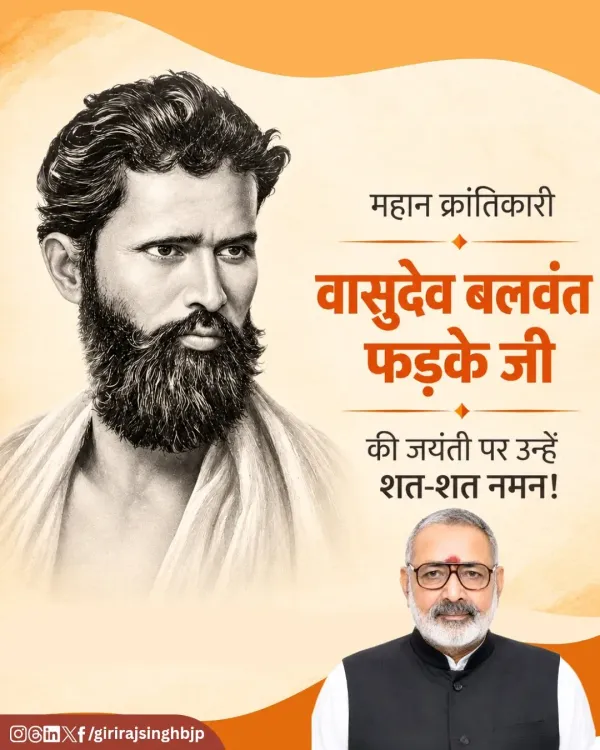
Union Textiles Minister Giriraj Singh paid homage to Vasudev Balwant Phadke on his birth anniversary, calling the 19th-century Maharashtra revolutionary and Ramoshi leader a timeless inspiration for his armed resistance against British colonial rule.
Key Takeaways
Union Textiles Minister Giriraj Singh posted a tribute to revolutionary Vasudev Balwant Phadke on his birth anniversary on November 4, 2026 .
Phadke is recognised as a pioneering armed resistance leader who organised peasant and tribal communities in Maharashtra against British rule in the 1870s .
He led the Ramoshi armed organisation, one of the earliest structured anti-colonial insurgencies in post-1857 India.
Singh praised Phadke's 'indomitable courage, sacrifice, and struggle' as a continuing source of national inspiration.
BJP leaders regularly mark such anniversaries to highlight the armed resistance strand of India's independence movement.
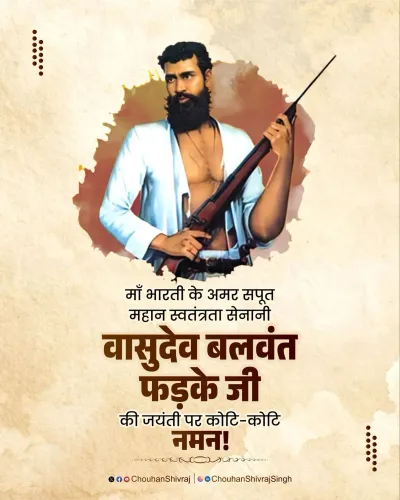
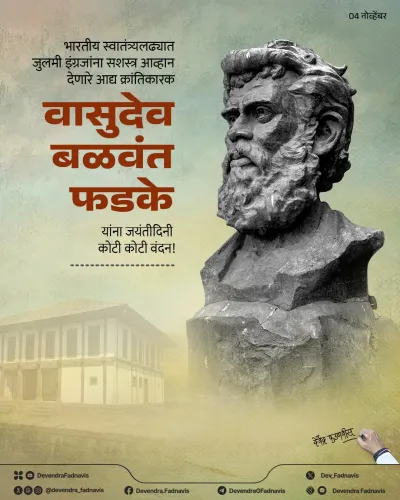
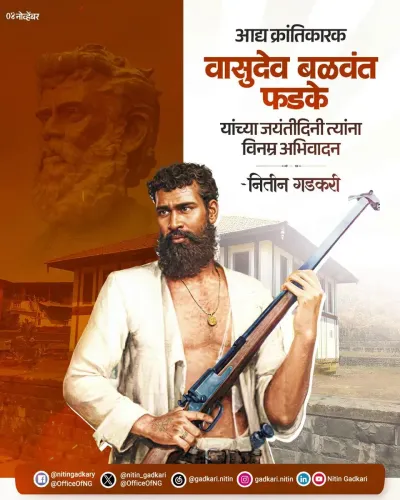
Before the word 'independence' became a mass movement, one man picked up arms in Maharashtra and dared to dream it into reality. Union Textiles Minister Giriraj Singh marked the birth anniversary of Vasudev Balwant Phadke on Wednesday, November 4, 2026, with a respectful tribute on X, honouring the 19th-century revolutionary as a 'leading warrior of the freedom struggle' and the driving force behind the armed organisation Ramoshi.
Who Was Vasudev Balwant Phadke?
Vasudev Balwant Phadke was among the earliest Indians to organise armed resistance against British colonial rule in the years following the 1857 revolt. Born in Maharashtra, Phadke mobilised peasant and tribal communities — particularly through the Ramoshi network — into a guerrilla force that posed a direct challenge to colonial authority in the 1870s. His methods were unconventional, his conviction absolute: that the British had to be driven out not just through petitions, but through organised resistance.
The colonial administration eventually captured and exiled him, but his legacy endured as a template for the armed strand of India's independence movement — a lineage that would later inspire generations of revolutionaries across the subcontinent.
The Ramoshi Uprising and Its Place in History
The Ramoshi community, historically a marginalised group, became the backbone of Phadke's revolt. By uniting agrarian grievances with nationalist fervour, Phadke built what was arguably one of the first organised armed anti-colonial insurgencies in post-1857 India. Minister Singh's tribute specifically names the Ramoshi organisation, a pointed acknowledgement of this lesser-cited chapter of the freedom struggle.
Phadke's anniversary observances remain relatively understated in mainstream national commemoration, though Maharashtra has long recognised him as a pioneer of armed resistance. BJP leaders and Union ministers have consistently used social media platforms on such anniversaries to surface figures from this tradition — broadening the official memory of independence beyond the non-violent movement.
Singh's Message to the Nation
Writing in Hindi, Minister Singh offered his sadar naman — a respectful salutation — and noted that Phadke's 'indomitable courage, sacrifice, and struggle for the freedom of the motherland will always inspire the people of this country.' The tribute carries both reverence and a forward-looking charge: that the memory of such fighters is not merely historical, but actively motivating.
These periodic tributes by senior government figures also nudge public and educational attention toward less-celebrated revolutionaries — with quiet implications for how school curricula and state commemorations might eventually frame figures like Phadke.
One man, one armed network, and one audacious uprising in colonial Maharashtra — Phadke's story is a reminder that the freedom struggle began long before it became inevitable.
Point of View
Minister Singh's tribute does more than mark a calendar date — it inserts a marginalised chapter of armed anti-colonial history into mainstream national discourse. BJP's consistent pattern of honouring 19th-century armed revolutionaries reflects a deliberate ideological project: broadening India's official memory of independence beyond Gandhian non-violence to encompass militant resistance traditions rooted in Maharashtra and beyond. For Phadke, whose anniversary draws little institutional fanfare compared to figures like Bhagat Singh, a Union minister's public tribute is a nudge toward curricular and commemorative reconsideration. The question is whether such social media salutes eventually translate into textbook revisions or state-sponsored commemorations.
NationPress
4 Nov 2026
Frequently Asked Questions
Who was Vasudev Balwant Phadke?
Vasudev Balwant Phadke was a 19th-century Indian revolutionary from Maharashtra who organised armed resistance against British colonial rule, primarily in the 1870s , mobilising peasant and tribal communities through the Ramoshi network. He is considered one of the earliest leaders of organised armed anti-colonial insurgency in post-1857 India.
What was the Ramoshi organisation?
The Ramoshi was an armed community network led by Vasudev Balwant Phadke that formed the backbone of his uprising against British authority in Maharashtra. It brought together marginalised agrarian communities under a nationalist banner in one of India's earliest structured armed revolts.
Why did Giriraj Singh pay tribute to Phadke?
Union Textiles Minister Giriraj Singh posted his tribute to mark Vasudev Balwant Phadke's birth anniversary on November 4, 2026 , honouring him as a 'leading warrior of the freedom struggle' whose courage and sacrifice continue to inspire Indians.
When is Vasudev Balwant Phadke's birth anniversary?
Vasudev Balwant Phadke's birth anniversary falls on November 4 , as marked by Union Minister Giriraj Singh's tribute post on that date in 2026.
Why do BJP leaders frequently tribute 19th-century revolutionaries?
BJP leaders and ministers regularly post tributes to 19th-century armed revolutionaries on their birth anniversaries as part of a broader pattern of highlighting the armed resistance strand of India's independence movement alongside more widely commemorated figures.