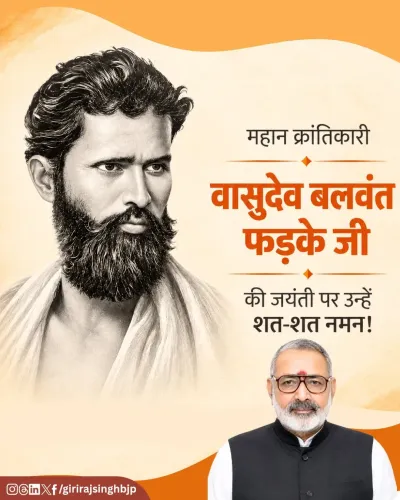
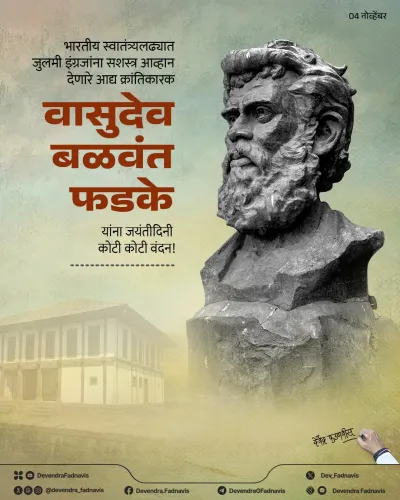
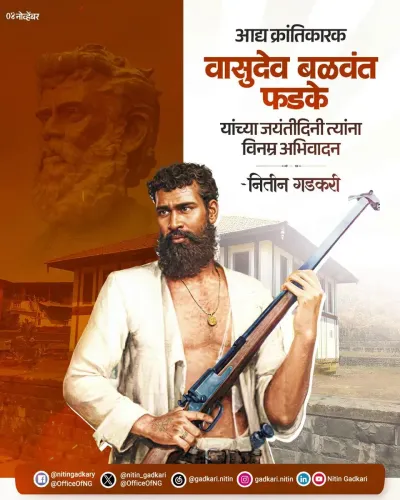
Shivraj Singh Chouhan pays tribute to Vasudev Balwant Phadke
Synopsis
Union Agriculture Minister Shivraj Singh Chouhan marked the birth anniversary of Vasudev Balwant Phadke, hailing the 19th-century Maharashtra revolutionary and Ramoshi leader as an eternal inspiration for India's youth in national service.
Key Takeaways
Union Agriculture Minister Shivraj Singh Chouhan paid tribute to freedom fighter Vasudev Balwant Phadke on his birth anniversary on November 4, 2026 .
Phadke, born in 1845 in Maharashtra , is regarded as one of India's first organised armed rebels against British colonial rule.
He led the Ramoshi community as a guerrilla force in an uprising launched in 1879 , fuelled by outrage over famine and British economic exploitation.
Captured in 1879 , Phadke was deported to Aden and died in prison in 1883 , earning the posthumous title Aadya Kraantiveer — the first revolutionary.
Chouhan invoked Phadke's legacy as a perennial source of inspiration for India's youth toward national and public service.
On the birth anniversary of one of India's earliest armed revolutionaries, Union Agriculture Minister Shivraj Singh Chouhan offered tribute to Vasudev Balwant Phadke on Wednesday, November 4, 2026 — invoking the legacy of a freedom fighter whose rebellion against British rule predated the mainstream independence movement by decades.
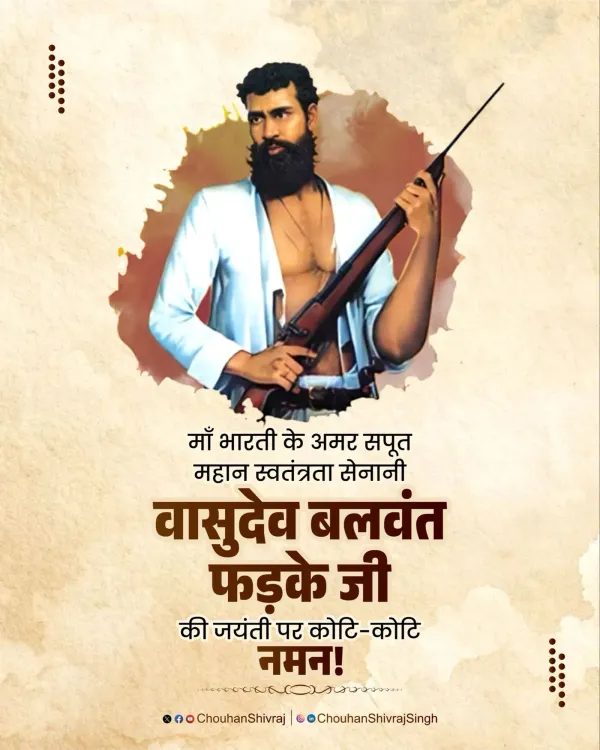
Chouhan wrote, 'सशस्त्र संगठन रामोशी के नायक, महान स्वतंत्रता सेनानी, आद्य क्रांतिवीर वासुदेव बलवंत फड़के जी की जयंती पर कोटि-कोटि नमन करता हूँ' — translating to: 'I offer a crore salutations on the birth anniversary of Vasudev Balwant Phadke, the great freedom fighter and pioneer revolutionary, the leader of the armed organisation Ramoshi.' He added that the heroic saga of the brave son of Mother India, who sacrificed his life in her service, would forever inspire the youth toward national service.
Who was Vasudev Balwant Phadke — India's first armed revolutionary
Vasudev Balwant Phadke is widely regarded as one of India's first organised armed rebels against British colonial rule. Born in 1845 in Shirdhon village, Raigad district, Maharashtra, he launched an armed uprising in 1879 — nearly seven decades before independence — at a time when most organised resistance had not yet taken a militant form. His rebellion was rooted in the devastating famines that ravaged Maharashtra in the late 1870s, which he blamed squarely on British economic exploitation.
Phadke organised the Ramoshi community — a marginalised tribal group — into an armed guerrilla force, conducting raids on British-controlled treasuries to fund his insurrection. The British administration treated his uprising with enough seriousness to mount a large-scale manhunt. He was eventually captured in 1879, tried, and deported to Aden (present-day Yemen), where he died in prison in 1883. His defiance earned him the posthumous title 'Aadya Kraantiveer' — the first revolutionary.
Why Phadke's legacy resonates with India's ruling establishment
Chouhan's tribute reflects a consistent effort by senior BJP leaders to foreground Maharashtra's revolutionary heritage — particularly figures who took the path of armed resistance rather than petition-based reform. Phadke's story carries special weight in Maharashtra, where he is celebrated as a precursor to the later freedom movement. His emphasis on economic injustice under colonial rule — famine, agrarian distress, extraction — also carries a resonance for a minister whose portfolio covers agriculture and rural development.
The tribute lands on a date that holds genuine historical weight. Phadke represents a lineage of Maharashtrian revolutionary thought that connects, symbolically if not organisationally, to later figures like Bal Gangadhar Tilak and the broader militant nationalism of the early twentieth century. His story — a man who built an army from the margins and paid for it with his life in exile — is precisely the kind of founding-era narrative political leaders reach for when they want to call the youth toward public service.
India's freedom movement produced many tributaries; Phadke led one of its earliest and least sung. That a Union Cabinet minister pauses to name him by his full title — Aadya Kraantiveer — ensures at least one morning the name reaches a national feed.
Point of View
Militant-nationalist figures from the margins of official history — particularly those from Maharashtra, a politically crucial state. By naming Phadke as 'Aadya Kraantiveer' and linking his sacrifice to the inspiration of youth, the Agriculture Minister draws a line from 19th-century agrarian revolt to present-day rural development discourse. The choice of Phadke — whose uprising was explicitly tied to famine and colonial economic extraction — is not incidental for a minister overseeing agriculture and farmers' welfare. Such tributes also serve to remind audiences that the BJP's ideological genealogy reaches deeper into India's pre-independence story than the Congress-centric narrative of the freedom movement typically acknowledges.
NationPress
4 Nov 2026
Frequently Asked Questions
Who was Vasudev Balwant Phadke?
Vasudev Balwant Phadke (1845–1883) was a Maharashtrian revolutionary widely regarded as one of India's first organised armed rebels against British rule. He led the Ramoshi community in an uprising in 1879 and died in British captivity in Aden.
What is the Ramoshi organisation Phadke led?
The Ramoshi were a marginalised tribal community in Maharashtra. Phadke organised them into an armed guerrilla force in 1879 to resist British colonial rule, conducting raids to fund his insurrection.
Why is Phadke called 'Aadya Kraantiveer'?
'Aadya Kraantiveer' means 'the first revolutionary.' Phadke earned this title posthumously because his armed uprising in 1879 preceded the mainstream organised independence movement by decades.
What did Shivraj Singh Chouhan say about Vasudev Balwant Phadke?
Chouhan offered crore-fold salutations to Phadke on his birth anniversary and said the heroic saga of the warrior who sacrificed his life serving Mother India would forever inspire the youth toward national service.
When is Vasudev Balwant Phadke's birth anniversary?
Vasudev Balwant Phadke was born on November 4, 1845. His birth anniversary is observed on November 4 each year.