Giriraj Singh Shares India's High-Speed Rail Push Beyond Shinkansen
Synopsis
Union Textiles Minister Giriraj Singh amplified India's high-speed rail push on X, sharing that the country is building its own identity in bullet-train technology beyond its foundational Japanese Shinkansen collaboration, as the Mumbai-Ahmedabad corridor progresses.
Key Takeaways
Giriraj Singh , Union Textiles Minister and BJP MP from Begusarai , shared a post on 22 July 2026 highlighting India's evolving high-speed rail ambitions.
India's high-speed rail programme began with an India-Japan MoU in 2015 , adopting Shinkansen standards for the Mumbai-Ahmedabad High Speed Rail Corridor .
Policy emphasis has shifted from technology import to indigenisation of rolling stock, signalling, and civil works.
The National High Speed Rail Corporation Limited (NHSRCL) is the designated SPV executing India's dedicated high-speed rail projects.
The post signals that high-speed rail has become a cross-ministerial symbol of India's Atmanirbhar Bharat infrastructure narrative.
Key milestones to watch include operational progress on the Mumbai-Ahmedabad corridor and decisions on additional high-speed corridors.
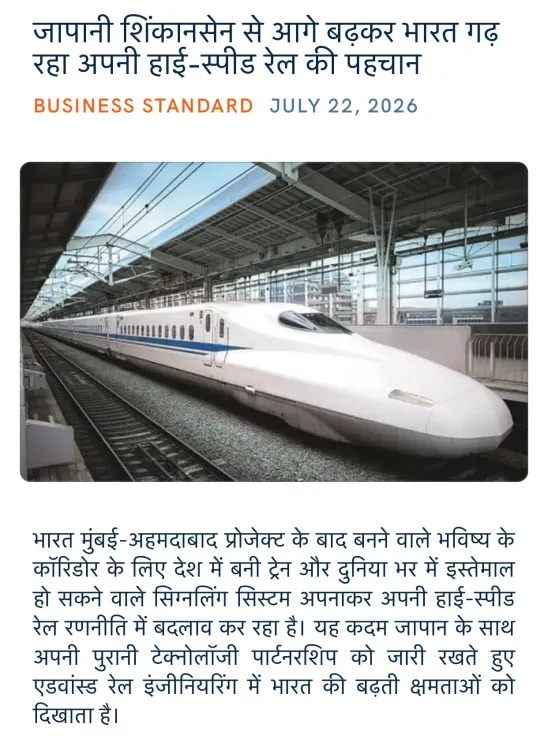
Union Textiles Minister Giriraj Singh on Wednesday, 22 July 2026 shared an article on X highlighting India's evolving approach to high-speed rail, signalling that the country is charting an identity in this domain that goes beyond its foundational collaboration with Japan's Shinkansen technology.
The post, shared via the NaMo App, carried a Hindi caption — 'जापानी शिंकानसेन से आगे बढ़कर भारत गढ़ रहा अपनी हाई-स्पीड रेल की पहचान' — which translates to: 'Moving beyond Japan's Shinkansen, India is forging its own identity in high-speed rail.' The senior BJP leader and Lok Sabha MP from Begusarai, Bihar, used the platform to amplify what is increasingly a point of national pride in infrastructure policy circles.
Context
India's high-speed rail journey formally began with a bilateral agreement. In 2015, India and Japan signed a memorandum of understanding for the Mumbai-Ahmedabad High Speed Rail Corridor, adopting Shinkansen standards and backed by Japanese financing and technology transfer. The foundation stone for the corridor was laid in 2017, marking India's first concrete step into bullet-train infrastructure.
The National High Speed Rail Corporation Limited (NHSRCL), a special purpose vehicle created specifically for this purpose, was tasked with executing the project. Indian Railways has since been working alongside NHSRCL to build not just the physical corridor but also the domestic institutional capacity to sustain high-speed rail over the long term.
Policy Backdrop
The early phase of India's high-speed rail programme was heavily reliant on Japanese expertise — covering rolling stock design, signalling systems, and civil engineering standards. However, policy emphasis has progressively shifted toward indigenisation. This mirrors a broader pattern visible across Indian strategic infrastructure: initial technology import followed by a deliberate push to develop domestic platforms and manufacturing capability.
This indigenisation drive aligns with the government's wider Atmanirbhar Bharat ('self-reliant India') framework, which seeks to reduce dependence on foreign systems in sectors deemed strategically significant. High-speed rail, given its capital intensity and long operational life, is a natural candidate for such a transition. The shift from technology recipient to technology developer — even if gradual — represents a meaningful evolution in India's infrastructure ambitions.
Stakeholders and Impact
The most direct beneficiaries of a mature high-speed rail network would be rail passengers on high-density corridors, particularly between major commercial and industrial hubs. Beyond commuters, the ecosystem of infrastructure developers, component manufacturers, and engineering firms stands to gain significantly if India succeeds in building an indigenous supply chain for high-speed rolling stock and signalling.
For Japan, the partnership has been a flagship example of economic diplomacy and technology exports. A shift toward Indian self-sufficiency does not necessarily diminish the relationship, but it does reframe it — from technology provider to strategic partner in a more equal footing. How that transition is managed will matter both commercially and diplomatically.
What's Next
The immediate focus remains on operational milestones for the Mumbai-Ahmedabad High Speed Rail Corridor, which has faced construction timelines shaped by land acquisition and civil works complexity. Cabinet decisions on additional high-speed corridors and the development of indigenous train prototypes are the next inflection points to watch.
That a senior minister from the Textiles portfolio is amplifying rail infrastructure messaging underscores how high-speed rail has become a whole-of-government symbol of India's development ambitions — cutting across ministerial silos and speaking directly to a narrative of technological self-determination.
Point of View
Feeding into the Atmanirbhar Bharat narrative that has defined infrastructure communication since 2020. The indigenisation push in rail mirrors patterns seen in defence and semiconductors, where initial import dependence is recast as a launchpad rather than a limitation. Whether the industrial capacity to back that narrative materialises on schedule will determine whether this messaging holds.
NationPress
22 Jul 2026
Frequently Asked Questions
What is India's high-speed rail project?
India's flagship high-speed rail project is the Mumbai-Ahmedabad High Speed Rail Corridor, developed in collaboration with Japan using Shinkansen technology, with the foundation stone laid in 2017.
What is the Shinkansen and how is India connected to it?
The Shinkansen is Japan's bullet-train system. India adopted Shinkansen standards for its first high-speed rail corridor under a 2015 MoU with Japan, which also provided financing and technology transfer.
Why is India moving beyond Shinkansen technology?
India's policy has shifted toward indigenisation — developing domestic rolling stock, signalling, and civil engineering capabilities — to reduce reliance on imported systems and align with the Atmanirbhar Bharat framework.
Why did Giriraj Singh post about rail when he is the Textiles Minister?
Senior ministers frequently amplify government infrastructure achievements on social media regardless of their specific portfolio; such posts reflect a whole-of-government communication approach around flagship projects.