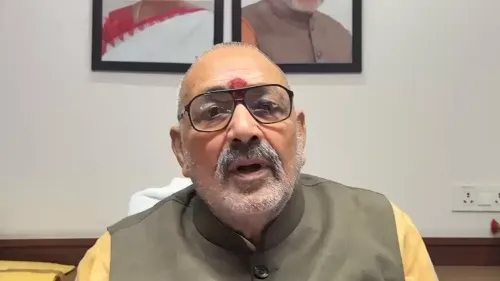
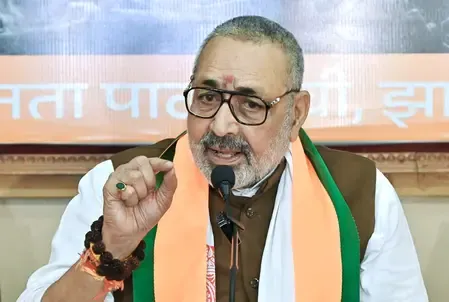
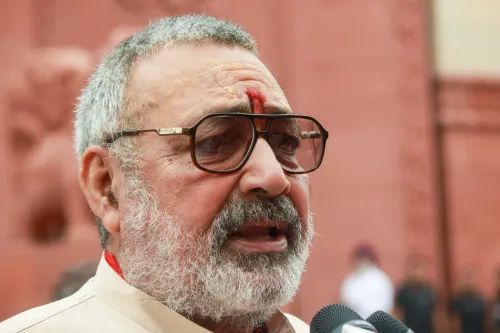
Giriraj Singh targets 'Deepke' over selective audit demand
Synopsis
Union Textiles Minister Giriraj Singh accused critics demanding audits of the Election Commission and Supreme Court of ignoring opposition-governed states, alleging a foreign-funded bid by Rahul Gandhi and Kejriwal to spread anarchy in India.
Key Takeaways
Union Textiles Minister Giriraj Singh posted on August 7, 2026 targeting critics he called 'deepke' for selectively demanding audits of constitutional bodies.
Singh questioned why the same audit demand does not extend to opposition-governed Jharkhand , Punjab , and Karnataka .
He alleged that Rahul Gandhi , Arvind Kejriwal , and the broader opposition are sponsoring foreign-funded efforts to create anarchy in India.
The accusation echoes a broader BJP pattern of countering institutional criticism by invoking the Foreign Contribution Regulation Act (FCRA) framework.
The post signals that electoral-institution accountability debates are likely to intensify ahead of future parliamentary sessions.
A sharp political volley landed on the morning of Friday, August 7, 2026, when Union Textiles Minister Giriraj Singh turned the tables on critics of India's electoral institutions — asking why those eager to audit the Election Commission and the Supreme Court go conspicuously silent when the conversation turns to Jharkhand, Punjab, and Karnataka.
In a pointed post on X, Singh trained his fire on a figure he referred to as 'deepke' — a colloquial shorthand used in political discourse — accusing them of hiding their face from opposition-governed states even while demanding accountability from constitutional bodies. 'Either they do not consider those states part of the country,' Singh wrote, 'or they are making a vile attempt to spread anarchy in the nation through foreign funding sponsored by Rahul Gandhi, Kejriwal, and the rest of the opposition.'
The selective-scrutiny charge
The core of Singh's argument is a consistency test: if the Election Commission and the Supreme Court deserve a comprehensive audit, why not the governments of Jharkhand, Punjab, and Karnataka — all states where opposition parties hold power? The rhetorical structure is familiar in Indian political combat, but the specificity of naming three states gives it a sharper edge than a generic broadside. It frames the demand for institutional scrutiny as politically motivated rather than principled.
The foreign-funding allegation
Singh's second charge escalates the stakes considerably. He directly invokes the spectre of foreign-funded destabilisation, linking Congress leader Rahul Gandhi and Aam Aadmi Party chief Arvind Kejriwal to what he calls a 'vile attempt' (kutsit prayas) to create an atmosphere of anarchy. This line of attack echoes a long-running BJP argument that opposition criticism of electoral institutions is not organic dissent but externally bankrolled disruption — a framing that has intensified since successive amendments to the Foreign Contribution Regulation Act (FCRA) in 2010 and 2020 tightened oversight of foreign money flowing into Indian civil society and political ecosystems.
The ruling party has repeatedly deployed this playbook: when opposition voices question the Election Commission's neutrality or seek judicial intervention in electoral disputes, BJP leaders counter by questioning the funding sources behind such campaigns. Singh's post is a textbook instance — two accusations in one breath, each designed to put the critic on the defensive.
Opposition states as the political mirror
The choice of Jharkhand, Punjab, and Karnataka is deliberate. All three are governed by parties outside the NDA fold, and centre-state friction over governance standards, financial accountability, and law-and-order has been a recurring feature of the political landscape. By invoking them, Singh implicitly argues that the same audit instinct should apply uniformly — and that its absence reveals double standards.
Whether this exchange escalates into formal parliamentary debate or court proceedings around electoral audit demands is the next variable to watch. For now, the minister has drawn a clear line: institutional scrutiny, in his telling, must be a two-way street — or it is not scrutiny at all.
Point of View
He shifts the burden of proof onto the critics by demanding symmetry. The invocation of foreign funding is not incidental — it is designed to delegitimise the audit demand entirely by questioning its origins. This move fits a broader BJP strategy of framing opposition institutional criticism as externally orchestrated rather than domestically driven, a narrative that gains traction each time FCRA violations by civil-society groups make headlines. The naming of three specific opposition-governed states sharpens the political contrast and sets up a ready-made talking point for the next parliamentary session.
NationPress
7 Aug 2026
Frequently Asked Questions
What did Giriraj Singh say about the Election Commission audit demand?
Singh argued that those demanding an audit of the Election Commission and the Supreme Court are conspicuously silent about opposition-governed states like Jharkhand, Punjab, and Karnataka, suggesting the demand is politically selective rather than principled.
Who is 'deepke' that Giriraj Singh referred to?
The term 'deepke' appears to be a colloquial political reference used by Singh; the exact individual or group he intended cannot be independently verified from the post alone.
What is the foreign funding allegation Giriraj Singh made?
Singh alleged that Rahul Gandhi, Arvind Kejriwal, and the opposition are sponsoring foreign-funded efforts to create an atmosphere of anarchy in India, framing institutional criticism as externally bankrolled disruption.
Why did Giriraj Singh mention Jharkhand, Punjab, and Karnataka specifically?
All three states are governed by opposition parties outside the NDA, and Singh used them to argue that audit demands should apply uniformly — implying their exclusion reveals double standards.
What is the FCRA and why is it relevant here?
The Foreign Contribution Regulation Act governs foreign money flowing into Indian entities; amended in 2010 and 2020, it is frequently cited by BJP leaders when alleging that opposition criticism of electoral institutions is externally funded.