Giriraj Singh Slams Opposition Over FCRA Bill Disruptions
Synopsis
Union Textiles Minister Giriraj Singh on August 6, 2026 accused the opposition of paralysing Parliament to shield foreign funding interests, demanding MPs debate the FCRA Bill on the floor rather than disrupt proceedings and collect salaries without working.
Key Takeaways
Giriraj Singh accused the opposition on August 6, 2026 of stalling Parliament on the agenda of 'foreign masters.' He called opposition resistance to the FCRA Bill a bid to keep 'black earnings from foreign funding' flowing, not a patriotic stand.
Singh demanded MPs stop accepting salaries without working and bring their arguments to the floor of the House.
The Foreign Contribution (Regulation) Act was originally enacted in 1976 and last significantly amended in 2020 to tighten foreign funding oversight.
Parliamentary disruptions over contentious legislation are a recurring pattern, but Singh's post explicitly frames opposition action as protecting external financial interests.
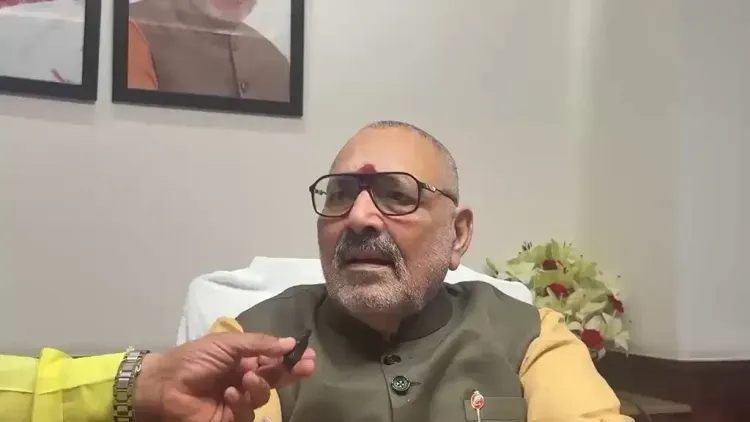
A sharp accusation landed in Parliament's direction on Thursday, August 6, 2026: Union Textiles Minister Giriraj Singh charged the opposition with stalling parliamentary proceedings to protect foreign funding pipelines, calling their resistance to the FCRA Bill a cover for 'black earnings from foreign funds.'
Posting in Hindi on X, Singh did not mince words. 'Filling pockets on taxpayers' money and paralysing Parliament to run on the agenda of foreign masters is the opposition's real strategy,' he wrote. He demanded that MPs who disrupt proceedings stop 'gulping down free salaries without doing any work' and instead make their case on the floor of the House. His sharpest line was reserved for the FCRA opposition itself: 'The resistance to the FCRA Bill is not rooted in patriotism — it is to keep the doors of black earnings from foreign funding open and spread anarchy in the country.'
FCRA: A Law With a Long Paper Trail of Controversy
The Foreign Contribution (Regulation) Act has been a fault line in Indian politics for decades. First enacted in 1976, it was substantially tightened in 2010 and again in 2020 — each revision expanding compliance requirements, banning sub-granting of foreign funds, and capping administrative expenditure for recipient organisations. Successive governments, regardless of party, have leaned on FCRA amendments to assert that unchecked foreign money in civil society poses a risk to domestic political sovereignty. Opposition parties and NGO coalitions have consistently pushed back, arguing the law is used selectively to choke dissent and civil society voices. That tension is the backdrop to Singh's broadside — a pattern as old as the Act itself, now playing out again in what appears to be a fresh legislative push.Parliament Disrupted, Opposition in the Crosshairs
Parliamentary disruptions are not new — walkouts, well invasions, and adjournments have punctuated nearly every contentious session in recent memory. But Singh's framing goes further than procedural complaint. By linking the disruptions explicitly to foreign funding interests, he is making a political argument: that opposition resistance is not principled dissent but a protection racket for external money flows. The charge is politically loaded and the opposition is certain to contest it. What is clear is that the FCRA debate has moved from committee rooms to the social media battlefield — and with a senior Cabinet minister firing this directly at opposition benches, the temperature inside Parliament is unlikely to cool soon. Whether the FCRA Bill clears the House in the current session or spills into the next, Singh's post signals that the ruling side intends to fight this one hard — and publicly.Point of View
' he is also appealing directly to a public increasingly impatient with parliamentary gridlock. The opposition's response — and whether it can articulate a credible counter-narrative beyond procedural objections — will shape how the FCRA debate lands with voters.
NationPress
20 Sept 2026
Frequently Asked Questions
What is the FCRA Bill that Giriraj Singh is referring to?
The FCRA Bill relates to proposed amendments to the Foreign Contribution (Regulation) Act, which governs how Indian NGOs and associations receive and use foreign funds. The Act was originally passed in 1976 and has been amended in 2010 and 2020 to tighten compliance rules.
Why is the opposition against the FCRA Bill?
Opposition parties have historically argued that FCRA restrictions are used selectively to target civil society groups and dissenting voices. Giriraj Singh, however, contends the opposition is protecting foreign funding channels rather than acting out of principle.
What did Giriraj Singh say about Parliament disruptions?
Singh accused the opposition of paralysing Parliament to serve 'foreign masters' agendas,' demanded they stop collecting salaries without working, and called on them to make their case inside the House rather than through disruptions.
What are the key changes the FCRA has seen over the years?
The Foreign Contribution (Regulation) Act was enacted in 1976, significantly amended in 2010 to broaden its scope, and further tightened in 2020 to ban sub-granting of foreign funds and cap administrative expenses at 20 percent for recipient organisations.
Who is Giriraj Singh?
Giriraj Singh is a senior BJP leader, Union Minister of Textiles, and Lok Sabha MP from Begusarai in Bihar. He is known for outspoken positions on national security and governance issues.