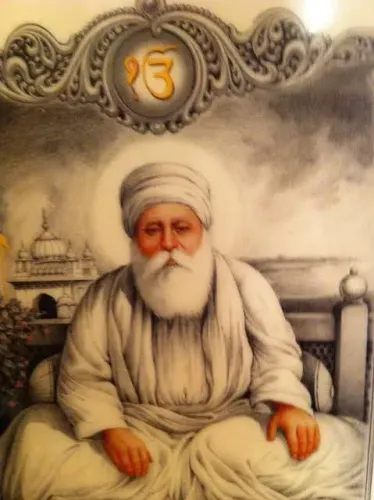
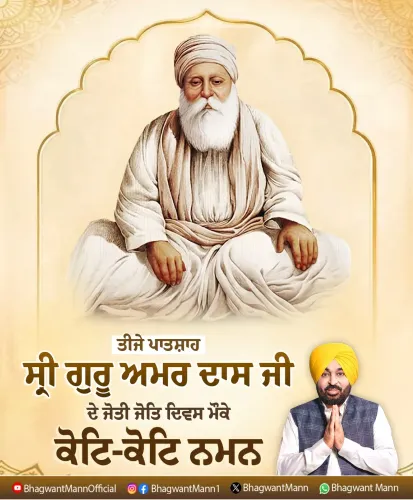
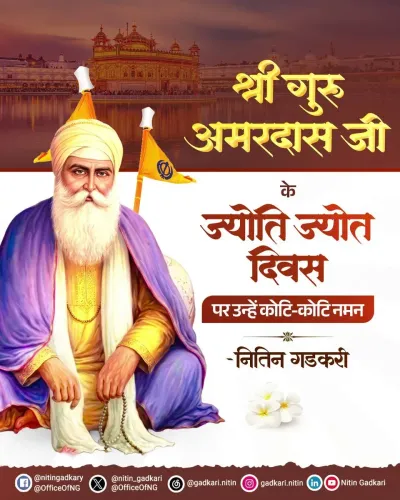
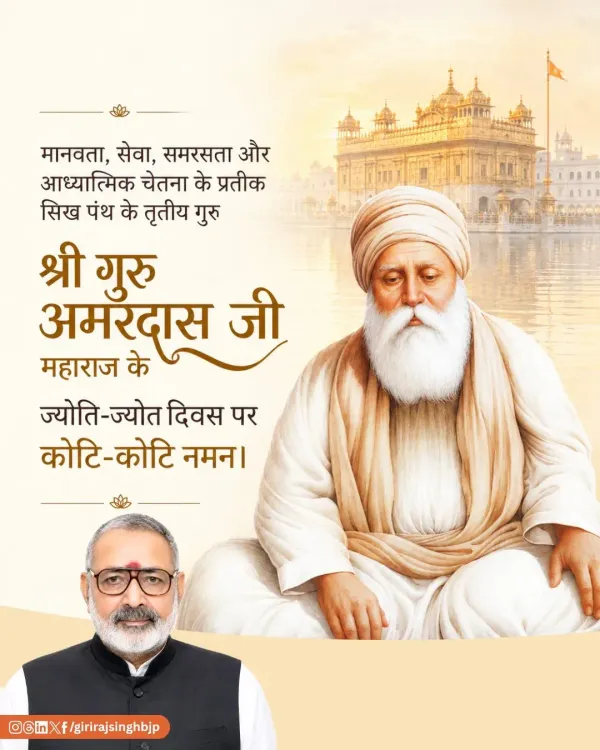
Giriraj Singh pays tribute to Guru Amar Das Ji on Jyoti-Jyot Divas
Synopsis
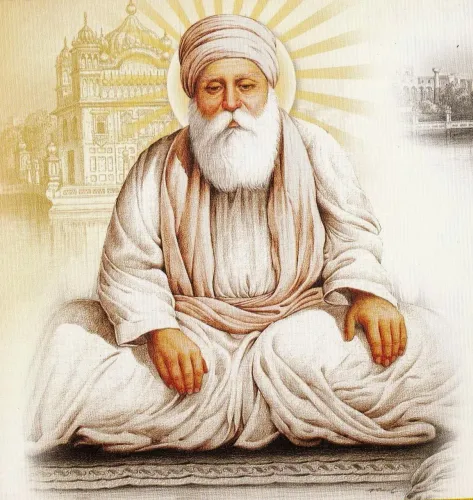
Union Textiles Minister Giriraj Singh paid tribute to Guru Amar Das Ji on his Jyoti-Jyot Divas, honouring the Third Sikh Guru's revolutionary Langar tradition and lifelong mission to eradicate caste discrimination through the principle of 'Pehle Pangat, Peeche Sangat.'
Key Takeaways
Guru Amar Das Ji , Third Guru of Sikhism, led the faith from 1552 to 1574 and institutionalised the Langar system of communal meals open to all castes.
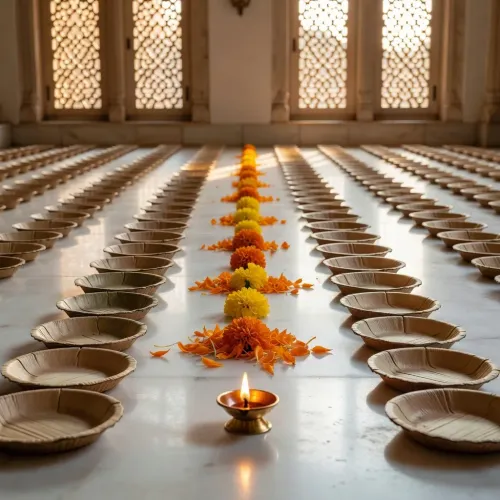
The principle 'Pehle Pangat, Peeche Sangat' mandated that every visitor — regardless of rank — share a meal with the congregation before any religious audience.
Union Textiles Minister Giriraj Singh paid homage on September 26, 2026 , calling the Guru a beacon of humanity, selfless service, harmony, and spiritual consciousness.
Gurdwara Goindwal Sahib in Punjab, founded by Guru Amar Das Ji, is the principal site of Jyoti-Jyot Divas observances.
Guru Amar Das Ji also campaigned against the practice of sati and advocated for women's dignity, marking his tenure as a period of sweeping social reform.
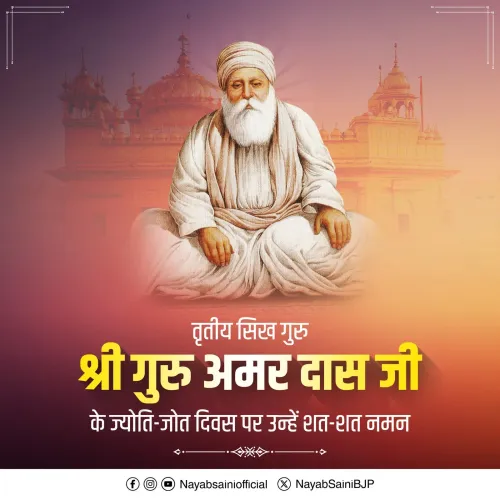
On the solemn occasion of Guru Amar Das Ji's Jyoti-Jyot Divas — the death anniversary of Sikhism's Third Guru — Union Textiles Minister Giriraj Singh offered his reverence on Saturday, September 26, 2026, honouring the saint's enduring legacy of equality, selfless service, and spiritual awakening.
In his post, Singh paid homage in Hindi, calling Guru Amar Das Ji a 'beacon of humanity, selfless service, harmony and spiritual consciousness' — मानवता, निष्काम सेवा, समरसता एवं आध्यात्मिक चेतना के पुंज. He specifically invoked the Guru's reinforcement of the Langar tradition through the principle 'Pehle Pangat, Peeche Sangat' — 'first the communal meal, then the congregation' — a practice designed to shatter the caste hierarchy that defined medieval Indian society.
The Guru who put food before faith — and changed India
Guru Amar Das Ji, the Third Guru of Sikhism, led the Sikh faith from 1552 to 1574. His most radical contribution was the institutionalisation and deepening of the Langar system: a communal kitchen where every person — regardless of caste, creed, or status — sat together and ate as equals before joining any religious congregation. In a society rigidly stratified by caste, the act of sharing a meal was nothing less than a social revolution.
The principle of 'Pehle Pangat, Peeche Sangat' was not merely a logistical rule. It was a theological and social statement — that no one enters the presence of the Guru without first shedding hierarchy at the threshold of the kitchen. Even the Mughal Emperor Akbar is said to have sat and eaten with ordinary people before meeting the Guru, a detail that underlines the radical egalitarianism the principle enforced. Guru Amar Das Ji also championed the abolition of the practice of sati and advocated for the dignity of women, making his tenure among the most reformist in early Sikh history.
Jyoti-Jyot Divas and Goindwal Sahib
Jyoti-Jyot Divas — literally 'the day the light merged with Light' — marks the anniversary of a Guru's passing into eternal union with the divine, observed with prayer, kirtan, and acts of seva (service) at Gurdwaras across India and the world. The Gurdwara Goindwal Sahib in Punjab, the town Guru Amar Das Ji himself founded, remains the principal seat of commemoration on this day. Pilgrims undertake the ritual of bathing in the Baoli Sahib, the sacred stepwell built by the Guru to make spiritual access democratic and open to all.
Why political leaders mark this day
Across party lines, senior Indian leaders regularly issue tributes on the death anniversaries of the ten Sikh Gurus. These messages carry both spiritual sincerity and political currency — the Sikh community constitutes a significant and deeply respected constituency, and the Gurus' teachings on equality and seva resonate far beyond Sikhism into India's broader cultural fabric. Singh's tribute, framed around caste annihilation and communal solidarity, aligns the Guru's 16th-century vision with contemporary debates about social justice and inclusivity.
The teachings of Guru Amar Das Ji — that the table of a shared meal is the truest leveller of human pride — remain as urgent a message in 2026 as they were four and a half centuries ago.
Point of View
Particularly significant given the community's presence across Punjab, Haryana, and the diaspora. Singh's framing of Guru Amar Das Ji's legacy around caste annihilation is notable — it subtly ties a 16th-century saint's radical egalitarianism to contemporary political discourse on social justice. Such tributes, while ceremonial, serve as soft signals of inclusive identity that the ruling party consistently projects. The emphasis on Langar as an institution of structural equality rather than mere charity elevates the message beyond a routine death-anniversary post.
NationPress
26 Sept 2026
Frequently Asked Questions
Who was Guru Amar Das Ji?
Guru Amar Das Ji was the Third Guru of Sikhism, who led the faith from 1552 to 1574. He is best known for institutionalising the Langar system — a communal kitchen where people of all castes ate together as equals — and for advocating against the practice of sati.
What is Jyoti-Jyot Divas?
Jyoti-Jyot Divas is the death anniversary of a Sikh Guru, observed with prayers, kirtan, and acts of community service at Gurdwaras. The term 'Jyoti-Jyot' means the merging of a soul's light with the divine light.
What does 'Pehle Pangat, Peeche Sangat' mean?
'Pehle Pangat, Peeche Sangat' means 'first the communal meal row, then the congregation.' It was a rule set by Guru Amar Das Ji requiring every visitor to sit and eat in the Langar before meeting the Guru, breaking caste barriers by forcing all to eat as equals.
Where is Guru Amar Das Ji's Jyoti-Jyot Divas observed?
The primary observance takes place at Gurdwara Goindwal Sahib in Punjab, the town founded by Guru Amar Das Ji himself. Pilgrims traditionally take a holy dip in the Baoli Sahib stepwell built by the Guru.
Why did Giriraj Singh pay tribute to Guru Amar Das Ji?
Union Textiles Minister Giriraj Singh posted his tribute on September 26, 2026, to mark the Guru's Jyoti-Jyot Divas. He highlighted the Guru's mission to eliminate caste discrimination and strengthen the Langar tradition as a living example of social equality.