CM Yogi: Gorakhpur Fertilizer Plant Revived, 50,000 Jobs Created in GIDA
Synopsis
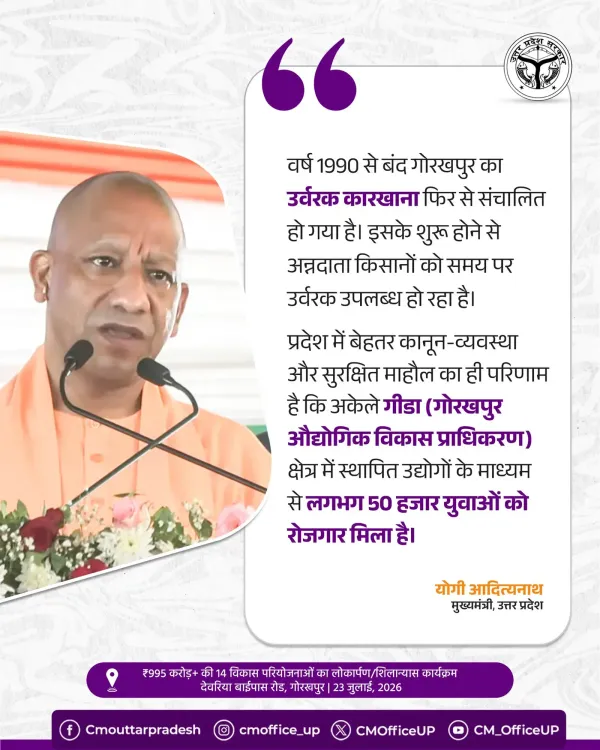
The Gorakhpur Fertilizer Plant, shuttered since 1990, has resumed production under CM Yogi Adityanath's tenure, ensuring timely urea supply for UP farmers. Industries in the GIDA zone have simultaneously created jobs for approximately 50,000 youth, reflecting the state's push to revive eastern UP's economy.
Key Takeaways
The Gorakhpur Fertilizer Plant , closed since 1990 , has been revived and is now supplying fertilizer to farmers in Uttar Pradesh .
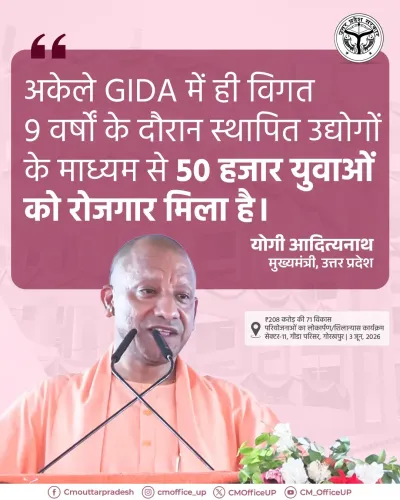
Industries in the GIDA (Gorakhpur Industrial Development Authority) zone have generated employment for approximately 50,000 youth .
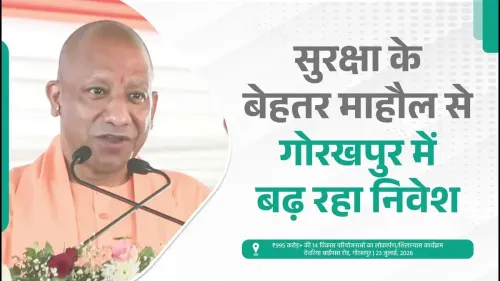
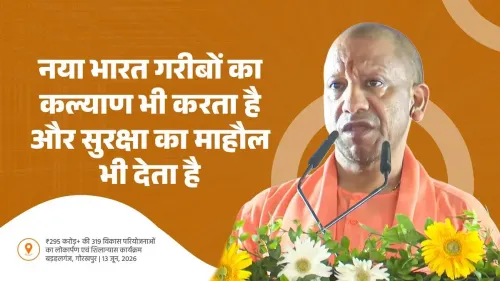
CM Yogi Adityanath credited improved law and order and a secure environment as key enablers of industrial growth.
The plant's revival traces back to a 2016 Union Cabinet decision to restart three closed urea units through Hindustan Urvarak Rasayan Ltd .
Timely fertilizer availability is expected to benefit farmers across Purvanchal during critical sowing seasons.
The Gorakhpur model — combining security, public-sector revival, and industrial investment — is being positioned as replicable across eastern Uttar Pradesh .
The Chief Minister's Office of Uttar Pradesh, quoting Chief Minister Yogi Adityanath, announced on Thursday, 23 July 2026 that the Gorakhpur Fertilizer Plant — shut since 1990 — has resumed operations, and that industries in the Gorakhpur Industrial Development Authority (GIDA) zone have generated employment for approximately 50,000 youth in the region.
Context
The post, attributed directly to CM Yogi Adityanath, states: 'वर्ष 1990 से बंद गोरखपुर का उर्वरक कारखाना फिर से संचालित हो गया है' ('The Gorakhpur fertilizer factory, shut since 1990, has been operationalised once again'). The Chief Minister credited improved law and order and a secure environment in the state as the enabling conditions for both the plant's revival and the industrial growth in GIDA.
The plant's restart means that 'अन्नदाता किसानों को समय पर उर्वरक उपलब्ध हो रहा है' — farmers, described as 'annadata' (providers of food), are now receiving fertilizer on time, addressing a long-standing supply bottleneck in eastern Uttar Pradesh.
Policy Backdrop
The revival of the Gorakhpur Fertilizer Plant has roots in a 2016 Union Cabinet decision that approved the restart of three closed urea manufacturing units through Hindustan Urvarak Rasayan Ltd (HURL), a joint venture between central public-sector enterprises. The Gorakhpur unit was among the three earmarked for revival under that initiative.
The plant's closure in 1990 had left Purvanchal — the eastern belt of Uttar Pradesh — dependent on fertilizer supplies transported from distant states, often causing delays during critical sowing seasons. Restoring domestic urea production capacity in the region directly addresses that vulnerability.
Since 2017, the state government under CM Yogi Adityanath has pursued a parallel strategy of reviving defunct public-sector units and attracting new investment to eastern districts, positioning improved security as a prerequisite for industrial confidence. New industrial corridors and MSME clusters form part of this broader effort to reduce the economic disparity between western and eastern Uttar Pradesh.
Stakeholders and Impact
Uttar Pradesh is India's most populous state and among its largest agricultural economies. Timely and adequate fertilizer availability has a direct bearing on crop yields, farmer income, and rural purchasing power across the state's vast agrarian hinterland.
On the employment front, the Chief Minister cited the GIDA zone specifically, noting that industries established there have provided jobs to approximately 50,000 young people. GIDA, the regional development authority for Gorakhpur, has been a focal point for investment attraction in Purvanchal, a region historically marked by high out-migration due to limited local employment.
The convergence of fertilizer supply restoration and industrial job creation in the same geography signals an attempt to reposition Gorakhpur as an economic anchor for eastern Uttar Pradesh, with benefits flowing to both the farming community and urban youth.
What's Next
Observers will watch whether the revived plant scales up urea output to meet the full demand of farmers in Purvanchal and adjoining districts during the upcoming kharif and rabi sowing cycles. The state government is also expected to announce further investment milestones within GIDA as it continues to market the region's improved industrial climate to domestic and foreign investors.
If the fertilizer plant sustains operations and GIDA's employment numbers grow, Gorakhpur could serve as a replicable model for reviving other legacy public-sector assets across the state — a theme likely to feature prominently in the government's economic narrative ahead of future electoral cycles.
Point of View
Both attributed to the law-and-order dividend of the post-2017 dispensation. By anchoring both achievements in Gorakhpur — the Chief Minister's own constituency — the messaging carries unmistakable political symbolism alongside its policy substance. The GIDA employment figure and the plant's restart together serve as tangible proof-points for the government's 'Purvanchal transformation' thesis, a recurring claim that will likely be stress-tested against ground-level data as elections approach. Whether the fertilizer plant can sustain output at scale, and whether GIDA's job numbers translate into stable, quality employment, will determine how durable this narrative proves to be.
NationPress
22 Oct 2026
Frequently Asked Questions
When did the Gorakhpur Fertilizer Plant reopen?
The Gorakhpur Fertilizer Plant has been revived after remaining closed since 1990 , as announced by the Chief Minister's Office of Uttar Pradesh on 23 July 2026 . The exact restart date was not specified in the official post.
How many jobs have been created in GIDA Gorakhpur?
According to CM Yogi Adityanath , approximately 50,000 youth have received employment through industries established in the GIDA (Gorakhpur Industrial Development Authority) zone.
Why was the Gorakhpur Fertilizer Plant closed for so long?
The Gorakhpur Fertilizer Plant was shut down in 1990 and remained non-operational for over three decades. Its revival was approved by the Union Cabinet in 2016 through Hindustan Urvarak Rasayan Ltd , a central public-sector joint venture.
How does the Gorakhpur plant revival help UP farmers?
The revived plant produces urea locally in Purvanchal , reducing dependence on supplies transported from distant states. This ensures farmers receive fertilizer on time during critical kharif and rabi sowing seasons.
What is GIDA and what is its role in Gorakhpur's development?
GIDA , the Gorakhpur Industrial Development Authority , is a regional body tasked with attracting industries and generating employment in eastern Uttar Pradesh . It has been a central pillar of the state government's strategy to reduce economic disparity in Purvanchal .