Arunachal Governor Urges APPSC to Uphold Integrity in Recruitment
Synopsis
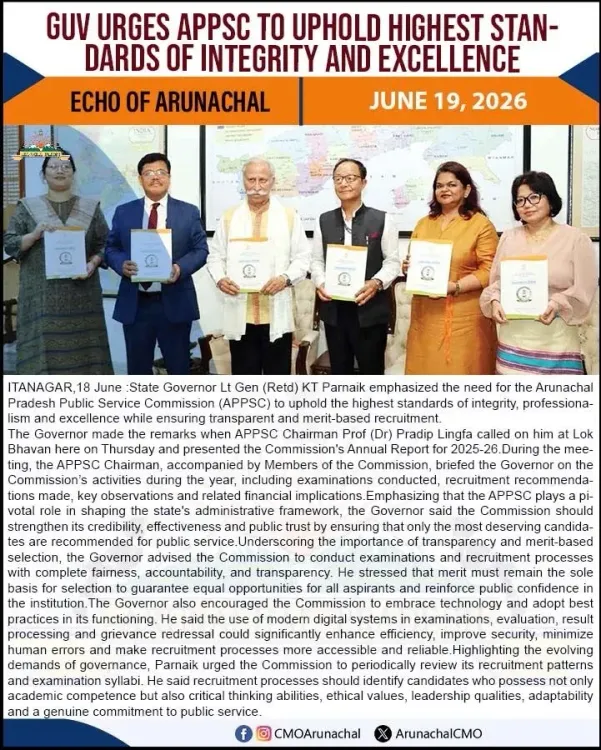
Governor K. T. Parnaik called on the Arunachal Pradesh Public Service Commission on June 19, 2026, to uphold integrity, transparency, and merit in recruitment, urging technology adoption to rebuild public trust — a signal from the state's highest constitutional office amid national concerns over examination irregularities.
Key Takeaways
Parnaik addressed the APPSC on June 19, 2026 , stressing integrity, transparency, and merit-based recruitment.
The Chief Minister's Office of Arunachal Pradesh amplified the Governor's remarks on its official X account.
The Governor called for leveraging technology and best practices to strengthen public trust and administrative excellence.
APPSC is the constitutional body responsible for civil services and government recruitment in Arunachal Pradesh .
The intervention aligns with a national pattern of governors and chief ministers pushing public service commissions toward technology-driven, tamper-proof processes.
Upcoming APPSC recruitment notifications and any announced examination reforms will be the first measure of follow-through.
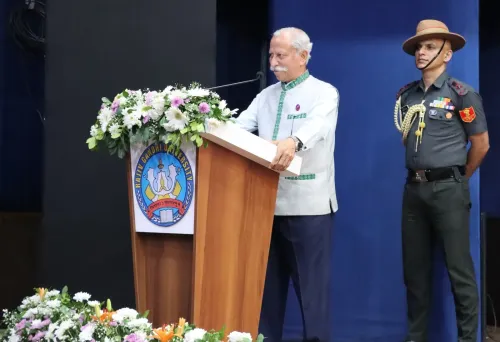
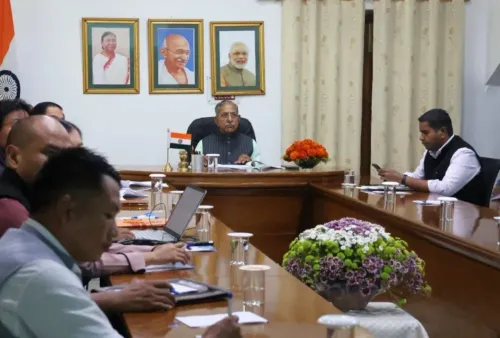
Governor K. T. Parnaik of Arunachal Pradesh on Friday, June 19, 2026, called on the Arunachal Pradesh Public Service Commission (APPSC) to maintain the highest standards of integrity, transparency, and merit-based recruitment, urging the body to leverage technology and best practices to strengthen public trust and administrative excellence. The Chief Minister's Office of Arunachal Pradesh shared the Governor's remarks on its official X account.
Context
Governor Parnaik's statement underscores persistent concerns about the credibility of state-level recruitment processes across India. The APPSC is the constitutional body mandated to conduct civil services examinations and fill key government posts in the state, making its integrity foundational to the quality of Arunachal Pradesh's public administration.
The Governor, who took charge in 2023 with a military background, has consistently focused on administrative discipline and governance reforms since assuming office. His emphasis on merit-based selection reflects a broader concern that recruitment irregularities, if unchecked, erode public confidence in state institutions.
Policy Backdrop
Indian states have been under sustained pressure since the 2010s to modernise public service commission processes through computer-based testing and e-governance tools. These measures are designed to reduce human intervention at sensitive stages of the examination cycle, minimising opportunities for malpractice.
Several northeastern states, along with others across the country, have faced high-profile allegations of paper leaks and irregularities in commission-conducted examinations. These controversies have prompted governors and chief ministers alike to issue repeated directives demanding transparency and technological upgrades in recruitment systems.
Stakeholders and Impact
The primary stakeholders are civil service aspirants across Arunachal Pradesh — thousands of young candidates who invest years preparing for APPSC examinations and whose futures depend on a fair, credible process. Any perception of bias or irregularity directly undermines their trust in the system.
State administration also has a direct stake: merit-based recruitment produces a more capable bureaucracy, which in turn improves service delivery in a geographically challenging, strategically sensitive border state. The Governor's remarks signal that the highest constitutional office in the state is actively watching APPSC's functioning.
What's Next
Attention will now turn to whether APPSC issues concrete notifications detailing technology-driven examination reforms or announces revised protocols for upcoming recruitment cycles. Performance audits and independent reviews of past examination processes may also follow as part of any credibility-restoration effort.
Governor Parnaik's public intervention, amplified through the Chief Minister's Office's official channel, raises the political stakes for APPSC leadership to demonstrate measurable improvements. The coming recruitment notifications from the Commission will serve as the first tangible test of whether the Governor's directives translate into institutional change.
Point of View
Routed through the Chief Minister's Office, is a deliberate constitutional signal — placing the weight of Raj Bhavan behind demands for APPSC reform at a moment when examination credibility crises have become a national political liability. By explicitly invoking technology and best practices, the Governor is nudging the Commission toward the kind of computer-based, end-to-end digital examination infrastructure that has become the benchmark for credible state recruitment. The intervention also subtly raises the accountability bar for the elected government: with the Governor on record, any future APPSC controversy in Arunachal Pradesh will invite sharper scrutiny of whether his directives were acted upon. For civil service aspirants in a remote, under-resourced border state, this is a rare moment of high-level institutional attention to a process that shapes their careers and the state's governance capacity.
NationPress
18 Sept 2026
Frequently Asked Questions
What did Arunachal Pradesh Governor K. T. Parnaik say about APPSC?
Governor K. T. Parnaik emphasised that APPSC must uphold the highest standards of integrity, transparency, and merit-based recruitment, and urged the Commission to use technology and best practices to strengthen public trust and administrative excellence.
What is APPSC and what does it do?
The Arunachal Pradesh Public Service Commission (APPSC) is the state's constitutional recruitment body, responsible for conducting civil services examinations and filling key government positions in Arunachal Pradesh.
Why is the Governor calling for APPSC reforms?
Multiple Indian states, including northeastern ones, have faced allegations of irregularities in public service commission examinations. The Governor's call reflects a broader national push to restore credibility in state-level recruitment through technology and transparent processes.
How has technology been used to reform public service commission exams in India?
Since the 2010s, Indian states have increasingly adopted computer-based testing and e-governance tools to reduce human intervention and minimise opportunities for malpractice in public service commission examinations.
What should we watch for after the Governor's statement on APPSC?
Key developments to watch include APPSC notifications on technology-driven examination reforms, revised recruitment protocols, and any performance audits or independent reviews of past examination processes in Arunachal Pradesh.