Goyal frames animal husbandry as income tool, not just tradition
Synopsis
Union Minister Piyush Goyal calls animal husbandry a vehicle for farmer income and village prosperity, outlining three priorities — livestock health, rising milk output, and full utilisation of cattle dung — anchored in the Rashtriya Gokul Mission and Gobar-Dhan scheme.
Key Takeaways
On October 30, 2026 , Minister Piyush Goyal posted a three-point animal husbandry vision: healthy animals, higher milk production, and full use of cattle dung.
He framed the sector as an income-generation and village-prosperity tool, not merely a cultural tradition.
The Rashtriya Gokul Mission (2014) underpins breed improvement and milk productivity goals he referenced.
The Gobar-Dhan scheme (2018) addresses dung utilisation by converting waste into biogas and organic fertiliser.
State-level execution — breed improvement coverage, veterinary reach, and biogas plant commissioning — will determine whether the stated goals translate into measurable rural income gains.
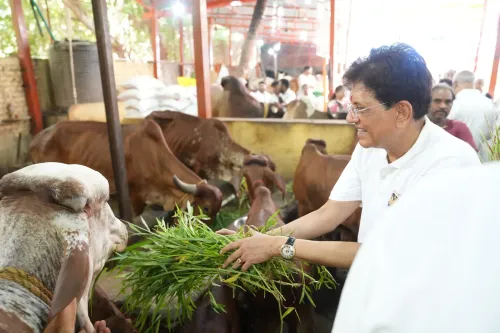
Healthy livestock, higher milk output, and zero-waste use of cattle dung — Union Commerce and Industry Minister Piyush Goyal has set out a three-point rural vision in a post on X on Friday, October 30, 2026, arguing that animal husbandry must be reimagined as a structured income driver for farmers rather than a practice inherited by habit.
Posting in Hindi, Goyal wrote: 'हमारा लक्ष्य साफ है, पशु स्वस्थ हों, दूध उत्पादन बढ़े और गोबर का भी पूरा उपयोग हो' ('Our goal is clear — animals must be healthy, milk production must rise, and cattle dung must be fully utilised'). He added that the government is turning animal husbandry from 'merely a tradition' into a means of raising farmer incomes and making villages prosperous.
From Gokul Mission to Gobar-Dhan: the policy spine behind the post
The vision Goyal articulates has a decade-long policy architecture beneath it. The Rashtriya Gokul Mission, launched in 2014, placed indigenous cattle breeds at the centre of a national drive to lift milk productivity — targeting not just output volumes but the genetic quality of the herd. Four years later, the Gobar-Dhan scheme (2018) closed the loop on waste, channelling cattle dung into biogas plants and organic fertiliser units, converting what was once a disposal problem into a rural energy and manure resource.
Together, the two schemes sketch exactly the triangle Goyal described: animal health, dairy yield, and dung utilisation. His post positions the livestock economy as an integrated value chain, not a series of disconnected welfare measures.
Why the framing of 'tradition vs. income' matters
The political signal in Goyal's language is precise. By explicitly contrasting 'tradition' with 'income', the minister is pushing back against the perception that cattle-related policy is driven primarily by cultural sentiment. The argument being made — publicly, on a major platform — is economic: animal husbandry as a productivity sector that can materially change what a rural household earns.
Dairy farming already anchors the livelihoods of tens of millions of rural families across India. Any measurable gain in milk output per animal, or a reliable secondary income stream from dung-based biogas and fertiliser, compounds quickly at that scale. The challenge, as sector observers note, lies in state-level execution — breed-improvement programmes, veterinary coverage in remote districts, and the actual commissioning of Gobar-Dhan biogas units against announced targets.
What the numbers will have to show
Goyal's post arrives as state governments prepare periodic progress reports on both schemes. Budgetary allocations for the dairy sector in the next cycle, and district-level data on biogas plant commissioning, will be the hardest test of whether the goal he describes as 'clear' is also on track. For now, the minister has drawn the line in public — healthy animals, more milk, no wasted dung — and invited the results to speak next.
India's livestock sector is not just a rural tradition waiting to be preserved. If the policy architecture holds, it is a supply chain waiting to be scaled.
Point of View
More measurable language of agricultural economics. This matters politically because it broadens the constituency for livestock investment beyond any one community to every dairy farmer watching input costs and milk prices. The explicit linkage of animal health, milk yield, and dung-to-energy in a single statement also signals that the government wants the Gokul Mission and Gobar-Dhan seen as a coherent value chain, not siloed welfare schemes. The real test will come in budget allocations and state-level delivery data — a public benchmark the minister has now set for himself.
NationPress
30 Oct 2026
Frequently Asked Questions
What did Piyush Goyal say about animal husbandry?
Goyal said the government's goal is clear: livestock should be healthy, milk production should rise, and cattle dung must be fully utilised. He argued that animal husbandry should be treated as a means of raising farmer incomes and making villages prosperous, not just as a tradition.
What is the Rashtriya Gokul Mission?
The Rashtriya Gokul Mission is a central government scheme launched in 2014 focused on conserving and developing indigenous cattle breeds to improve milk productivity across India.
What is the Gobar-Dhan scheme?
Gobar-Dhan, launched in 2018, is a government scheme that converts cattle dung into biogas and organic fertiliser, turning a waste product into a source of rural energy and income.
How does India plan to increase milk production?
India's central government has pursued milk production growth through breed-improvement programmes under the Rashtriya Gokul Mission, improved veterinary coverage, and incentivising dairy farmers — a strategy that Minister Goyal reiterated in his October 2026 statement.
Why is cattle dung economically important in India?
Cattle dung can be converted into biogas for cooking and electricity, and into organic fertiliser, providing rural households with an additional income stream and reducing dependence on chemical inputs — the core premise of the Gobar-Dhan scheme.