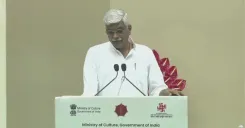
Goyal at Bloomberg Forum: Trust the Bedrock of Global Supply Chains
Synopsis
Commerce Minister Piyush Goyal joined Singapore's Deputy PM Gan Kim Yong, Canada's Trade Minister Maninder Sidhu, and DP World CEO Yuvraj Narayan at the Bloomberg New Economy Forum on October 14, arguing that Aatmanirbhar Bharat and trusted global partnerships are complementary, not contradictory, pillars of resilient supply chains.
Key Takeaways
Union Commerce Minister Piyush Goyal spoke at the Bloomberg New Economy Forum on October 14, 2026 in a session titled 'Self-Sufficiency Scramble.' Co-panelists included Gan Kim Yong (Singapore's Deputy PM and Trade Minister), Maninder Sidhu (Canada's International Trade Minister), and Yuvraj Narayan (Global CEO, DP World).
Goyal positioned Aatmanirbhar Bharat — launched by PM Modi in May 2020 — as a foundation for both domestic capacity and trusted global engagement, not a retreat from trade.
The panel emphasised that trust is the non-negotiable prerequisite for building supply chains resilient enough to survive technology-driven disruption.
India-Canada trade negotiations and India-Singapore economic cooperation were both directly represented at the forum table.
DP World's presence underscored the private-sector logistics dimension of India's supply-chain strategy.
At the Bloomberg New Economy Forum on Wednesday, October 14, 2026, Union Commerce and Industry Minister Piyush Goyal stepped into a session titled 'Self-Sufficiency Scramble' and made India's position unmistakably clear: Aatmanirbhar Bharat is not a wall — it is a foundation, one that must rest on trusted global partnerships to hold.
A high-stakes panel, a pointed message
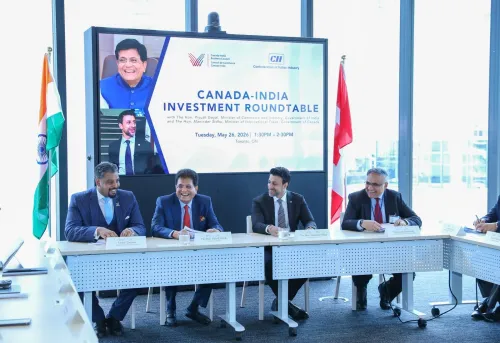
Goyal shared the stage with three figures whose presence alone signalled the forum's diplomatic weight. Gan Kim Yong, Deputy Prime Minister and Minister for Trade and Industry of Singapore — a country that anchors Southeast Asian logistics — sat alongside Maninder Sidhu, Canada's Minister of International Trade, at a moment when India-Canada trade negotiations remain very much a live conversation. Completing the panel was Yuvraj Narayan, Global CEO of DP World, the ports-and-logistics giant with deep infrastructure stakes across the Indian subcontinent.
The minister's message, as he framed it, was that the panel collectively 'underlined the critical need for trust in global collaborations to be able to build resilient supply chains.' In a world where technology is increasingly the driver of economic fortune, he argued, that resilience must be designed to 'leverage the future for the benefit of all.'
Aatmanirbhar Bharat's dual identity
Launched by Prime Minister Narendra Modi in May 2020 against the backdrop of COVID-19's savage disruption to global supply lines, Aatmanirbhar Bharat was built on a simple premise: India could not afford to be a passive link in chains it did not help forge. The initiative pushed hard for domestic manufacturing capacity and reduced import dependence.
But the policy has always carried a second, less-discussed dimension — active global engagement through free-trade agreements, investment corridors, and multilateral forums. Goyal's Bloomberg appearance crystallised exactly that duality: self-reliance at home, trusted partnerships abroad. The question the session wrestled with is the one every major economy faces right now — how do you build sufficient without becoming isolated?
Why Singapore, Canada, and DP World in the same room matters
Singapore is already bound to India by the Comprehensive Economic Cooperation Agreement and serves as a critical financial and logistics gateway to ASEAN markets. Canada brings commodity depth, technology investment appetite, and a large Indian diaspora that quietly oils bilateral trade. DP World, meanwhile, is not an abstract logistics firm — it operates ports and warehouses that physically touch Indian trade flows every day.
That this particular combination of voices converged at a Bloomberg forum framed around 'self-sufficiency' is itself the story. The message from the panel: supply-chain resilience in a tech-driven world is not a solo project — it is, by design, a coalition effort built on verifiable trust between partners.
India's trade architecture is being rebuilt in real time. What is decided at forums like this one — who sits at which table, and what principles they agree to anchor — will shape which supply chains survive the next disruption.
Point of View
New Delhi is signalling that its industrial policy is a complement to, not a competitor with, the supply-chain diversification agendas of Singapore, Canada, and major logistics players. The choice of co-panelists is not accidental: Singapore anchors ASEAN access, Canada represents Western-aligned commodity and tech capital, and DP World speaks for the private infrastructure that actually moves goods. Together, they project an India that wants to be the indispensable node in tomorrow's resilient supply chains — not merely a large domestic market turning inward.
NationPress
14 Oct 2026
Frequently Asked Questions
What did Piyush Goyal say at the Bloomberg New Economy Forum 2026?
Commerce Minister Piyush Goyal spoke at the Bloomberg New Economy Forum's 'Self-Sufficiency Scramble' session on October 14, 2026, arguing that India's Aatmanirbhar Bharat policy and trusted global partnerships are mutually reinforcing pillars of resilient supply chains.
Who were the panelists at the Bloomberg Forum session with Piyush Goyal?
Goyal's co-panelists were Gan Kim Yong (Singapore's Deputy Prime Minister and Trade Minister), Maninder Sidhu (Canada's International Trade Minister), and Yuvraj Narayan (Global CEO of DP World).
What is Aatmanirbhar Bharat and how does it relate to global trade?
Aatmanirbhar Bharat, launched by Prime Minister Narendra Modi in May 2020, is India's self-reliance initiative to boost domestic manufacturing. The government has consistently framed it as complementary to global trade partnerships rather than a protectionist policy.
What is DP World's role in India's supply chain strategy?
DP World is a major global ports and logistics operator with significant infrastructure investments in India. Its CEO Yuvraj Narayan's presence at the forum highlighted the private-sector logistics dimension of India's supply-chain resilience push.
What is the current status of India-Canada trade talks?
India-Canada trade negotiations are ongoing. The participation of Canada's International Trade Minister Maninder Sidhu alongside Goyal at the Bloomberg Forum signals continued diplomatic and commercial engagement between the two countries.