Goyal Chairs Board of Trade Meet on Export Push
Synopsis
Union Commerce Minister Piyush Goyal chaired a Board of Trade meeting on 3 July 2026 with states, industry and officials, focusing on logistics, trade costs, district-level exports, and Centre-State collaboration to make India a global trade and manufacturing hub.
Key Takeaways
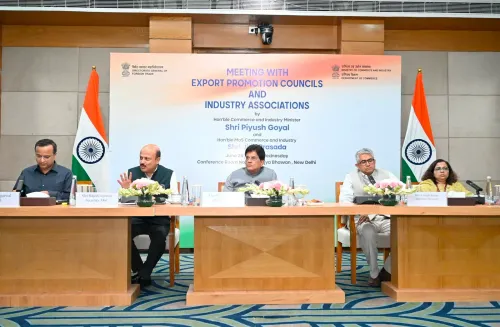
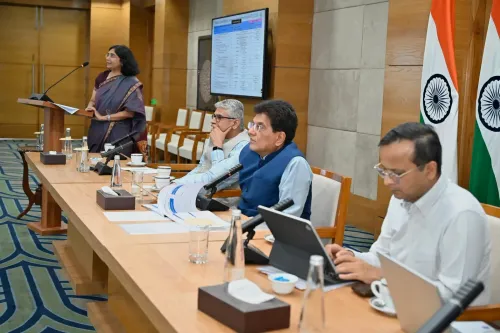
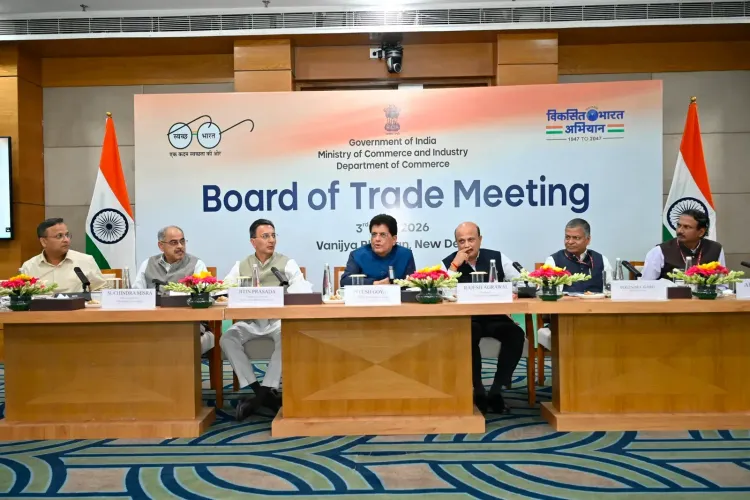
Union Commerce and Industry Minister Piyush Goyal chaired a Board of Trade meeting on 3 July 2026 with States, UTs, industry leaders, trade bodies, and senior officials.
Key discussion themes included improving logistics and supply chains, reducing trade costs, and unlocking district-level export potential.
The meeting emphasised stronger Centre-State collaboration to create opportunities for enterprises and MSMEs .
The Modi government's PLI schemes (across 14 sectors ), Make in India initiative, and FTAs with partners such as the UAE and Australia were cited as enabling frameworks.
The Foreign Trade Policy 2023-28 provides the overarching roadmap, with district-level export promotion a key focus area.
Follow-up state-level action plans on logistics and export facilitation are expected as the next step.
Union Commerce and Industry Minister Piyush Goyal on Friday, 3 July 2026 chaired a Board of Trade meeting that brought together representatives from States and Union Territories, industry leaders, trade bodies, and senior government officials to deliberate on accelerating India's export momentum and strengthening its manufacturing ecosystem.
Context
The Board of Trade is an advisory body under the Ministry of Commerce and Industry that serves as a platform for structured dialogue between the Centre, state governments, and the private sector on trade strategy. At the 3 July meeting, discussions centred on improving logistics and supply chains, reducing trade costs, unlocking district-level export potential, and further enhancing ease of doing business. Minister Goyal underlined the importance of stronger Centre-State collaboration to create greater opportunities for enterprises and MSMEs.
In a post on X, Goyal described the session as 'productive' and stressed the need to 'expand the global footprint of Indian businesses and accelerate India's journey towards becoming a leading global trade and manufacturing hub.'
Policy Backdrop
The meeting sits within a broader reform arc that began with the launch of the Make in India initiative in September 2014, which sought to position the country as a global manufacturing destination. This was followed by the rollout of Production Linked Incentive (PLI) schemes from 2020 across 14 sectors, designed to attract investment and raise export volumes by incentivising domestic manufacturing at scale.
The Foreign Trade Policy 2023-28 added a district-level dimension to export promotion, pushing states to identify and develop local export clusters beyond traditional hubs. Free Trade Agreements — including those concluded with the UAE and Australia — have opened preferential market access for Indian goods, and the government has framed these FTAs as levers to integrate Indian firms into global value chains.
Stakeholders and Impact
MSMEs stand at the centre of the policy conversation, given their role as the backbone of India's manufacturing base and their potential to diversify the country's export basket. State governments are key implementation partners, particularly for logistics upgrades and district-level export facilitation, areas where ground-level action determines how effectively national policy translates into actual trade volumes.
Trade bodies representing sectors ranging from textiles and engineering goods to pharmaceuticals and electronics have consistently called for lower logistics costs and simpler compliance procedures — themes that featured prominently in the Board of Trade deliberations. Improved supply-chain efficiency is widely seen as a prerequisite for Indian exporters to remain price-competitive in global markets.
What's Next
Attention will now turn to follow-up action plans at the state level, particularly on logistics infrastructure and export facilitation measures. The Foreign Trade Policy 2023-28 implementation roadmap is expected to be a reference point for states as they draw up their own export strategies in consultation with the Centre. Any concrete announcements on revised trade-cost reduction targets or new district-level export clusters will be closely watched by industry stakeholders and MSME associations across the country.
Point of View
With federal coordination emerging as the central mechanism. By explicitly linking FTAs, PLI schemes, and district-level export clusters in a single forum, the Commerce Ministry is attempting to convert macro-level trade agreements into micro-level economic activity. The emphasis on MSME integration into global value chains reflects an acknowledgement that India's export base needs to broaden beyond large corporates to achieve durable growth. This meeting is consistent with a pattern of high-visibility ministerial engagement designed to signal policy seriousness to both domestic industry and international trading partners.
NationPress
2 Oct 2026
Frequently Asked Questions
What is the Board of Trade in India?
The Board of Trade is an advisory body under India's Ministry of Commerce and Industry that brings together state governments, industry representatives, trade bodies, and senior officials to deliberate on trade policy and export strategy.
What was discussed at the Board of Trade meeting on 3 July 2026?
The meeting chaired by Minister Piyush Goyal focused on improving logistics and supply chains, reducing trade costs, unlocking district-level export potential, enhancing ease of doing business, and fostering Centre-State collaboration to support enterprises and MSMEs.
How do India's FTAs help exporters?
India's Free Trade Agreements — including those with the UAE and Australia — provide preferential market access for Indian goods, helping exporters compete on price and expand into new markets that were previously subject to higher tariffs.
What is the Foreign Trade Policy 2023-28?
The Foreign Trade Policy 2023-28 is India's medium-term trade roadmap that emphasises ease of doing business, district-level export promotion, and diversification of India's export basket beyond traditional sectors and regions.
How do PLI schemes support India's export goals?
Production Linked Incentive schemes, rolled out from 2020 across 14 sectors, provide financial incentives to manufacturers who meet production and export targets, aiming to attract investment and raise India's share in global trade.