Piyush Goyal Reviews Export Strategy with EPCs and Industry Bodies
Synopsis
Union Commerce Minister Piyush Goyal chaired a review meeting with Export Promotion Councils and industry associations on 24 June 2026, covering MSME support, FTA utilisation, deep-tech exports, and India's integration into global value chains under the Brand India framework.
Key Takeaways
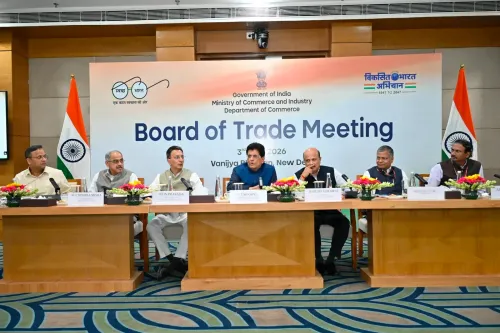
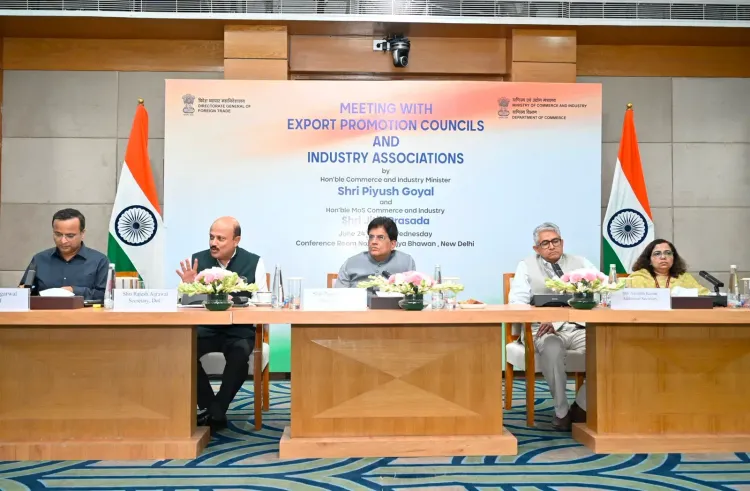
Piyush Goyal held a meeting with Export Promotion Councils (EPCs) and industry associations on 24 June 2026 to review India's export strategy.
Key agenda items included strengthening support for MSMEs , maximising gains from Free Trade Agreements , and improving export facilitation.
The minister emphasised fostering innovation and deep-tech capabilities as part of India's export diversification push.
Expanding India's role in global value chains and reinforcing Brand India were stated as central objectives.
The meeting aligns with the Foreign Trade Policy 2023 and broader initiatives including PLI schemes and the Make in India programme.
Upcoming EU trade negotiations and the next Foreign Trade Policy review will be key milestones to watch.
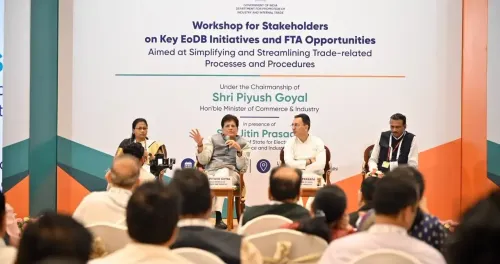
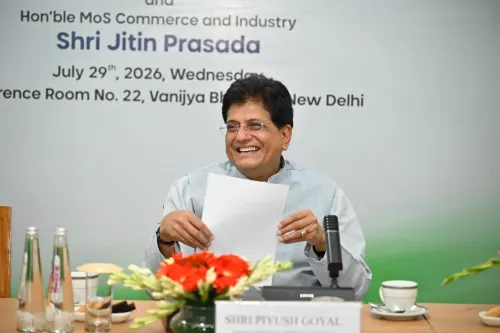
Union Commerce and Industry Minister Piyush Goyal on Wednesday, 24 June 2026 chaired a meeting with Export Promotion Councils (EPCs) and industry associations to review strategies aimed at accelerating India's export growth, market diversification, and global trade competitiveness.
Context
The minister described the engagement as 'productive', with discussions spanning support for MSMEs, maximising opportunities through Free Trade Agreements (FTAs), fostering innovation and deep-tech capabilities, improving export facilitation, and expanding India's role in global value chains. The overarching goal, as stated by Goyal, was to 'further strengthen Brand India' on the world stage.
Export Promotion Councils are sector-specific bodies set up to provide market intelligence, policy advocacy, and direct support to Indian exporters. Their periodic review meetings with the Commerce Ministry are a key mechanism for translating trade policy into on-the-ground action.
Policy Backdrop
The meeting sits within a well-established policy architecture. The Foreign Trade Policy 2023 set out ambitious targets for export growth, market diversification, and deeper integration into global value chains. Complementing this, Production Linked Incentive (PLI) schemes, rolled out from 2020 across 14 sectors, were designed to boost domestic manufacturing capacity and export competitiveness.
India's bilateral trade push has also gathered pace. The Comprehensive Economic Partnership Agreement (CEPA) with the UAE, signed in February 2022, was an early milestone in a broader FTA strategy aimed at lowering tariffs and unlocking new markets. The Make in India initiative, launched in September 2014, laid the foundational vision of positioning India as a global manufacturing and export hub — a thread that runs through each of these subsequent policies.
The emphasis on deep-tech and high-value sectors reflects a deliberate shift away from commodity-led export growth toward technology-intensive industries, where India's services and engineering talent can command premium positioning in global markets.
Stakeholders and Impact
MSMEs stand as the most directly affected constituency. They account for a substantial share of India's merchandise exports but often lack the scale and resources to navigate complex international markets independently. Strengthened EPC support, combined with preferential access under FTAs, could meaningfully lower barriers for smaller exporters.
Industry associations participating in the review bring sectoral intelligence on bottlenecks — ranging from logistics and customs clearance to standards compliance in destination markets. Their input shapes the facilitation measures the ministry prioritises. For global buyers and trading partners, the meeting signals continued institutional commitment to supply-chain reliability and 'Brand India' positioning.
What's Next
Attention will now turn to the progress of pending trade negotiations, most notably with the European Union, where talks on a comprehensive trade agreement have been a long-running priority. The next annual review of the Foreign Trade Policy will be an important marker for whether the strategies discussed on 24 June translate into measurable export gains.
With global trade routes under pressure from geopolitical realignments and supply-chain restructuring, India's ability to deepen its role in global value chains — and to position MSMEs and deep-tech firms as credible export players — will be central to sustaining the momentum behind its trade ambitions.
Point of View
Ministry-led effort to convert India's FTA pipeline and PLI investments into tangible export gains — a priority that has grown more urgent as global supply chains reorganise post-pandemic. By bringing EPCs and industry associations into a single review forum, Goyal is reinforcing a stakeholder-driven model for trade policymaking that has been a hallmark of the Commerce Ministry's approach since 2014. The explicit focus on deep-tech and global value chains signals an ambition to move India up the export value ladder, beyond its traditional strengths in textiles, pharmaceuticals, and IT services. The political salience of MSME export support should not be underestimated — it connects trade policy directly to employment and small-business constituencies that matter electorally.
NationPress
23 Sept 2026
Frequently Asked Questions
What was discussed at Piyush Goyal's meeting with Export Promotion Councils?
The meeting covered strategies for market diversification, MSME export support, utilisation of Free Trade Agreements, deep-tech innovation, export facilitation improvements, and expanding India's presence in global value chains.
What are Export Promotion Councils and what do they do?
Export Promotion Councils are sector-specific bodies set up by the Indian government to promote exports, provide market intelligence, assist exporters with compliance, and liaise between the industry and the Commerce Ministry.
How do Free Trade Agreements help Indian exporters?
FTAs lower or eliminate tariffs on Indian goods and services in partner countries, giving Indian exporters a price advantage and broader market access compared to competitors without such agreements.
What is India's Foreign Trade Policy 2023?
The Foreign Trade Policy 2023 is a framework released by the Commerce Ministry outlining India's export targets, market diversification goals, and strategies for integrating into global value chains, with a focus on raising India's share in world trade.
Why is MSME export support a priority for India's trade policy?
MSMEs contribute significantly to India's manufacturing output and export earnings but often face challenges in accessing international markets. Targeted support helps them leverage FTAs and global demand, linking trade growth to broader employment and economic development goals.