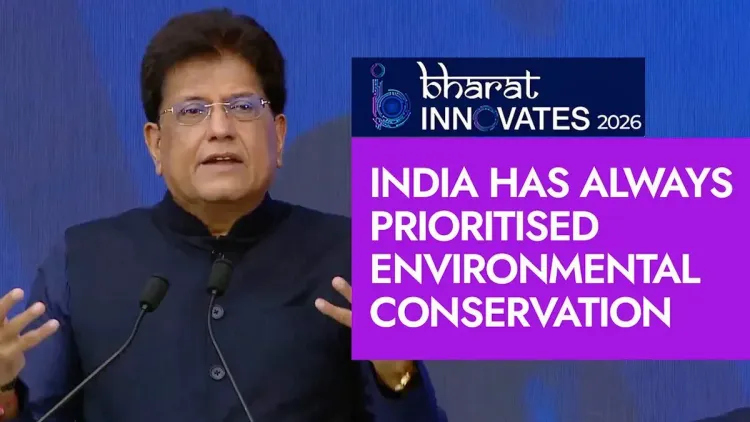
Piyush Goyal Highlights India's Conservation Ethos
Synopsis
Union Commerce Minister Piyush Goyal on June 16, 2026, declared that environmental conservation is integral to India's ethos. The remark connects India's civilisational traditions with its formal climate commitments under the NAPCC and Paris Agreement, and signals the ministry's growing role in green trade and industrial policy.
Key Takeaways
Piyush Goyal , Union Commerce and Industry Minister, posted on June 16, 2026 that environmental conservation is 'integral to India's ethos.' India's National Action Plan on Climate Change , launched in 2008 , remains the cornerstone of its domestic climate architecture.
India updated its Nationally Determined Contributions under the Paris Agreement in 2022 , targeting lower emission intensity and higher renewable capacity.
The International Solar Alliance , co-launched in 2015 , reflects India's leadership in global solar deployment.
The Commerce Ministry's mandate increasingly overlaps with climate goals through green manufacturing incentives and trade-linked sustainability standards.
Analysts will watch for new sustainability clauses in ongoing free-trade negotiations and progress on the National Green Hydrogen Mission .
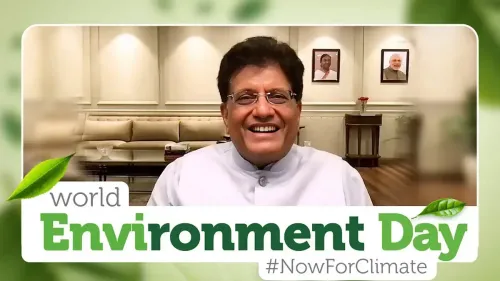
Union Commerce and Industry Minister Piyush Goyal on Tuesday, June 16, 2026, reaffirmed that environmental conservation is deeply rooted in India's civilisational values, sharing the message on his official X account in the context of ongoing global climate conversations.
Context
In his post, Goyal stated: 'Environmental conservation has always been integral to India's ethos.' The remark, though brief, carries weight coming from a senior cabinet minister who sits at the intersection of trade policy and industrial growth — two domains increasingly scrutinised for their environmental footprint. As Leader of the House in the Rajya Sabha, Goyal's public positions often signal the government's broader messaging priorities.
India has historically grounded its climate arguments in cultural philosophy — from the Atharvaveda's reverence for nature to Mahatma Gandhi's ethic of minimal consumption. This framing has become a recurring feature of Indian diplomacy at multilateral climate forums.
Policy Backdrop
India's formal climate architecture stretches back to the National Action Plan on Climate Change (NAPCC), launched in 2008, which embedded eight national missions — covering solar energy, energy efficiency, water, and sustainable agriculture — into the national development planning process. The plan was among the first comprehensive climate frameworks adopted by a major developing economy.
India ratified the Paris Agreement in 2016 and updated its Nationally Determined Contributions (NDCs) in 2022, committing to reduce the emission intensity of its GDP and expand its non-fossil fuel energy capacity. Separately, the International Solar Alliance, co-launched in 2015, positioned India as a global leader in promoting solar deployment across tropical nations.
The Commerce and Industry Ministry's role in this architecture has grown steadily. Green manufacturing incentives, sustainability clauses in trade negotiations, and export standards aligned with the European Union's carbon border adjustment mechanism have all drawn the ministry into climate policy territory.
Stakeholders and Impact
The minister's statement resonates across several constituencies. Renewable energy firms and green hydrogen developers see cultural and political endorsement of conservation as a tailwind for policy support. Manufacturing exporters — particularly those facing tightening environmental standards in key markets — benefit when senior ministers publicly align industrial ambition with ecological responsibility.
Agricultural communities, among the most vulnerable to climate variability, are also central stakeholders. India's conservation ethos, when translated into policy, has historically included soil health, water conservation, and climate-resilient crop programmes that directly affect rural livelihoods.
At the diplomatic level, such statements reinforce India's positioning in multilateral forums — that its climate commitments are not merely transactional but rooted in a long-standing civilisational relationship with nature.
What's Next
Observers will watch for whether this statement precedes any concrete policy announcement — such as new sustainability provisions in free-trade agreements currently under negotiation, or an update on the National Green Hydrogen Mission. The convergence of trade and climate policy is expected to intensify as India pursues deals with the European Union and other partners that carry stringent environmental conditionalities.
For now, Goyal's post sets a public tone: that India's engagement with environmental goals draws from a well far deeper than any single international treaty.
Point of View
Not just a policy actor. Coming from the Commerce and Industry portfolio, the statement also signals that green credentials are becoming a trade-diplomacy asset, particularly as the EU's carbon border mechanism tightens. The timing, absent a specific trigger, suggests the government is sustaining a steady drumbeat of climate messaging ahead of potential treaty milestones or trade-deal announcements. It is a low-cost, high-signal move that costs nothing domestically while reinforcing India's image abroad.
NationPress
15 Sept 2026
Frequently Asked Questions
What did Piyush Goyal say about the environment?
Piyush Goyal posted on June 16, 2026, that 'environmental conservation has always been integral to India's ethos,' linking the country's cultural traditions to its climate commitments.
What is India's National Action Plan on Climate Change?
The National Action Plan on Climate Change, launched in 2008, is India's primary framework for integrating climate goals into national development, covering eight missions on solar energy, water, efficiency, and sustainable agriculture.
Has India signed the Paris Agreement?
Yes. India ratified the Paris Agreement in 2016 and updated its Nationally Determined Contributions in 2022, committing to reduce GDP emission intensity and expand non-fossil fuel energy capacity.
What is the International Solar Alliance?
The International Solar Alliance, co-launched by India in 2015, is a multilateral initiative to promote solar energy deployment among tropical and developing nations.
How does India's Commerce Ministry relate to climate policy?
The Commerce and Industry Ministry intersects with climate policy through green manufacturing incentives, export standards, and sustainability clauses being negotiated in free-trade agreements with major partners.