Gujarat to add STATCOM at 7 substations after Gir Somnath success
Synopsis
Gujarat is scaling a quiet grid revolution. After becoming the first state in India to deploy STATCOM technology in 2019, GETCO is now rolling out seven more installations — including at the high-profile Dholera-2 substation — targeting the voltage instability that has long plagued agricultural regions. It is a technical bet that could set a national template for dynamic grid compensation.
Key Takeaways
Gujarat will install STATCOM systems at seven more substations , the state government announced on 22 May 2025 .
GETCO commissioned India's first state-level STATCOM — ±120 MVAR — at the 220 kV Timbdi substation , Gir Somnath , on 5 March 2019 .
The new installations will carry ±125 MVAR capacity and cover substations at Tharad, Diodar, Sagpara, Kheralu, Kukma, Dhrangadhra , and the upcoming 400 kV Dholera-2 substation.
Voltage at Timbdi previously swung between 190 kV and 245 kV ; STATCOM now manages this in real time.
The expansion is designed to address grid stress caused by high agricultural electricity demand across the state.
Gujarat is set to install advanced Static Synchronous Compensator (STATCOM) systems at seven more substations across the state, the state government announced on Friday, 22 May, building on the proven success of the technology first deployed at the Timbdi substation in Gir Somnath district. The expansion is aimed at reinforcing voltage stability and ensuring uninterrupted electricity supply, particularly in regions with high agricultural demand.
Background: India's First State STATCOM
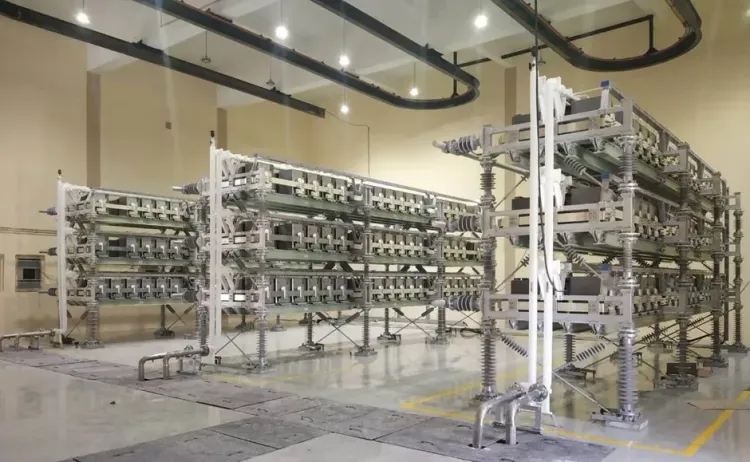
Gujarat's tryst with STATCOM technology began on 5 March 2019, when Gujarat Energy Transmission Corporation Limited (GETCO) — operating under the state's Energy and Petrochemicals Department — commissioned a ±120 MVAR STATCOM at the 220 kV Timbdi substation. With that commissioning, GETCO became the first state transmission utility in India to deploy STATCOM technology, marking a significant milestone in the country's grid modernisation journey.
The Timbdi substation had long struggled with persistent voltage instability. The absence of nearby power generation sources and a single-circuit transmission link meant voltage levels fluctuated between 190 kV and 245 kV — dropping to 190–200 kV during peak demand and spiking to 235–245 kV during the low-demand monsoon season. Conventional compensators such as capacitors and reactors, which offer only fixed support, proved insufficient to handle such rapid swings.
How STATCOM Works
Described by the state government as a 'smart voltage stabiliser', the STATCOM system continuously monitors grid conditions in real time and instantly responds to fluctuations by either supplying or absorbing reactive power. Unlike static compensators, it dynamically regulates the power factor, curbs over-voltage, and prevents sudden voltage drops under varying load conditions.
Officials said the technology has measurably reduced the load on the transmission network, lowered power losses, and improved equipment safety at the Timbdi site. Consumers in Gir Somnath, Junagadh, Amreli, and surrounding areas — particularly farmers — have benefited from more reliable and better-quality electricity supply for both rural and industrial use.
The Seven New Installations
Following the Timbdi project's success, the government has proposed ±125 MVAR capacity STATCOM systems at six existing 220 kV substations — located at Tharad, Diodar, Sagpara, Kheralu, Kukma, and Dhrangadhra — as well as at the upcoming 400 kV Dholera-2 substation, bringing the total new installations to seven.
Officials said the need for STATCOM across these locations stems from large fluctuations in electricity demand, especially in the agricultural sector, which make maintaining voltage stability and power quality difficult in several regions of the state.
Policy Context and State Ambitions
Officials attributed Gujarat's broader energy transformation to reforms introduced under then Chief Minister and current Prime Minister Narendra Modi, noting that the state had moved from facing power shortages to becoming self-reliant in the energy sector. Initiatives such as the 'Jyotigram Yojana' — which secured a 24-hour electricity supply in rural areas — were cited as models emulated by other states.
The current expansion is being pursued under Chief Minister Bhupendra Patel, as the state continues to scale and modernise its power infrastructure. The government stated that the seven new STATCOM installations would further strengthen Gujarat's grid and support reliable, quality electricity supply statewide.
Point of View
Built for predictable industrial loads, is buckling under the irregular demand patterns of agriculture-heavy states. The fact that GETCO pioneered this technology in 2019 and is only now scaling it to seven sites suggests the pace of adoption remains cautious relative to the scale of the problem. With the Dholera-2 substation — a flagship industrial corridor node — on the list, the government is also signalling that next-generation industrial zones will be built on a more resilient grid foundation. Other states facing similar agricultural voltage stress would do well to watch Gujarat's execution closely.
NationPress
6 Oct 2026
Frequently Asked Questions
What is STATCOM technology and why is Gujarat installing it?
STATCOM, or Static Synchronous Compensator, is a real-time grid device that supplies or absorbs reactive power to maintain voltage stability. Gujarat is expanding its use because large fluctuations in electricity demand — especially from the agricultural sector — have made it difficult to maintain stable voltage levels across several regions of the state.
Where will the seven new STATCOM systems be installed in Gujarat?
The seven new installations are planned at six existing 220 kV substations — Tharad, Diodar, Sagpara, Kheralu, Kukma, and Dhrangadhra — and at the upcoming 400 kV Dholera-2 substation. Each new unit will have a capacity of ±125 MVAR.
When was Gujarat's first STATCOM commissioned and what was its impact?
GETCO commissioned Gujarat's first STATCOM — with a capacity of ±120 MVAR — at the 220 kV Timbdi substation in Gir Somnath district on 5 March 2019, making it the first state transmission utility in India to use the technology. The installation resolved persistent voltage fluctuations that had ranged between 190 kV and 245 kV, improving power reliability for consumers in Gir Somnath, Junagadh, and Amreli districts.
Why was conventional equipment like capacitors insufficient at Timbdi?
Capacitors and reactors provide only fixed reactive power support and cannot respond dynamically to rapid demand changes. At Timbdi, the absence of nearby generation sources and a single-circuit transmission link caused voltage swings too fast and wide for static equipment to manage, necessitating a dynamic compensation system like STATCOM.
Who oversees Gujarat's STATCOM programme?
The programme is executed by Gujarat Energy Transmission Corporation Limited (GETCO), which functions under the state's Energy and Petrochemicals Department. The current expansion is being pursued under Chief Minister Bhupendra Patel's administration.