Gujarat CM Patel meets Western Naval Command chief in Gandhinagar
Synopsis
Vice Admiral Sanjay Vatsyayan, chief of India's Western Naval Command, met Gujarat CM Bhupendra Patel in Gandhinagar to brief him on naval operations securing Gujarat's coastline, the Arabian Sea, and critical global chokepoints including the Strait of Hormuz and Bab-el-Mandeb.
Key Takeaways
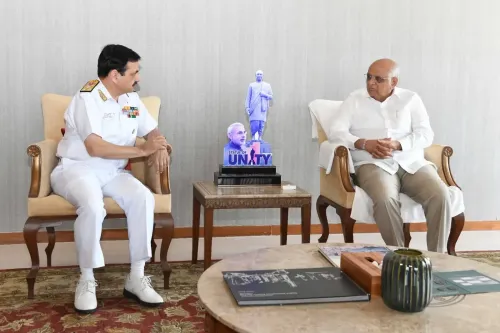
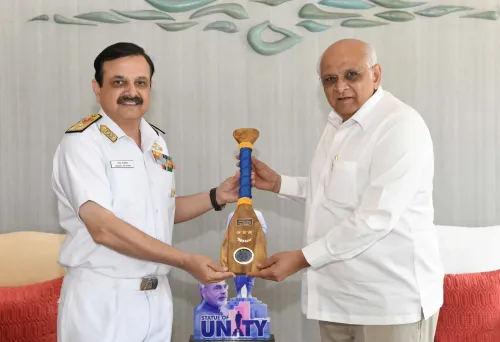
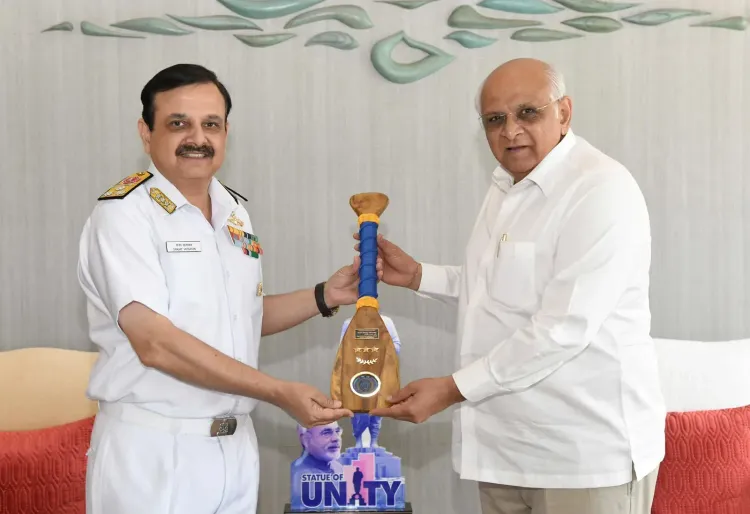
Vice Admiral Sanjay Vatsyayan , Flag Officer Commanding-in-Chief of the Western Naval Command, paid a courtesy visit to CM Bhupendra Patel in Gandhinagar on 21 October 2026 .
The Western Naval Command's area covers the Arabian Sea, Strait of Hormuz, Bab-el-Mandeb, Suez Canal, Mozambique Channel, and Cape of Good Hope .
Gujarat has India's longest coastline at approximately 1,600 km , bordering the Arabian Sea and proximate to sensitive maritime boundaries.
The meeting focused on three pillars: protecting the western coastline , securing trade and energy routes , and defending India's maritime borders .
State-navy coordination of this kind is part of India's post-2008 coastal security architecture , established after the Mumbai attacks exposed surveillance gaps.
Arabia's chokepoints, Gujarat's 1,600-kilometre coastline, and the lanes that carry India's energy lifeline were on the table when Vice Admiral Sanjay Vatsyayan, Flag Officer Commanding-in-Chief of the Indian Navy's Western Naval Command, called on Chief Minister Bhupendra Patel in Gandhinagar on Wednesday, 21 October 2026.
The Chief Minister's Office of Gujarat confirmed the courtesy visit, noting that Vice Admiral Vatsyayan briefed CM Patel on the Indian Navy's ongoing activities related to the security of Gujarat's strategically vital coastline. The state's seaboard, at roughly 1,600 km, is the longest of any Indian state — a corridor of ports, petrochemical hubs, and defence infrastructure that makes it a first line of concern for any western-seaboard threat assessment.
From the Strait of Hormuz to the Cape of Good Hope
The Western Naval Command's remit is strikingly broad. Under the Flag Officer Commanding-in-Chief's leadership, the command covers the entire Arabian Sea, the western Indian Ocean, the Strait of Hormuz, the Bab-el-Mandeb Strait, the Suez Canal, the Mozambique Channel, and the Cape of Good Hope — every critical choke-point through which a large share of India's oil imports and export cargo must pass.
That geography is not academic. Disruption at any one of these nodes — whether by state or non-state actors — directly threatens India's energy security and trade revenues. The Western Naval Command is the institution standing between those chokepoints and Indian economic stability.
Gujarat's coastal security after the 2008 reforms
The architecture for this kind of state-navy coordination was cemented after the 2008 Mumbai attacks, when a catastrophic lapse in coastal surveillance exposed the gap between civilian policing and naval operations. From 2009 onwards, India built layered coastal security mechanisms requiring state governments and the Navy to actively synchronise — sharing intelligence, infrastructure, and patrolling responsibilities.
Gujarat, with major ports such as Kandla and Mundra, and a coastline that hugs Pakistan's maritime boundary to the north, sits at the most sensitive end of that architecture. Regular high-level visits by the Western Naval Command's top officer to the state government are a working part of that system, not just protocol.
Defence of trade, energy, and maritime borders
According to the CMO Gujarat post, three priorities defined Wednesday's discussion: protecting the country's mahatvapurna pashchimi dariya kantha (critical western coastline), securing trade and energy routes, and defending India's maritime boundaries. These align precisely with the Western Naval Command's stated primary role.
Such meetings keep state-level coastal policing, port security infrastructure, and emergency-response planning aligned with the Navy's operational picture — a coordination loop that runs continuously but is rarely visible in public.
Gujarat's coast will remain a strategic asset and a strategic vulnerability in equal measure; the question is always how tightly the civilian and naval layers are stitched together — and Wednesday's meeting suggests that stitching is being actively maintained.
Point of View
Whose coastline is the longest in India and whose ports handle a disproportionate share of national trade and energy imports, alignment with the Western Naval Command is not ceremonial. As naval competition intensifies in the western Indian Ocean and chokepoints like the Strait of Hormuz and Bab-el-Mandeb face recurring instability, the frequency and substance of these engagements will be a quiet but important indicator of India's maritime preparedness.
NationPress
21 Oct 2026
Frequently Asked Questions
Why did the Western Naval Command chief visit Gujarat CM Bhupendra Patel?
Vice Admiral Sanjay Vatsyayan called on CM Bhupendra Patel in Gandhinagar to brief him on the Indian Navy's activities related to the security of Gujarat's strategically important coastline and to discuss maritime security coordination.
What areas does the Western Naval Command cover?
The Western Naval Command covers the entire Arabian Sea, the western Indian Ocean, and critical global chokepoints including the Strait of Hormuz, Bab-el-Mandeb Strait, Suez Canal, Mozambique Channel, and Cape of Good Hope.
Why is Gujarat's coastline strategically important for India?
Gujarat has India's longest coastline at approximately 1,600 km, hosts major commercial ports like Kandla and Mundra, and sits adjacent to sensitive maritime boundaries, making it central to national trade, energy security, and coastal defence.
When was India's coastal security coordination between the Navy and states established?
India established layered coastal security mechanisms requiring coordination between state governments and the Navy from 2009 onwards, following the security failures exposed by the 2008 Mumbai attacks.
What is the role of the Western Naval Command in protecting India?
The Western Naval Command's primary roles include protecting India's western coastline, securing trade and energy sea routes, and defending India's maritime boundaries across a vast area from the Arabian Sea to the Cape of Good Hope.