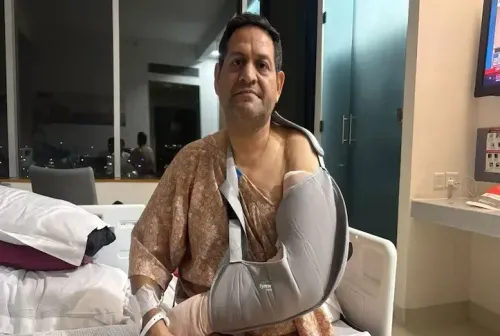
Gurugram IVF embryo mix-up: Couple says family traumatised, demands probe

Synopsis
A Gurugram couple's IVF treatment allegedly ended in an embryo swap — DNA tests on their twin daughters returned negative for both maternity and paternity. With an 80-year-old grandmother in mental shock and an FIR filed only after court intervention, the case exposes a critical gap in how India regulates and audits fertility clinic procedures.
Key Takeaways
Rahul Rathore and Meenu Rathore of Gurugram allege their embryos were swapped during IVF treatment at a reputed fertility clinic.
Embryos were implanted on 14 May 2025 ; twin daughters were born in January 2026 .
DNA profiling reportedly returned negative results for both maternity and paternity.
The couple approached authorities for three months before an FIR was registered, only after a court directed a probe.
The family — including an 80-year-old mother — is reportedly in severe psychological distress; Meenu Rathore has allegedly developed memory loss.
The case has raised broader concerns about enforcement of the Assisted Reproductive Technology (Regulation) Act, 2021 .
A Gurugram couple has come forward with a deeply distressing account of an alleged embryo mix-up during In-Vitro Fertilisation (IVF) treatment, claiming that suspected negligence by a fertility clinic has left their entire family emotionally shattered. Rahul Rathore and his wife Meenu Rathore say they have spent the past three months seeking answers about their biological children and demanding a formal investigation into the incident.
How the Ordeal Unfolded
According to the couple, their IVF journey began last year at a reputed fertility hospital in the region. They followed the standard clinical procedure — semen collection, egg retrieval, and embryo development. On 14 May 2025, the embryos were implanted into Meenu Rathore's womb. She subsequently gave birth to twin daughters in January 2026.
Suspicion arose when the couple noticed sharp physical differences between the infants and themselves. They arranged for DNA profiling of the twins, and the results reportedly confirmed that the children were not their biological offspring. 'Both the maternity and paternity tests were negative,' Rahul Rathore said. He added that the couple still does not know at which stage in the IVF process the alleged embryo swap occurred.
Family in Trauma, Authorities Unresponsive
'Our ageing parents are under immense pain. My father is so traumatised that he has gone completely silent, and my 80-year-old mother is in mental shock. My wife and other family members are struggling very hard to cope with the trauma inflicted on us,' Rahul Rathore said.
He described the couple as emotionally, physically, and mentally drained — not only by the alleged clinical error but also by what they characterise as indifference from authorities, including a medical board they approached for intervention. Meenu Rathore has reportedly begun suffering from memory loss as a result of the prolonged stress.
Legal Action and Demands for Investigation
The couple approached the police and concerned authorities repeatedly over the past three months, but their complaint reportedly received no substantive response. An FIR was registered only after a court directed a probe into the matter. The Rathores are now demanding an inspection of the clinic's embryo and laboratory records, as well as a review of its CCTV footage, to determine when and how the alleged mix-up occurred.
Wider Concerns Over IVF Oversight in India
The case has reignited debate about the adequacy of regulatory safeguards governing fertility clinics in India. The Assisted Reproductive Technology (Regulation) Act, 2021 lays down standards for IVF clinics, but critics argue that enforcement and independent auditing of embryo-handling protocols remain inconsistent. Notably, this is not the first time an embryo mix-up allegation has surfaced in India, raising questions about whether existing compliance mechanisms are sufficient to protect patients.
The couple has said that if justice is not forthcoming, their lives will be irreparably damaged. As the case moves through the legal system, it is expected to draw renewed scrutiny on how fertility clinics across the country document, label, and handle embryos.
Point of View
But the couple's three-month ordeal before an FIR was even registered suggests that enforcement is reactive at best. Embryo chain-of-custody — who handles it, when, and under what documentation — is the core of IVF safety, and if CCTV and lab records are the couple's only recourse, the system has already failed them. India's IVF market is among the fastest-growing in the world; without mandatory third-party audits of embryo-handling protocols, cases like this will recur.
NationPress
19 Sept 2026
Frequently Asked Questions
What happened in the Gurugram IVF embryo mix-up case?
A Gurugram couple, Rahul and Meenu Rathore, allege that their embryos were swapped during IVF treatment at a fertility clinic. Twin daughters born in January 2026 were found through DNA testing to not be their biological children, with both maternity and paternity tests returning negative results.
When did the alleged IVF embryo swap occur?
The embryos were implanted on 14 May 2025, and the twin daughters were born in January 2026. The couple says they do not yet know at which stage of the IVF process the alleged mix-up occurred.
What legal action has been taken in the IVF mix-up case?
An FIR was registered only after a court directed a probe into the matter, despite the couple approaching police and authorities for three months. The Rathores are demanding inspection of the clinic's embryo records, lab documentation, and CCTV footage.
How has the IVF mix-up affected the Rathore family?
The family is reportedly in severe psychological distress. Rahul Rathore's 80-year-old mother is said to be in mental shock, his father has gone silent, and Meenu Rathore has allegedly developed memory loss due to prolonged stress. The couple says they are emotionally, physically, and mentally drained.
What does this case mean for IVF regulation in India?
The case has renewed scrutiny of the Assisted Reproductive Technology (Regulation) Act, 2021, which governs IVF clinics in India. Critics argue that while the law exists, enforcement of embryo-handling protocols and independent auditing of fertility clinics remains inconsistent across the country.