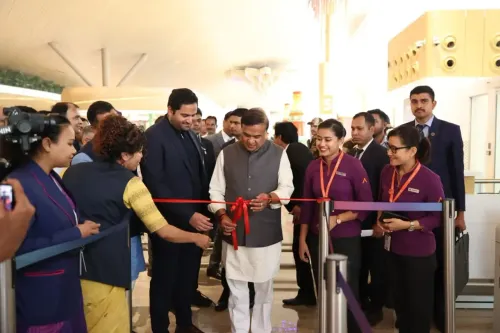
Guwahati Airport Moves All Int'l Flights to Terminal 2

Synopsis
Guwahati's Lokpriya Gopinath Bordoloi International Airport has consolidated all international flight operations at its award-winning Terminal 2, a step the Chief Minister's Office of Assam highlighted as a major infrastructure milestone for the Northeast region's aviation connectivity.
Key Takeaways
All international flights at Guwahati airport have been shifted to the award-winning Terminal 2 .
The Chief Minister's Office of Assam announced the development on 3 July 2026 .
The move is part of Airports Authority of India 's strategy to separate international and domestic operations for greater efficiency.
Guwahati was included in the UDAN regional connectivity scheme launched in 2016 , underpinning years of phased airport investment.
The upgrade is expected to support growth in international routes and boost Assam 's tourism and business sectors.
The Chief Minister's Office of Assam announced on Friday, 3 July 2026 that Lokpriya Gopinath Bordoloi International Airport, Guwahati has shifted all international flight operations to its award-winning Terminal 2, marking a significant upgrade in the airport's capacity and passenger experience.
Context
Guwahati's primary airport serves as the main gateway for both domestic and international travel to Northeast India. The consolidation of all international flights under a single, purpose-built terminal is designed to streamline operations, reduce congestion, and deliver a more consistent passenger experience for travellers connecting the region to the rest of the world.
Terminal 2 has been recognised with awards for its design and operational standards, positioning Guwahati among a growing list of Indian cities that have invested in world-class aviation infrastructure outside the traditional metro hubs.
Policy Backdrop
The shift aligns with the Airports Authority of India (AAI)'s broader strategy of separating international and domestic operations at high-traffic airports to improve efficiency. Phased terminal development at secondary cities has been a cornerstone of India's aviation modernisation drive over the past decade.
Guwahati was among the northeastern hubs included under the UDAN regional connectivity scheme, launched in 2016, which aimed to boost flight operations and economic integration across peripheral regions. The terminal upgrade reflects how that policy push has translated into tangible ground infrastructure.
Stakeholders and Impact
Air passengers flying international routes through Guwahati stand to benefit most directly, gaining access to a modern, award-recognised facility. Airlines operating international services from the airport are expected to see smoother turnaround processes with dedicated terminal resources.
The Assam tourism sector, which depends heavily on seamless air connectivity to attract visitors to destinations such as Kaziranga and the Brahmaputra riverfront, also stands to gain from an improved international gateway. Businesses reliant on freight and executive travel across the Northeast corridor may similarly benefit from the upgraded facilities.
What's Next
The consolidation of international operations at Terminal 2 sets the stage for potential expansion of international routes from Guwahati, as airlines are more likely to consider new destinations when a dedicated, well-equipped international terminal is in place. Authorities are expected to pursue additional terminal capacity and new route announcements under ongoing regional connectivity programmes.
The development reinforces the Assam government's push to position Guwahati as the aviation and commercial hub of Northeast India, with infrastructure investments intended to attract investment and reduce the region's historical connectivity deficit.
Point of View
The announcement fits a consistent pattern of using infrastructure milestones to project developmental momentum ahead of electoral cycles. At the national level, it reinforces the central government's argument that aviation modernisation under schemes like UDAN is delivering visible dividends in historically underserved regions. The real test, however, will be whether the upgraded terminal translates into new international routes and measurable passenger growth rather than remaining a facility upgrade in search of demand.
NationPress
3 Jul 2026
Frequently Asked Questions
Which terminal handles international flights at Guwahati airport now?
All international flights at Lokpriya Gopinath Bordoloi International Airport, Guwahati now operate from Terminal 2 , following the consolidation announced in July 2026.
Why was Terminal 2 built at Guwahati airport?
Terminal 2 was developed as part of the Airports Authority of India 's phased modernisation plan to separate international and domestic operations, improve passenger experience, and accommodate rising traffic at Guwahati .
What awards has Guwahati airport Terminal 2 won?
Terminal 2 at Guwahati airport has been recognised with awards for its design and operational standards, though specific award details are yet to be officially enumerated in public disclosures.
How does this affect passengers flying internationally from Guwahati?
Passengers on international routes from Guwahati will now check in, board, and arrive exclusively through Terminal 2 , which offers modern facilities and a dedicated international experience.
What is the UDAN scheme and how is it connected to Guwahati airport?
The UDAN (Ude Desh ka Aam Naagrik) regional connectivity scheme, launched in 2016 , included Guwahati among targeted northeastern hubs to boost flight operations and improve economic connectivity for the region.