Giriraj Singh: Bharat Tex 2026 to Showcase India's Textile Strength
Synopsis
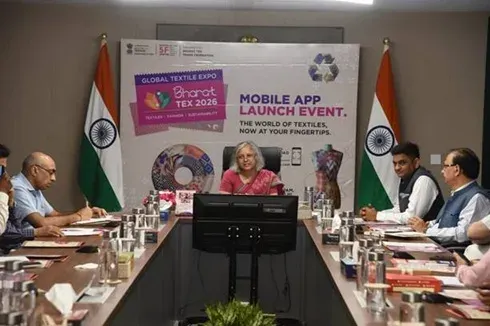
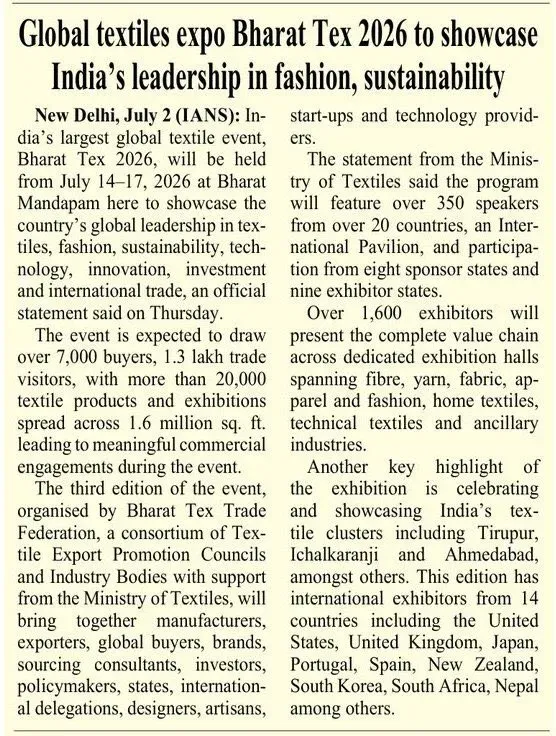
Union Textiles Minister Giriraj Singh has announced Bharat Tex 2026, a major international textile exhibition at India Mandapam, New Delhi, from 14-17 July 2026, aimed at showcasing India's textile strength to global buyers, investors, and artisans.
Key Takeaways
Bharat Tex 2026 will be held from 14 to 17 July 2026 at India Mandapam, New Delhi .
The event will bring together domestic and international buyers, investors, industry players, and artisans under one roof.
Union Textiles Minister Giriraj Singh announced the event on 3 July 2026 , linking it to PM Modi's vision of innovation and global competitiveness in textiles.
The exhibition is aligned with the Make in India programme and the Viksit Bharat 2047 national development vision.
The government's PLI scheme for man-made fibre apparel and technical textiles, notified in 2021 with an outlay of Rs 10,683 crore , forms part of the policy backdrop for the event.
Investment commitments and MoUs signed at the event will be closely watched as indicators of sector momentum.
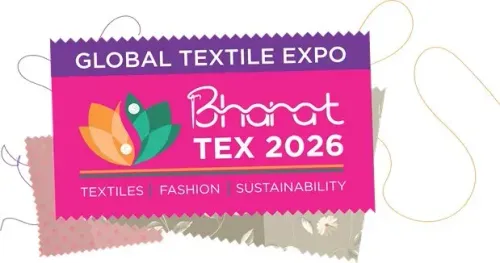
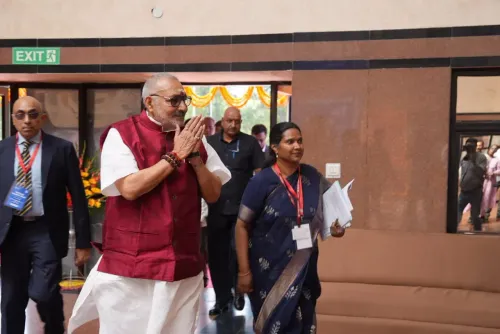
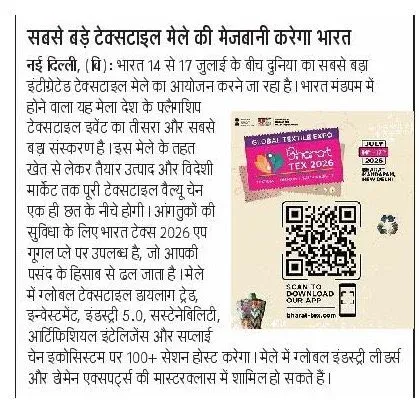
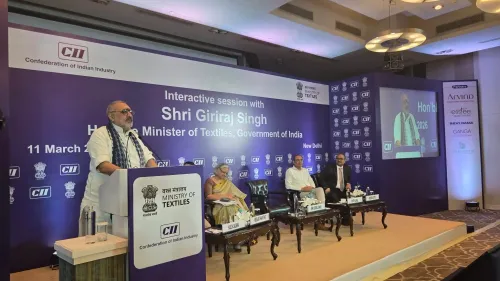
Union Textiles Minister Giriraj Singh on Friday, 3 July 2026 announced that Bharat Tex 2026, an international textile exhibition, will be held from 14 to 17 July 2026 at India Mandapam, New Delhi, positioning the event as a major global platform for India's textile sector.
Posting on X, the Minister wrote: 'भारत टेक्स 2026 भारत के वस्त्र उद्योग की ताकत को दुनिया के सामने प्रस्तुत करने का एक बड़ा मंच बनेगा' — 'Bharat Tex 2026 will become a major platform to present the strength of India's textile industry before the world.' He added that buyers, investors, industry representatives, and artisans from India and abroad will converge at the event.
Context
The announcement comes as the Union Ministry of Textiles intensifies its push to attract foreign investment and integrate Indian manufacturers into global supply chains. Bharat Tex 2026 is framed as a convergence point for the entire value chain — from grassroots artisans and handloom weavers to large exporters and multinational buyers. Singh invoked Prime Minister Narendra Modi's leadership, stating that under his guidance, India's textile sector is 'establishing new dimensions of innovation, investment, and global competitiveness.'
Policy Backdrop
The event sits within a long arc of textile-sector policy. The Make in India programme, launched in September 2014, explicitly targeted apparel and textiles as a pillar of manufacturing growth. In 2021, the government notified a Production Linked Incentive (PLI) scheme for man-made fibre apparel and technical textiles with an outlay of Rs 10,683 crore, aimed at boosting domestic production and export competitiveness.
The Ministry of Textiles has a well-established practice of organising large-format trade events and buyer-seller meets to support handloom and powerloom clusters. Bharat Tex 2026 continues this pattern, with a sharper focus on signalling policy continuity and drawing fresh foreign direct investment. The event's hashtags — #BharatTex2026, #MakeInIndia, and #ViksitBharat2047 — directly link it to the government's overarching vision of a developed India by 2047, the centenary of independence.
Stakeholders and Impact
The textile sector is one of India's largest employers, with a workforce spanning cotton farmers, handloom artisans, powerloom operators, garment workers, and MSME manufacturers. Events of this scale are designed to generate direct business leads — purchase orders, sourcing agreements, and investment memoranda — that filter down to smaller units in textile clusters across states such as Gujarat, Tamil Nadu, Maharashtra, Uttar Pradesh, and West Bengal.
Global buyers attending such exhibitions typically scout for suppliers across the value chain, from raw fibre to finished garments and technical textiles. For artisans and small producers, access to international buyers at a single venue reduces transaction costs and improves market visibility.
What's Next
The key metrics to watch when Bharat Tex 2026 concludes on 17 July will be the volume and value of investment commitments, the number of MoUs signed, and the diversity of international participation. Any fresh announcements on export targets or sector-specific incentives made at the event could feed into the next Union Budget or a forthcoming foreign trade policy review. The government's ability to translate exhibition momentum into sustained order flows and FDI inflows will be the true measure of the event's success.
Point of View
The Ministry is signalling continuity of purpose rather than a standalone initiative. For the textiles sector — historically fragmented across states and segments — such events serve a dual function: attracting FDI and providing political optics of government engagement with artisans and exporters alike. The real test will be whether the commitments made on the exhibition floor translate into verifiable order flows and investment disbursals in the months that follow.
NationPress
3 Jul 2026
Frequently Asked Questions
What is Bharat Tex 2026?
Bharat Tex 2026 is an international textile exhibition announced by Union Textiles Minister Giriraj Singh, scheduled to be held from 14 to 17 July 2026 at India Mandapam, New Delhi, bringing together buyers, investors, industry representatives, and artisans from India and abroad.
Where will Bharat Tex 2026 be held?
Bharat Tex 2026 will be held at India Mandapam, a large convention and exhibition centre in New Delhi.
What is the purpose of Bharat Tex 2026?
The event aims to showcase the strength of India's textile industry to a global audience, attract foreign investment, facilitate buyer-seller connections, and advance the government's Make in India and Viksit Bharat 2047 goals.
Who announced Bharat Tex 2026?
Union Textiles Minister Giriraj Singh announced Bharat Tex 2026 on 3 July 2026 via a post on X, linking the event to PM Narendra Modi's vision for the sector.
What government schemes are linked to Bharat Tex 2026?
The event is connected to the Make in India programme launched in 2014 and the Production Linked Incentive scheme for man-made fibre apparel and technical textiles notified in 2021 with an outlay of Rs 10,683 crore, as well as the broader Viksit Bharat 2047 national development vision.