Clouded Leopard Conservation Plan: 14 Northeast landscapes prioritised
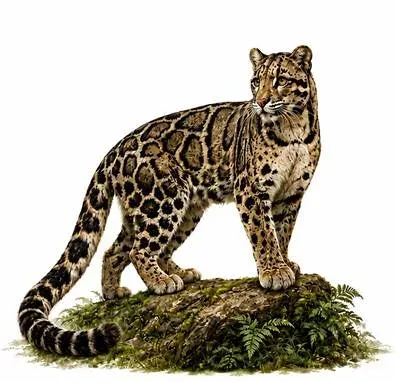
Synopsis
India has unveiled a detailed Clouded Leopard Conservation Action Plan anchored by 14 priority landscapes in Northeast India — deploying eDNA science, the M-STrIPES app, and community livelihood support in a coordinated push to protect one of Asia's most elusive wild cats. The plan's release on International Clouded Leopard Day signals a shift from intent to structured, technology-backed action.
Key Takeaways
India's Ministry of Environment, Forest and Climate Change detailed the Clouded Leopard Conservation Action Plan (CAP) on 4 August 2025 .
The plan identifies 14 priority conservation landscapes across Northeast India as focal areas.
Scientific monitoring will use camera traps , occupancy surveys, genetics, and environmental DNA (eDNA) .
The M-STrIPES smart application will be used to strengthen field-level anti-poaching and conservation efforts.
The clouded leopard has been included under the Species Recovery Programme of the IDWH scheme for dedicated institutional support.
The CAP was released at the 91st SCNBWL meeting in Coimbatore in July 2025 .
India's Ministry of Environment, Forest and Climate Change on 4 August 2025 detailed the key pillars of the Clouded Leopard Conservation Action Plan (CAP), identifying 14 priority conservation landscapes across Northeast India as central to securing the future of one of Asia's most elusive wild cats. The plan also encompasses habitat restoration and forest corridor conservation as core strategies.
What the Action Plan Covers
The CAP was prepared under the Government of India–GEF–UNDP initiative and was formally released during the 91st meeting of the Standing Committee of the National Board for Wild Life (SCNBWL), held in July at Coimbatore. It provides a comprehensive framework combining habitat protection, landscape restoration, scientific monitoring, community participation, and international cooperation.
The ministry noted that the conservation of the clouded leopard is intrinsically tied to the preservation of forests and natural heritage across Northeast India — a region that holds the bulk of the species' remaining range within the country.
Scientific Monitoring and Technology
The CAP mandates standardised scientific monitoring through camera traps, occupancy surveys, genetics analysis, and environmental DNA (eDNA) techniques. These tools are intended to improve understanding of the species' population dynamics and habitat requirements.
Frontline staff capacity building is also a key component, with the M-STrIPES smart application being deployed to strengthen field-level conservation efforts. The plan additionally emphasises anti-poaching measures and wildlife crime prevention as non-negotiable safeguards.
Institutional and Community Framework
The government has strengthened the institutional backbone for clouded leopard protection by including the species under the Species Recovery Programme of the Integrated Development of Wildlife Habitats (IDWH) scheme. This inclusion unlocks dedicated funding and administrative support for targeted recovery efforts.
Recognising that wildlife conservation cannot succeed without local buy-in, the CAP promotes community-based conservation and sustainable livelihood support for communities living in and around clouded leopard habitats.
India Reaffirms Commitment on International Clouded Leopard Day
International Clouded Leopard Day, observed annually on 4 August, was founded in 2018 to raise global awareness about the threats facing the species across South and Southeast Asia. India used the occasion to reaffirm its conservation commitments and highlight the coordinated, multi-pronged approach outlined in the CAP.
With the action plan now in place and institutional frameworks reinforced, the focus shifts to implementation — particularly on whether the 14 priority landscapes receive sustained on-ground attention and funding in the years ahead.
Point of View
But the species remains far less monitored than tigers or elephants, and baseline population data is thin. The CAP's reliance on eDNA and camera traps is scientifically sound, but 14 priority landscapes across Northeast India is an ambitious footprint requiring sustained inter-state coordination in a region where administrative bandwidth is already stretched. The real measure of this plan will be whether the 14 landscapes receive ring-fenced budgets and independent outcome reporting — or whether the action plan becomes another document that looks rigorous on paper but fades in the field.
NationPress
4 Aug 2026
Frequently Asked Questions
What is India's Clouded Leopard Conservation Action Plan (CAP)?
The Clouded Leopard Conservation Action Plan is a comprehensive government framework prepared under the India–GEF–UNDP initiative to protect the clouded leopard across Northeast India. It covers habitat protection, scientific monitoring, anti-poaching measures, community participation, and international cooperation.
Which areas are prioritised under the Clouded Leopard CAP?
The plan identifies 14 priority conservation landscapes across Northeast India as the primary focus areas. These regions are considered critical for the species' survival and are targeted for habitat restoration and forest corridor conservation.
When and where was the Clouded Leopard CAP released?
The CAP was released during the 91st meeting of the Standing Committee of the National Board for Wild Life (SCNBWL), held in July 2025 in Coimbatore.
What monitoring methods will be used under the plan?
The CAP mandates standardised scientific monitoring using camera traps, occupancy surveys, genetic analysis, and environmental DNA (eDNA). The M-STrIPES smart application will also be used to support frontline staff in field-level conservation.
What is International Clouded Leopard Day?
International Clouded Leopard Day is observed every year on 4 August to raise awareness about the threats facing the species across South and Southeast Asia. It was founded in 2018 and serves as a platform for governments and conservation organisations to reaffirm protection commitments.