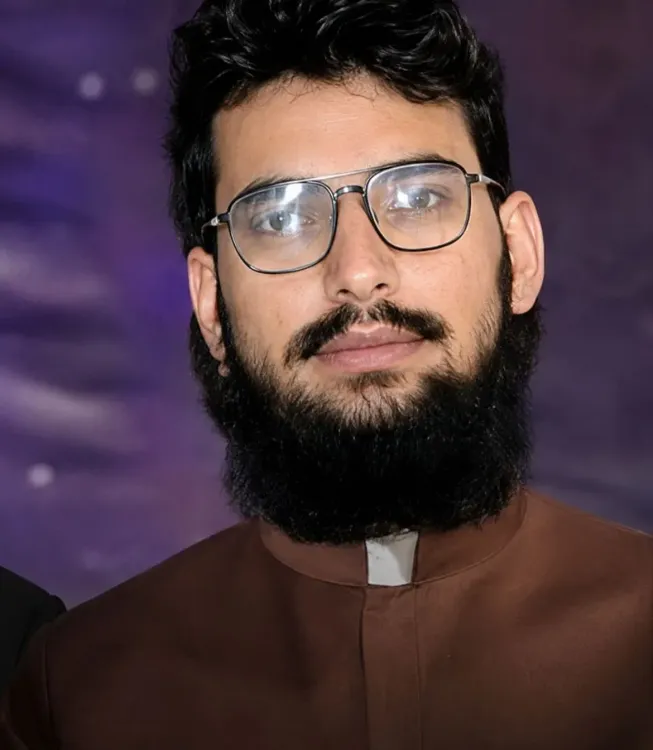
Hamza Burhan killing cripples Al Badr, Jaish poster propaganda in Kashmir
Synopsis
Hamza Burhan wasn't a gunman — he was a propagandist, and that made him more dangerous. The architect of Al Badr and Jaish-e-Mohammad's poster radicalisation network in Kashmir, he has been killed in PoK at the exact moment terror groups were doubling down on narrative warfare. His death removes a rare asset: someone who could craft ideology, coordinate distribution, and glamorise militancy simultaneously.
Key Takeaways
Hamza Burhan (real name Arjumand Gulzar Dar ), a key propaganda operative for Al Badr and Jaish-e-Mohammad , was killed by unidentified gunmen in Pakistan-occupied Kashmir (PoK) .
Burhan was designated a terrorist under the UAPA by the Union Home Ministry in 2022 .
He was the primary architect of poster-based radicalisation campaigns across the Kashmir Valley , personally drafting messaging and coordinating distribution.
A prior poster campaign in Srinagar linked to his network led to the busting of the Faridabad module and seizure of 2,900 kg of ammonium nitrate.
His death disrupts the propaganda operations of multiple groups including Hizbul Mujahideen and The Resistance Front , which also relied on poster campaigns.
The killing of Hamza Burhan, whose legal name was Arjumand Gulzar Dar, has dealt a significant blow to the narrative warfare operations of Al Badr and Jaish-e-Mohammad (JeM) in Jammu and Kashmir. Burhan was shot dead by unidentified gunmen in Pakistan-occupied Kashmir (PoK), according to officials, removing one of the most operationally critical figures in the terror ecosystem's propaganda machinery.
Who Was Hamza Burhan
Burhan was designated a terrorist under the Unlawful Activities Prevention Act (UAPA) by the Union Home Ministry in 2022. According to intelligence officials, he was the primary architect of poster-based radicalisation campaigns across the Kashmir Valley, personally crafting the messaging, suggesting wordings, and coordinating distribution through both physical and online channels. His ability to glamorise militancy and rapidly disseminate content made him a prized asset for multiple Pakistan-backed terror outfits.
Officials noted that Burhan ran active digital propaganda channels through which he instructed locals to print and paste posters across various parts of Kashmir — a low-cost, high-impact method of psychological influence that is, according to security analysts, more dangerous in the long run than direct armed operations.
The Poster Campaign Threat in J&K
Poster campaigns have long served as a radicalisation and recruitment tool in Jammu and Kashmir. A recent wave of propaganda posters in Srinagar was directly linked to the busting of the Faridabad module, which had carried out the Red Fort blast. That operation also led to the seizure of 2,900 kilograms of ammonium nitrate, underscoring how poster-led radicalisation can escalate to active violence.
Beyond Al Badr and JeM, Hizbul Mujahideen and Lashkar-e-Tayiba's proxy outfit The Resistance Front (TRF) have also deployed posters extensively. The Resistance Front used posters to threaten fruit growers and traders following the abrogation of Article 370, warning them to shut down operations or face being 'shot dead.' Hizbul Mujahideen operatives in Kulgam used adhesive tape to seal shops that defied strike calls, marking them with 'LW' — reportedly standing for 'Last Warning.'
Burhan's Role Post Article 370 Abrogation
Following the revocation of Article 370 in 2019, Burhan intensified a digital campaign aimed at psychologically influencing Kashmiri youth. His messaging framed the abrogation as oppression and urged youth to join terror outfits. He was also reportedly behind a specific poster campaign in Srinagar calling for a social boycott of families of active Jammu and Kashmir Police personnel — a tactic designed to isolate and intimidate those working with security forces.
Impact of His Death on Terror Groups
Security officials say Burhan's death arrives at a particularly vulnerable moment for Pakistan-backed terror groups, whose on-ground operational capacity in J&K has sharply diminished. With conventional infiltration routes under pressure and recruitment constrained, these outfits had reportedly pivoted toward narrative warfare — making Burhan's role even more critical. His elimination, officials argue, disrupts not just one campaign but the broader propaganda infrastructure that multiple groups relied upon.
With Burhan gone, terror outfits face the challenge of replacing a figure who combined ideological framing, digital reach, and on-ground coordination — a combination that security agencies say is difficult to replicate quickly.
Point of View
The propagandist can be more strategically valuable than the militant. Security agencies have long understood that poster campaigns and digital radicalisation pipelines are force multipliers — they lower the threshold for violence by normalising it. What mainstream coverage often misses is that Burhan's network wasn't just distributing leaflets; it was building a psychological infrastructure that outlasts any individual operation. The harder question is whether his elimination disrupts the system or merely creates a vacancy that a new operator, possibly more digitally sophisticated, will fill.
NationPress
14 Oct 2026
Frequently Asked Questions
Who was Hamza Burhan and why was he significant?
Hamza Burhan, whose legal name was Arjumand Gulzar Dar, was a UAPA-designated terrorist and the principal poster propaganda operative for Al Badr and Jaish-e-Mohammad in Jammu and Kashmir. He crafted messaging, coordinated physical poster distribution across the Kashmir Valley, and ran digital channels urging locals to radicalise and recruit for terror outfits.
Where and how was Hamza Burhan killed?
Burhan was shot dead by unidentified gunmen in Pakistan-occupied Kashmir (PoK), according to officials. The exact circumstances of the killing have not been officially detailed.
What is the significance of poster campaigns in Kashmir's terror ecosystem?
Poster campaigns have served as low-cost radicalisation and recruitment tools for multiple terror outfits in Jammu and Kashmir. A recent Srinagar poster campaign tied to Burhan's network led to the busting of the Faridabad module and the seizure of 2,900 kg of ammonium nitrate, illustrating how propaganda can directly enable violence.
Which terror groups used Hamza Burhan's propaganda services?
Al Badr and Jaish-e-Mohammad used Burhan extensively, but his influence extended to the broader terror ecosystem in J&K. Separately, Hizbul Mujahideen and Lashkar-e-Tayiba's proxy The Resistance Front have also conducted their own poster campaigns, including threats against traders and J&K Police families.
How does Burhan's death affect terror operations in Jammu and Kashmir?
Officials say his death significantly disrupts the narrative warfare capacity of Pakistan-backed groups at a time when their on-ground operational footprint in J&K has already shrunk. Burhan combined ideological framing, digital reach, and field coordination — a profile that security agencies say will be difficult for these groups to replace quickly.