Haryana CM Office: Mera Pani Meri Virasat Returns for Kharif 2026
Synopsis
The Chief Minister's Office of Haryana has announced financial incentives for farmers under the Mera Pani Meri Virasat scheme for Kharif 2026, continuing the state's six-year effort to reduce paddy cultivation and conserve rapidly depleting groundwater.
Key Takeaways
Mera Pani Meri Virasat will offer financial incentives to Haryana farmers in Kharif 2026 to encourage crop diversification away from water-intensive paddy.
The scheme was originally launched in 2020 and has now been extended into its sixth year of operation.
Haryana's rice-wheat belt has experienced severe groundwater depletion due to decades of paddy cultivation.
Neighbouring Punjab has also discussed similar diversification incentives, making Haryana's programme a regional policy reference point.
Exact incentive amounts, eligibility criteria, and disbursement details for 2026 have not yet been publicly announced.
Key metrics to watch: farmer enrolment figures and total area shifted away from paddy when the Kharif season begins.
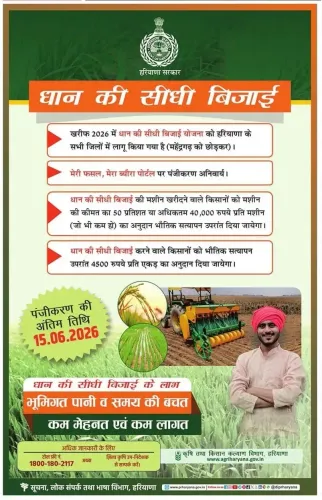
Haryana's groundwater clock is ticking — and the state government is once again reaching for its most direct lever. The Chief Minister's Office of Haryana announced on Saturday, 24 October 2026 that farmers will receive financial incentives under the Mera Pani Meri Virasat scheme during the Kharif 2026 season, reviving the flagship water-conservation programme for another cropping cycle.
The post, shared in Hindi, reads: 'मेरा पानी, मेरी विरासत — जल संरक्षण को बढ़ावा, किसानों को लाभ!' ('My Water, My Heritage — promoting water conservation, benefit to farmers!'), with the key message that an economic incentive awaits farmers who participate in Kharif 2026.
Six Years of Nudging Farmers Away from Paddy
Launched in 2020, Mera Pani Meri Virasat was built on a simple premise: paddy is a water guzzler, and Haryana's aquifers cannot keep pace. The scheme offered direct cash payments to farmers willing to swap water-intensive rice cultivation for less thirsty alternatives — maize, cotton, pulses, vegetables — during the critical Kharif season. The 2026 announcement extends that logic into its sixth year, signalling that the government views financial incentives as its most reliable tool to shift cropping patterns at scale.
Haryana sits at the heart of India's rice-wheat belt, a region where decades of paddy cultivation have pushed groundwater levels into alarming decline across multiple districts. The state has run successive programmes to curb extraction, but voluntary crop diversification has remained a hard sell — paddy's guaranteed procurement price and familiar cultivation practices make it the default choice for millions of smallholders.
A Pattern Punjab Is Watching Closely
The move carries significance well beyond Haryana's borders. Neighbouring Punjab faces an even sharper groundwater crisis and has discussed or piloted similar diversification incentives. Each successive Haryana announcement adds to the evidence base — and the political pressure — for a coordinated, regional approach to aquifer management across the Indo-Gangetic plain.
The specific incentive amount, eligibility criteria, and disbursement mechanism for the 2026 cycle have not yet been publicly detailed. What to watch when the season opens: farmer enrolment numbers and the actual area shifted away from paddy — the two metrics that will determine whether this year's round moves the needle or remains a well-intentioned nudge.
Water conservation policy rarely makes headlines the way a dam inauguration does. But the quiet arithmetic of aquifer depletion — measured in metres per year, felt in failed borewells and rising input costs — is one of the most consequential slow-burn crises in Indian agriculture. Haryana's bet is that a cheque in a farmer's hand is the fastest way to change what gets planted. Kharif 2026 will be the next test of that wager.
Point of View
The scheme's persistence signals institutional confidence, but the absence of publicly announced incentive amounts raises questions about whether the offer is competitive enough to overcome paddy's economic certainty for smallholders. With Punjab watching and India's groundwater crisis deepening, Haryana's enrolment numbers this season will carry weight well beyond state borders.
NationPress
24 Oct 2026
Frequently Asked Questions
What is the Mera Pani Meri Virasat scheme in Haryana?
Mera Pani Meri Virasat is a Haryana government scheme launched in 2020 that provides financial incentives to farmers who shift away from water-intensive paddy cultivation to less water-dependent crops during the Kharif season, aiming to conserve the state's rapidly depleting groundwater.
Who is eligible for the Mera Pani Meri Virasat incentive in Kharif 2026?
The scheme targets Haryana farmers who voluntarily replace paddy with alternative crops. Specific eligibility criteria and the exact incentive amount for Kharif 2026 have not yet been publicly detailed by the government.
Why is Haryana promoting crop diversification away from paddy?
Paddy cultivation is highly water-intensive and has contributed to severe groundwater depletion across multiple districts in Haryana. The state government uses financial incentives to encourage farmers to grow less thirsty crops like maize, pulses, and cotton.
How much incentive do farmers get under Mera Pani Meri Virasat 2026?
The exact incentive amount for Kharif 2026 has not been officially announced yet. Previous iterations of the scheme offered direct cash payments per acre of paddy area diverted to alternative crops.
Is Punjab running a similar water conservation scheme for farmers?
Punjab has discussed and piloted similar crop diversification incentives given its even more acute groundwater crisis, but Haryana's Mera Pani Meri Virasat remains one of the more established state-level programmes of this kind in the region.