Haryana CM Office Rolls Out DSR Scheme Across Districts for Kharif 2026
Synopsis
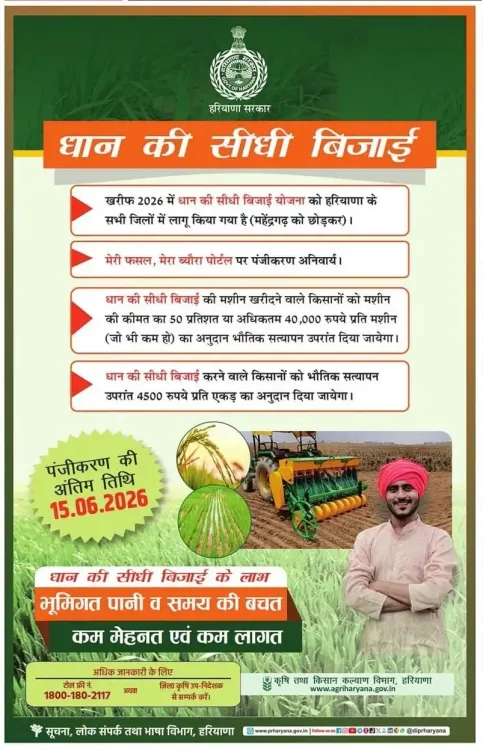
Haryana has launched its Direct Seeded Rice scheme across all districts except Mahendragarh for Kharif 2026, offering ₹4,500 per acre to farmers and up to ₹40,000 for DSR machinery. Registration on the MeriFasalMeraByora portal is mandatory to claim benefits.
Key Takeaways
The Haryana government has extended the Direct Seeded Rice (DSR) scheme to all districts for Kharif 2026 , excluding Mahendragarh .
Eligible farmers will receive ₹4,500 per acre after physical field verification of direct-seeded paddy.
A machinery subsidy of 50% of machine cost , capped at ₹40,000 per machine , is available for DSR equipment purchases.
Registration on the MeriFasalMeraByora portal is compulsory for accessing either subsidy.
The scheme targets groundwater conservation , lower input costs, and improved paddy productivity.
Haryana has been piloting DSR incentives since 2021–22 to address declining water tables in the rice-wheat belt.
The Chief Minister's Office of Haryana announced on Friday, 12 June 2026 that the state government has extended its Direct Seeded Rice (DSR) scheme to all districts for Kharif 2026, with the sole exception of Mahendragarh. The move aims to promote groundwater conservation, reduce input costs, and improve paddy yields across the state.
The official post stated: 'धान की सीधी बिजाई योजना को सभी जिलों में लागू किया गया है' ('The direct seeded rice scheme has been implemented across all districts'), underscoring the government's intent to scale a practice that had previously been piloted only in select areas.
Context
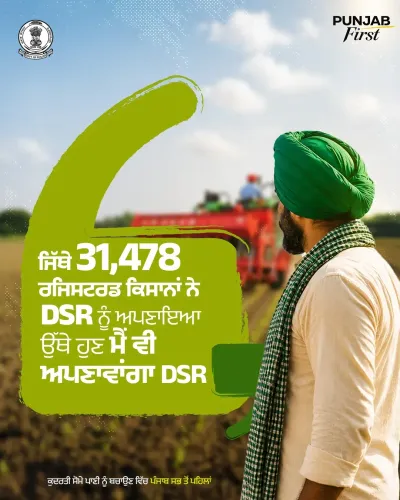
Direct Seeded Rice, or DSR, involves sowing paddy seeds directly into the field rather than first raising seedlings in a nursery and then transplanting them. This technique significantly reduces the volume of water required during the critical early growth phase. Haryana first began promoting DSR through limited incentive pilots during 2021–22, when declining groundwater levels in the state's paddy-growing belts triggered policy concern. The state's decision to expand the programme to nearly all districts for the upcoming Kharif season marks a decisive shift from pilot to mainstream policy.Policy Backdrop
Haryana and neighbouring Punjab sit at the heart of India's rice-wheat rotation belt and together account for a substantial share of the country's food-grain procurement. However, decades of intensive paddy cultivation have accelerated groundwater depletion across the Indo-Gangetic plains, prompting successive state governments to incentivise water-efficient alternatives. Under the 2026 scheme, eligible farmers who adopt direct seeding will receive a subsidy of ₹4,500 per acre following physical field verification. Farmers who purchase DSR machinery will additionally be eligible for a grant equivalent to 50 per cent of the machine's cost, subject to a ceiling of ₹40,000 per machine — whichever amount is lower. Both incentives are designed to lower the financial barrier to adoption while reducing dependence on flood-irrigation methods.Stakeholders and Impact
The primary beneficiaries are paddy farmers across Haryana's 21 participating districts. For smallholders, the per-acre cash incentive can offset a meaningful portion of seasonal input expenditure, while the machinery subsidy targets medium-scale operators who can invest in mechanised sowing equipment. Farm machinery suppliers are also expected to see increased demand as farmers seek to qualify for the equipment grant. To access either subsidy, registration on the #MeriFasalMeraByora portal is mandatory. The portal is the state government's unified platform for crop-related registrations, and linking subsidy disbursal to it is intended to improve targeting, reduce duplication, and create a verifiable digital record of participating fields. The exclusion of Mahendragarh district from the scheme has not been officially explained in the announcement. Mahendragarh is located in the semi-arid southern part of Haryana and is not a primary paddy-growing district, which may account for its omission.What's Next
Registration activity on the MeriFasalMeraByora portal in the weeks ahead will be a key indicator of farmer uptake. State agriculture officials are expected to conduct physical verification of sown fields before subsidy amounts are disbursed. If the Kharif 2026 rollout demonstrates measurable water savings and yield stability, it could strengthen the case for making DSR a permanent, state-wide fixture — and potentially inform similar policy decisions in other groundwater-stressed states across northern India.Point of View
500 per-acre subsidy is calibrated to compete with the inertia of traditional transplanting, which farmers view as lower-risk despite its water intensity. Linking disbursal to the MeriFasalMeraByora portal also advances the state's broader push toward digitally verifiable agricultural welfare, reducing leakage. If uptake is strong, Haryana could position itself as a template for Indo-Gangetic plain states grappling with the same groundwater crisis.
NationPress
26 Oct 2026
Frequently Asked Questions
What is the Direct Seeded Rice scheme in Haryana 2026?
The Direct Seeded Rice (DSR) scheme is a Haryana government initiative for Kharif 2026 that encourages farmers to sow paddy seeds directly in the field instead of transplanting nursery seedlings, offering a subsidy of ₹4,500 per acre to reduce water use and input costs.
How much subsidy will Haryana farmers get for direct seeded paddy?
Farmers who adopt direct seeded rice in Kharif 2026 will receive ₹4,500 per acre after physical verification of their fields by state agriculture officials.
Which districts are covered under Haryana's DSR scheme in 2026?
The scheme covers all districts of Haryana except Mahendragarh for Kharif 2026.
How do I register for the DSR scheme on MeriFasalMeraByora?
Farmers must visit the MeriFasalMeraByora portal and complete their crop registration before sowing; registration is mandatory to be eligible for the per-acre subsidy and the machinery grant.
What is the subsidy for buying a DSR machine in Haryana?
Haryana offers 50% of the machine's purchase price as a subsidy for DSR sowing equipment, subject to a maximum of ₹40,000 per machine, whichever amount is lower.