Punjab DSR rice area crosses 4 lakh acres, up 36% in 2026
Synopsis
Punjab's Chief Minister's Office reports DSR rice cultivation crossed 4 lakh acres in Kharif 2026 — a 36% jump over 2025 — with 31,478 farmers registered, marking a significant advance in the state's groundwater conservation drive.
Key Takeaways
DSR area in Punjab crossed 4 lakh acres in Kharif season 2026 , up 36% from 2.94 lakh acres in 2025.
31,478 registered farmers adopted DSR technology this season.
DSR cuts water use by an estimated 30–40% per hectare compared to traditional paddy transplanting.
Punjab has promoted DSR and crop diversification since the 2010s to combat critically low groundwater tables.
Year-on-year growth signals DSR is moving from a pilot initiative to mainstream agricultural practice in the state.
Punjab's war on groundwater depletion is showing measurable results on the ground. The Chief Minister's Office of Punjab announced on Thursday, 20 August 2026 that the area under Direct Seeded Rice (DSR) has crossed 4 lakh acres in Kharif season 2026 — a 36 percent jump over the previous year's 2.94 lakh acres.
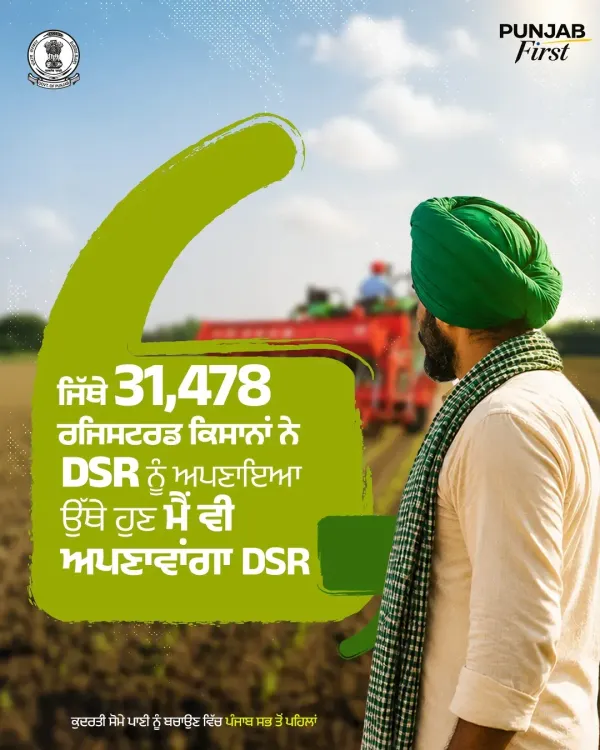
The state government confirmed that 31,478 registered farmers have adopted DSR technology this season. That number tells a quiet but important story: water-smart farming is no longer a pilot programme in Punjab — it is scaling.
Why DSR matters for Punjab's vanishing water table
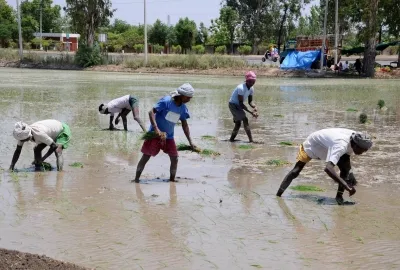
Punjab sits at the centre of India's rice-wheat belt, and the cost of that abundance has been severe. Decades of water-intensive paddy transplanting have pushed groundwater tables in many blocks to critically low levels. DSR — which involves sowing pre-germinated rice seed directly into the field rather than transplanting seedlings from flooded nurseries — cuts water consumption by an estimated 30 to 40 percent per hectare, according to agronomists who have tracked the technique across the state.
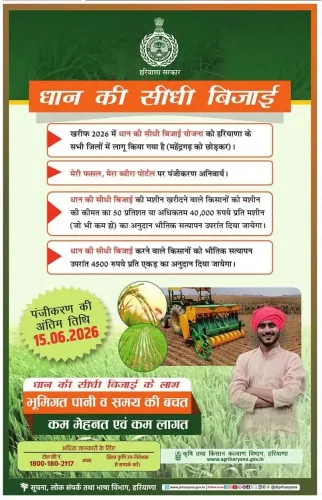
The Punjab government has been pushing DSR and crop diversification since the 2010s, pairing awareness drives with financial incentives to nudge farmers away from the flood-irrigation model that has defined the region for generations. The year-on-year jump from roughly 2.94 lakh acres in 2025 to over 4 lakh acres in 2026 suggests those nudges are compounding.
From a handful of converts to tens of thousands
The farmer registration figure is the detail that deserves attention. 31,478 registered DSR adopters in a single Kharif season represents a meaningful base of practitioners — farmers who have invested in the equipment, adjusted their sowing calendars, and accepted the technique's learning curve. Each one becomes a local proof point for neighbours still on the fence.
The state agriculture department and Punjab's farming community now face the harder question: whether this momentum can be sustained and deepened when the monsoon is generous and the immediate pressure on water feels less acute. The real test of any conservation programme is whether it holds when the crisis is temporarily out of sight.
Punjab's groundwater clock is still ticking. A 36 percent single-season expansion in DSR acreage is a genuine stride — but the state will need to keep accelerating if it is to outpace the depletion curve that decades of intensive paddy cultivation have set in motion.
Point of View
Which has staked significant political capital on water conservation as a governance credential. It fits a broader pattern of Indian state governments repackaging agrarian sustainability as electoral identity — particularly in states where farmer distress and resource depletion intersect. The real policy test, however, is whether incentive structures are robust enough to sustain adoption in years when water stress is less visible, and whether acreage gains translate into measurable groundwater recovery — a metric the government has yet to put on the table.
NationPress
5 Oct 2026
Frequently Asked Questions
What is Direct Seeded Rice (DSR) and how does it save water?
DSR is a technique where pre-germinated rice seeds are sown directly into the field instead of transplanting seedlings from flooded nurseries. It reduces water consumption by an estimated 30–40 percent per hectare compared to conventional paddy transplanting.
How much has DSR area grown in Punjab in 2026?
According to the Punjab government, DSR area crossed 4 lakh acres in Kharif season 2026, a 36 percent increase from approximately 2.94 lakh acres in 2025.
How many farmers have adopted DSR in Punjab in Kharif 2026?
31,478 registered farmers adopted DSR technology during Kharif season 2026, according to the Chief Minister's Office of Punjab.
Why is water conservation urgent for Punjab's agriculture?
Decades of water-intensive rice-wheat cultivation have caused groundwater tables in many Punjab blocks to fall to critically low levels, making water-efficient techniques like DSR essential for long-term agricultural sustainability.
How long has Punjab been promoting DSR farming?
The Punjab government has been promoting DSR and crop diversification since the 2010s, combining awareness campaigns with financial incentives to reduce dependence on flood irrigation in paddy cultivation.