Haryana CMO launches Paperless Registry 2.0 for land records
Synopsis
Haryana's Chief Minister's Office has launched Paperless Registry 2.0, an upgraded digital platform for end-to-end online property registration aimed at making land transactions simpler, transparent, secure and citizen-centric across the state.
Key Takeaways
The Chief Minister's Office of Haryana announced the launch of Paperless Registry 2.0 on 23 June 2026 .
The platform is designed to make land registration in Haryana simpler, more transparent, secure, and citizen-centric.
The initiative is administered by the Revenue Department of Haryana through its portal revenueharyana.gov.in .
The launch builds on the national Digital India Land Records Modernization Programme (DILRMP) , active since 2008 .
Key beneficiaries include property buyers, landowners, and revenue officials across Haryana.
Rollout metrics such as registration turnaround time and transaction volumes will determine the reform's real-world impact.
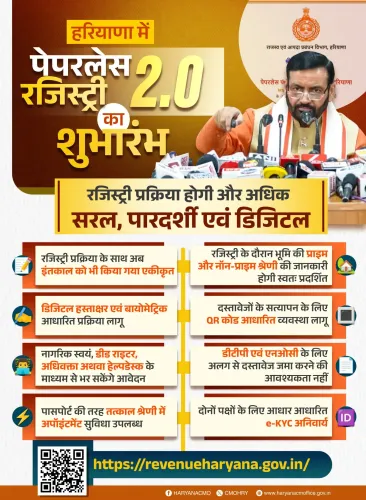
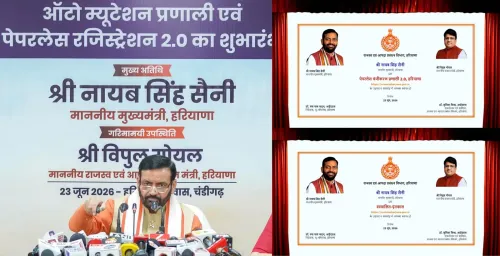
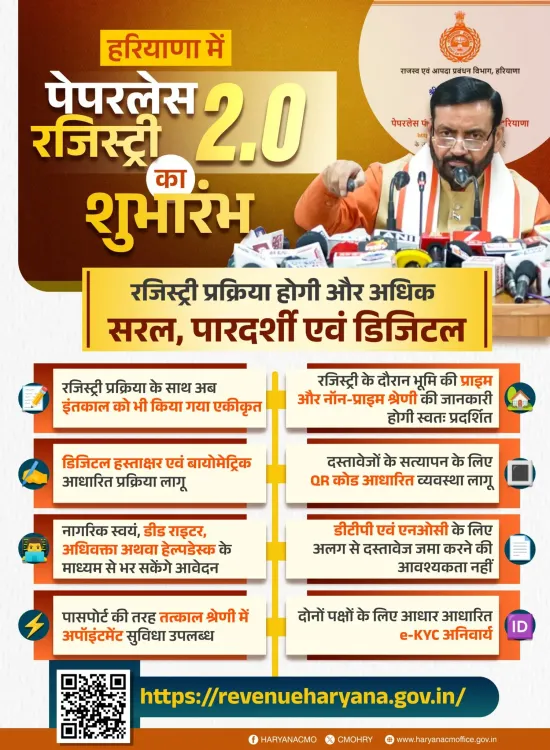
The Chief Minister's Office of Haryana announced the launch of Paperless Registry 2.0 on Tuesday, 23 June 2026, marking a significant upgrade to the state's digital land registration infrastructure. The initiative aims to make property registration simpler, more transparent, secure, and citizen-centric, according to the official post.
The CMO stated in its post: 'हरियाणा में पेपरलेस रजिस्ट्री 2.0 की शुरुआत इसके माध्यम से भूमि पंजीकरण प्रक्रिया को अधिक सरल, पारदर्शी, सुरक्षित और नागरिक-केंद्रित बनाया गया है' — ('Paperless Registry 2.0 has been launched in Haryana; through this, the land registration process has been made more simple, transparent, secure and citizen-centric'). The official portal for the initiative is revenueharyana.gov.in.
Context
Paperless Registry 2.0 is an updated digital platform designed for end-to-end online execution and registration of property documents in Haryana. The '2.0' designation signals an iterative upgrade over an earlier digital registry system, incorporating improvements to ease of use, data security, and process transparency. The platform is administered by the Revenue Department of Haryana, which manages land records, mutation processes, and citizen-facing revenue services through its digital infrastructure.
Policy Backdrop
The launch builds on the Digital India Land Records Modernization Programme (DILRMP), a national initiative started in 2008 to computerise land records and registration workflows across Indian states, including Haryana. Since the mid-2010s, multiple Indian states have progressively upgraded their online registration portals to reduce physical touchpoints, curb the role of middlemen, and integrate biometric or Aadhaar-based authentication into property transactions. Haryana's Paperless Registry 2.0 continues this trajectory of incremental digitisation under both state and central e-governance frameworks.
The broader push aligns with the central government's vision of a 'less government, more governance' model, where citizen services are delivered digitally without requiring physical presence at government offices. Land registration, historically one of the most friction-heavy and corruption-prone administrative processes in India, has been a priority target for such reforms.
Stakeholders and Impact
Property buyers, landowners, and revenue officials across Haryana stand to benefit most directly from this upgrade. For citizens, a fully digital process reduces the need for multiple visits to sub-registrar offices and limits dependence on intermediaries, potentially lowering both transaction costs and opportunities for corrupt practices. Revenue officials, in turn, gain access to a more structured and auditable digital record system.
The citizen-centric framing of the announcement suggests the platform may incorporate user-friendly interfaces, status-tracking features, and reduced documentation burdens — though specific functional specifications have not been independently verified at this stage.
What's Next
Key metrics to watch include the average property registration turnaround time under the new system, the volume of transactions processed digitally, and whether any legislative amendments are required to confer full legal sanctity on purely electronic deeds in Haryana. The state government's ability to scale the platform across all districts and sub-registrar offices will determine the real-world impact of this reform. Sustained adoption by first-time users, particularly in rural areas, will be a critical measure of the initiative's success.
Point of View
Transparency, security, and citizen-centricity — the Haryana government is signalling that this is not merely a backend IT upgrade but a service-delivery reform. The real test, however, will come in implementation: whether the platform achieves meaningful reductions in registration delays and middlemen dependency, particularly in semi-urban and rural sub-registrar offices. If Haryana can demonstrate strong adoption metrics, it could serve as a replicable model for other states still on the first iteration of digital registry systems.
NationPress
23 Jun 2026
Frequently Asked Questions
What is Paperless Registry 2.0 in Haryana?
Paperless Registry 2.0 is an upgraded digital platform launched by the Government of Haryana for end-to-end online execution and registration of property documents, accessible through revenueharyana.gov.in. It aims to make land registration simpler, more transparent, secure, and citizen-centric.
Who announced Paperless Registry 2.0 in Haryana?
The Chief Minister's Office of Haryana (CMO Haryana) announced the launch of Paperless Registry 2.0 on 23 June 2026 via an official post on X.
How does Paperless Registry 2.0 benefit property buyers in Haryana?
The platform reduces the need for multiple visits to sub-registrar offices, limits the role of intermediaries, and provides a more transparent and auditable process for property registration in Haryana.
Is Haryana's digital land registration connected to a central government scheme?
Yes, it aligns with the Digital India Land Records Modernization Programme (DILRMP), a national initiative launched in 2008 to computerise land records and registration processes across Indian states including Haryana.
Where can I access Haryana's Paperless Registry 2.0?
The platform is available through the Revenue Department of Haryana's official portal at revenueharyana.gov.in.