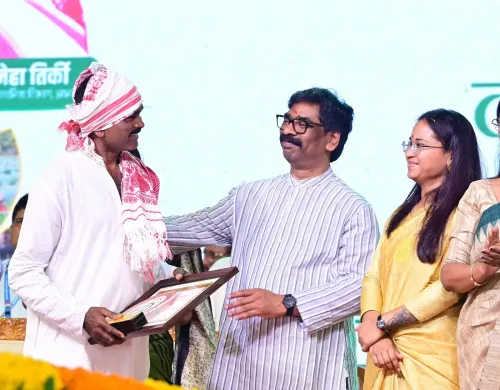
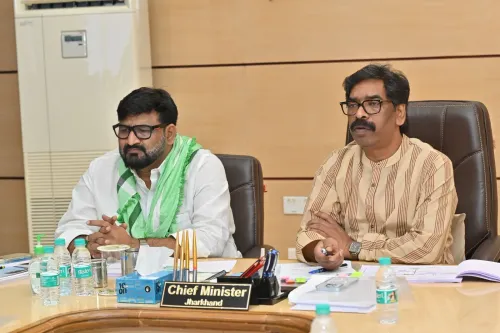
CM Hemant Soren Urges Jharkhand Farmers to Shift to Organic Farming
Synopsis
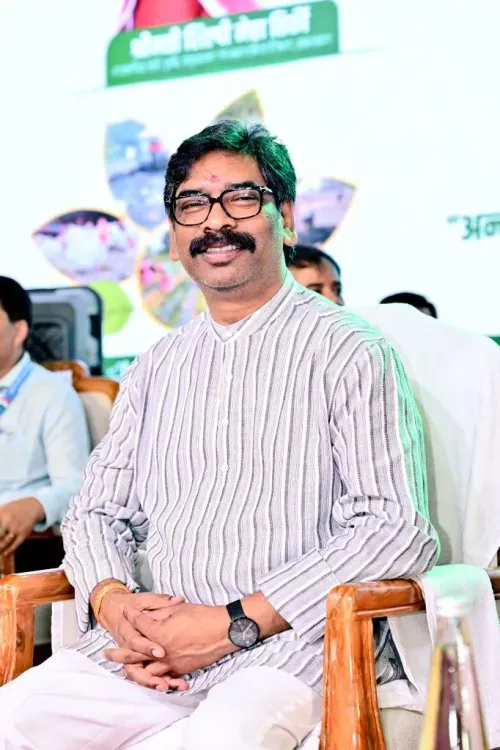
Jharkhand CM Hemant Soren on June 16, 2026, called on the state's farmers to cut chemical fertiliser use and adopt organic farming, water conservation, and modern low-water technologies to counter climate change threatening the livelihoods of the state's largely agriculture-dependent population.
Key Takeaways
Hemant Soren stated that approximately 80 per cent of Jharkhand's population depends on agriculture, making climate resilience a critical priority.
He urged farmers to shift from chemical fertilisers to organic farming for healthier soil and a safer environment.
The CM called for water conservation , afforestation , and adoption of modern technologies that maximise output with minimal water use.
The appeal aligns with the Paramparagat Krishi Vikas Yojana (PKVY) , the Central scheme promoting organic clusters since 2015 .
Jharkhand's rain-fed farming faces compounding pressures from mining, deforestation, and erratic monsoon patterns.
Policy follow-through — including micro-irrigation funding and climate-resilient seeds — will determine whether the call translates into on-ground change.
Jharkhand Chief Minister Hemant Soren on Tuesday, June 16, 2026, called on the state's farming communities to reduce dependence on chemical fertilisers and embrace organic agriculture, warning that climate change poses a direct threat to the livelihoods of a population that is overwhelmingly reliant on the land.
Context
Posting on X in Hindi, Soren noted that approximately 80 per cent of Jharkhand's population depends on agriculture — a figure that underscores the state's vulnerability to any disruption in crop cycles or water availability. 'झारखण्ड की लगभग 80 प्रतिशत आबादी खेती पर निर्भर है' ('Nearly 80 per cent of Jharkhand's population depends on farming'), he wrote, framing climate change as an immediate and practical threat rather than a distant concern.
The Chief Minister stressed a principle of reciprocity with natural resources: 'धरती से जितना पानी लेते हैं, उतना लौटाने की जिम्मेदारी भी हमारी है' ('Whatever water we take from the earth, we have an equal responsibility to return it'). He called for water conservation, afforestation, and adoption of modern technologies that produce more output with less water.
Policy Backdrop
Jharkhand, an eastern Indian state with a large tribal population and a predominantly rain-fed agricultural economy, has long faced compounding pressures from mining activity, deforestation, and erratic monsoon patterns linked to climate variability. Soil degradation and groundwater depletion have emerged as structural challenges for small and marginal farmers across the state's districts.
At the national level, the Paramparagat Krishi Vikas Yojana (PKVY), launched by the Central government in 2015, supports cluster-based adoption of organic farming and reduced chemical input use across states including Jharkhand. The National Mission for Sustainable Agriculture, a component of the 2008 National Action Plan on Climate Change, similarly funds water conservation and climate-resilient cropping in vulnerable regions. Jharkhand also introduced watershed development and agroforestry programmes in the 2010s under state agriculture missions to address soil and water stress.
Stakeholders and Impact
Soren directed his appeal specifically at the state's 'mehanatakash kisanon' — hardworking farmers — urging them to treat healthy soil, a safe environment, and a better future as inseparable goals. The shift toward organic farming, if adopted at scale, would most directly affect small and marginal farmers and tribal communities who form the backbone of Jharkhand's rural economy.
Reducing chemical fertiliser dependence carries dual benefits: lower input costs for farmers and reduced soil and water contamination over time. However, the transition typically requires sustained institutional support — including access to bio-inputs, market linkages for organic produce, and training — to be economically viable for subsistence-level cultivators.
What's Next
Attention will now turn to whether the Chief Minister's public appeal is followed by concrete budgetary or programmatic action — including expanded organic clusters under PKVY, state funding for micro-irrigation, or the introduction of climate-resilient seed varieties ahead of the 2026 monsoon season. Jharkhand's ability to operationalise the balance between development and environmental protection that Soren has articulated will be tested in the coming agricultural cycle, with small farmers watching closely for policy support to match the political intent.
Point of View
He signals alignment with both environmental sustainability and the economic anxieties of small farmers squeezed by rising input costs. The appeal also implicitly frames the Centre's PKVY as an instrument the state is willing to deepen, potentially building a case for enhanced Central allocations. Whether this translates into a measurable policy shift or remains aspirational rhetoric will depend on the next state budget and district-level implementation data.
NationPress
15 Sept 2026
Frequently Asked Questions
What did Hemant Soren say about farming in Jharkhand?
On June 16, 2026, Jharkhand CM Hemant Soren urged farmers to shift from chemical fertilisers to organic farming, adopt water conservation practices, and use modern technologies that produce more with less water, citing climate change as a direct threat to the state's agriculture-dependent population.
How much of Jharkhand's population depends on agriculture?
Chief Minister Hemant Soren stated in his post that approximately 80 per cent of Jharkhand's population depends on agriculture, highlighting the scale of risk posed by climate change to the state's rural economy.
What is the Paramparagat Krishi Vikas Yojana and does it apply to Jharkhand?
The Paramparagat Krishi Vikas Yojana (PKVY) is a Central government scheme launched in 2015 to promote cluster-based organic farming and reduce chemical input use; Jharkhand is among the states covered under this programme.
What steps is the Jharkhand government taking on water conservation in farming?
CM Soren has publicly called for water conservation, afforestation, and adoption of low-water modern agricultural technologies, though specific new state budget allocations or programme launches tied to this appeal are yet to be announced.
Why is organic farming important for Jharkhand's tribal farmers?
Jharkhand's tribal and small farming communities face soil degradation and groundwater stress from mining and deforestation; organic farming reduces chemical input costs and improves soil health, making it particularly relevant for subsistence-level cultivators in the state.