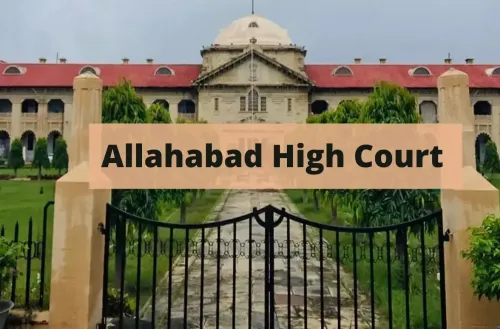
Allahabad High Court Demands Accountability from Police for Ignoring SC Arrest Protocols

Synopsis
In a recent ruling, the Allahabad High Court has taken a strong stance against Prayagraj police for their mishandling of an arrest, emphasizing adherence to Supreme Court guidelines. This case underscores the importance of lawful conduct by law enforcement.
Key Takeaways
Accountability : The court's ruling stresses police responsibility in adhering to legal protocols.
Judicial Oversight : The Allahabad High Court's intervention showcases the judiciary's role in upholding rights.
Legal Recourse : Individuals can pursue remedies when their rights are violated during arrests.
Timeliness of Compliance : The court's emphasis on immediate action underscores the necessity for prompt law enforcement responses.
Impact on Police Practices : This case may lead to changes in police training and conduct regarding arrests.
Prayagraj/New Delhi, March 1 (NationPress) The Allahabad High Court has reprimanded police officials from Prayagraj for their handling of a recent arrest and the delayed release of an individual involved in an Arms Act case, noting that their actions constituted contempt of the Supreme Court’s guidelines related to arrests for offenses carrying a potential sentence of up to seven years.
A Division Bench comprising Justices Siddharth and Jai Krishna Upadhyay mandated that action be taken against the negligent police personnel while considering a habeas corpus petition submitted by Sachin Arya, also known as Sachin Bhartiya, who contested his arrest and subsequent detention by the Prayagraj police.
The order issued on February 12 highlighted that the petitioner was detained under Sections 3 and 25(1B)(a) of the Arms Act, 1959, which stipulate penalties ranging from two to five years. Consequently, the court determined that the arrest did not align with the standards set forth by the Supreme Court in the case of Satender Kumar Antil vs. CBI and Anr.
In its ruling, the Allahabad High Court ordered the petitioner’s immediate release, stating that he “be released forthwith without awaiting the delivery of a certified copy of this order to Respondent Nos. 4 and 5.” With the Station House Officer (SHO) from Police Station Dhoomanganj present in court, the Bench emphasized that “the order must be executed immediately without waiting for a certified copy.”
However, in a follow-up order on February 17, the court noted that its directive was followed only after approximately 20 hours. “It is evident that this court's order was executed after about 20 hours of its issuance. Therefore, the court finds that Respondents Nos. 4 and 5 display a lack of respect for the law,” remarked the Justice Siddharth-led Bench.
The court instructed the Prayagraj Commissioner of Police to “initiate suitable action” against both SHO Dhoomanganj and SI Digvijay Singh, who oversees T.P. Nagar, within three days, and to report back on compliance before the next hearing.
When the case was revisited on February 23, the Allahabad High Court expressed its dissatisfaction with the measures taken and instructed the Commissioner of Police to submit a personal affidavit outlining the disciplinary actions initiated against the implicated officials, along with steps taken to ensure the dissemination and enforcement of Supreme Court guidelines across police stations.
During the final session on February 25, the Justice Siddharth-led Bench acknowledged that the petitioner had been released from custody and concluded the habeas corpus petition. While it denied compensation in the habeas corpus proceedings, the court made it clear that the petitioner retained the right to pursue any other legal remedies available.
“Since this petition is fundamentally a Habeas Corpus matter, a direction for compensation cannot be provided. However, it remains open for the petitioner to seek any other legal recourse,” stated the Justice Siddharth-led Bench.
Upon dismissing the petition, the Allahabad High Court remarked that the Commissioner of Police, Prayagraj, was expected to carry out the disciplinary process already initiated to its logical conclusion.
Frequently Asked Questions
What triggered the Allahabad High Court's action against the police?
The court acted after a habeas corpus petition revealed the delayed release of a man arrested under the Arms Act, which violated Supreme Court guidelines.
What are the implications of the court's order for police conduct?
The ruling emphasizes the necessity for police to comply with legal standards and respect the rights of individuals during arrests.
Can the petitioner seek compensation after the court's ruling?
While the court did not grant compensation in this instance, the petitioner retains the right to pursue other legal remedies.
What actions were directed by the Allahabad High Court against the police officials?
The court instructed the Prayagraj Commissioner of Police to take disciplinary action against the involved SHO and SI within three days.
Why is this case significant?
It underscores the importance of adhering to Supreme Court guidelines and maintaining accountability within law enforcement.