Himachal CMO: All UG Courses to Shift to Semester System
Synopsis
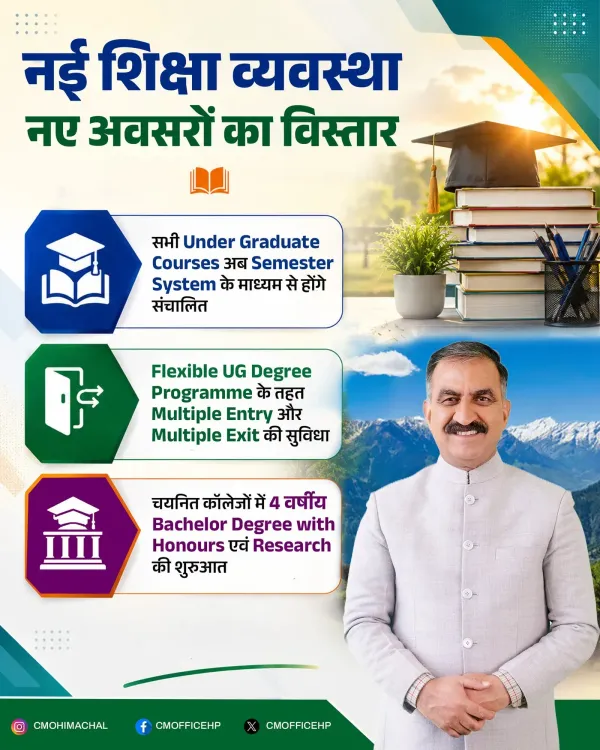
The Chief Minister's Office of Himachal Pradesh announced that all undergraduate courses in the state will be brought under the semester system, with a new Flexible UG Degree Program offering students multiple entry and multiple exit options, aligning the state with the National Education Policy 2020 and UGC's credit framework.
Key Takeaways
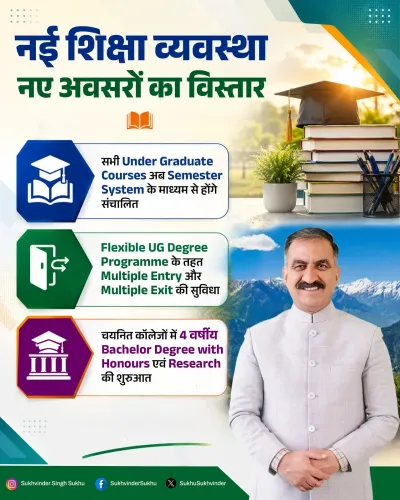
All UG courses in Himachal Pradesh will be brought under the semester system, the state CMO announced on 3 June 2026.
A Flexible Undergraduate Degree Program will give students multiple entry and multiple exit options.
The shift aligns the state with the National Education Policy 2020 and the UGC's 2021 Curriculum and Credit Framework.
Stakeholders include undergraduate students, state universities and affiliated colleges across districts such as Shimla, Kangra, Mandi and Solan.
A formal state higher education department notification is awaited on the rollout timeline and courses covered.
The Chief Minister's Office of Himachal Pradesh announced on 3 June 2026 that the state government will bring all undergraduate (UG) programmes under the semester system, while introducing a Flexible UG Degree structure that allows students multiple entry and multiple exit options. The announcement, made via the official handle of the CMO, signals a formal alignment of the state's higher education architecture with the national credit and curriculum framework.
In its post, the CMO stated that 'to make higher education more student-centric, our government will run all undergraduate (UG) courses under the semester system,' adding that under the Flexible Undergraduate Degree Program, students will be provided the facility of Multiple Entry evam Multiple Exit (multiple entry and multiple exit).
Context
The shift marks a significant structural change for Himachal Pradesh's state universities and their affiliated colleges, many of which still operate parts of their undergraduate offerings on an annual examination pattern. A semester-based assessment splits each academic year into two evaluative cycles, while multiple entry-exit allows learners to leave with a certificate, diploma or degree depending on the number of credits accumulated, and re-enter later to complete the qualification.
The CMO's post did not specify the academic session from which the new structure will take effect, nor the full list of courses to be brought under it. A detailed notification from the state higher education department is expected to follow.
Policy backdrop
The announcement follows the template set by the National Education Policy 2020, which explicitly recommended semester systems and multiple entry-exit facilities across all undergraduate degrees in India. The University Grants Commission operationalised this through its Curriculum and Credit Framework for Undergraduate Programmes, issued in 2021, which directed universities to adopt modular, credit-based degrees with flexible exit points.
Since then, several states — including Maharashtra, Karnataka and Madhya Pradesh — have issued comparable notifications. Himachal Pradesh's move continues that nationwide convergence, formally folding the hill state's UG ecosystem into the same credit architecture.
Stakeholders and impact
The primary stakeholders are undergraduate students across the state's universities and affiliated colleges, who stand to gain greater flexibility in pacing their degrees and combining academic work with internships, employment or care responsibilities. Under the multiple entry-exit design, a student who completes one year of study can typically receive a certificate, two years a diploma, and three or four years a bachelor's degree, with the option of re-joining within a stipulated period to upgrade the qualification.
For state universities and colleges, the transition implies a substantial administrative lift: redesigning syllabi into credit-weighted modules, conducting two examination cycles a year instead of one, training faculty on continuous assessment, and integrating with a national credit-banking system that records and stores academic credits digitally.
Affiliated colleges in districts such as Shimla, Kangra, Mandi and Solan — which together host the bulk of the state's UG enrolment — will need to recalibrate academic calendars and internal evaluation processes to match the new framework.
What's next
Attention now turns to the formal notification from the state higher education department, which is expected to specify the academic session for full rollout, the courses covered, and any accompanying faculty training programme or IT portal for credit storage and transfer. The pace at which state universities update their ordinances and examination regulations will determine how quickly the announced flexibility translates into a lived experience for students.
If implemented in step with the broader national framework, the change could position Himachal Pradesh's undergraduate graduates to move more seamlessly between institutions and across state lines, with their credits recognised under a common system — a quiet but consequential reshaping of how a degree is earned in the hill state.
Point of View
The Himachal government is choosing to own the NEP's flexibility narrative rather than treat it as a top-down imposition. The real test will lie in implementation capacity — examination reform, faculty training and credit-banking integration are where similar rollouts in larger states have slowed. If Himachal sequences these well, it could become a useful template for smaller hill states.
NationPress
17 Oct 2026
Frequently Asked Questions
What did the Himachal Pradesh CMO announce about UG courses?
The Himachal Pradesh CMO announced that all undergraduate (UG) courses in the state will be run under the semester system, and that a Flexible UG Degree Program will offer students multiple entry and multiple exit options.
What is the Flexible UG Degree Program with multiple entry and exit?
It is a degree structure in which students can exit after completing a certain number of credits — typically with a certificate, diploma or degree — and re-enter later to complete higher qualifications, instead of being locked into a single continuous course.
Is the Himachal Pradesh announcement linked to NEP 2020?
Yes. The National Education Policy 2020 recommended semester systems and multiple entry-exit options for all UG degrees, and the UGC's 2021 Curriculum and Credit Framework provided the operational template that states like Himachal Pradesh are now adopting.
From which academic year will the semester system apply in Himachal Pradesh?
The CMO's post did not specify the academic session for full rollout. A detailed notification from the state higher education department is expected to clarify the timeline and the list of courses covered.
Which students and institutions will be affected by the change?
Undergraduate students enrolled in Himachal Pradesh's state universities and their affiliated colleges across districts such as Shimla, Kangra, Mandi and Solan will be directly affected, along with faculty and examination systems of these institutions.