Manmohan Singh vindicated by Supreme Court, history will judge him kindly: Sonia Gandhi
Synopsis
Weeks after the Supreme Court upheld the CBI's clean chit to Manmohan Singh in the coal block case, Sonia Gandhi has written a sweeping column reclaiming his legacy — calling the decade-long campaign against him a coordinated witch-hunt and drawing a direct line between his vindication and what she calls the Modi government's misuse of investigative agencies.
Key Takeaways
The Supreme Court on 29 July 2026 upheld the CBI's clean chit to Dr Manmohan Singh in the coal block allocation case and pulled up the trial court for adverse observations made without compelling reason.
Sonia Gandhi wrote in The Indian Express on 11 August that the judgment concludes what she called a 'witch-hunt' against Dr Singh, alleging involvement of the RSS and BJP .
Gandhi accused the Modi government of misusing the ED and CBI for political coercion, contrasting it with Dr Singh's record of integrity.
She cited the UPA's 10-year economic record , MGNREGA , the RTI Act , the National Food Security Act , and the Indo-US nuclear deal as pillars of Dr Singh's legacy.
Gandhi recalled Modi's Rajya Sabha remarks of 8 February 2017 about Dr Singh, calling them 'the lowest point of our parliamentary history.' She closed by invoking Dr Singh's January 2014 prediction , saying it is becoming 'increasingly self-evident with every passing day.'
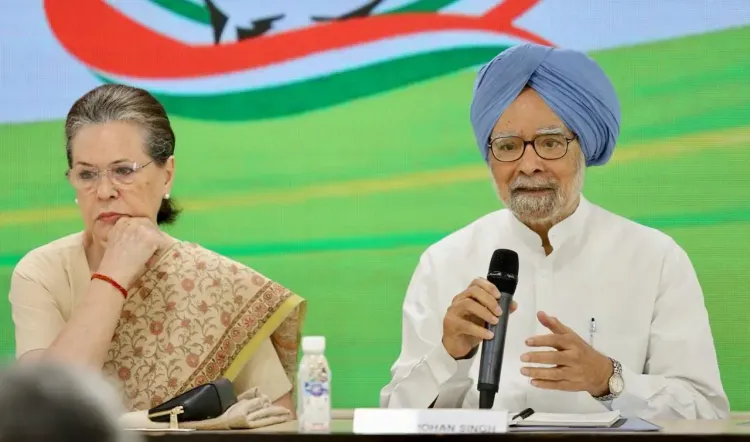
Congress Parliamentary Party (CPP) Chairperson Sonia Gandhi on Tuesday, 11 August wrote a column in The Indian Express asserting that history will remember former Prime Minister Dr Manmohan Singh as 'a quiet, gentle, but a most consequential Prime Minister' — her remarks coming weeks after the Supreme Court upheld the CBI's clean chit to Dr Singh in the alleged coal block allocation scam.
The Supreme Court Judgment
Sonia Gandhi anchored her column in the Supreme Court's ruling of 29 July 2026, which she described as 'an important but unacknowledged day in our recent political history.' The court upheld the CBI's closure report in the coal block allocation case and, according to Gandhi, reprimanded the trial court for making adverse observations against Dr Singh without any 'compelling reason.' Gandhi wrote that the judgment 'brings to a conclusion one of the most tragic arcs of our public discourse — the witch-hunt against Dr Singh, a man of the most remarkable probity and integrity.'
She alleged that the campaign against the former Prime Minister was 'coordinated and well-organised, with actors stretching from the bureaucracy to the media, the judiciary, civil society, and most certainly to the RSS and BJP.' Gandhi said the vindication was now complete: 'Dr Singh has been vindicated on every count.'
Contrast with the Current Government
Gandhi drew a sharp contrast between Dr Singh's governance record and what she described as the misuse of investigative agencies under Prime Minister Narendra Modi. 'Dr Singh's record of integrity and accountability stands in stark contrast to how the Narendra Modi government has operated, so clearly and grossly misusing agencies designed to investigate crime and corruption like the ED and the CBI,' she wrote.
She alleged a pattern of political coercion: 'Leaders are either silenced through coercion or cynically folded into the BJP or, in some remarkable instances, rewarded with ministerial positions as well. Corrupt when you're in the opposition, suddenly clean when you jump ship.' Gandhi also recalled Modi's remarks in the Rajya Sabha on 8 February 2017 — that Dr Singh knew 'the art of bathing with a raincoat on' — calling them 'the lowest point of our parliamentary history.'
Economic and Social Legacy of the UPA Era
Gandhi argued that the attack on Dr Singh was driven by a desire to obscure his governance record. She cited the UPA government's decade as a period of 'unprecedented rates of growth and a consumption and private investment boom that propelled us into the ranks of middle-income countries.' She claimed that, even accounting for revisions in GDP calculation methodology, the 10 years of UPA rule recorded higher economic growth than the subsequent 12 years, lifting millions out of poverty.
On social policy, she credited the Manmohan Singh government with landmark legislation: the Right to Education Act, the Forest Rights Act, the National Food Security Act, 2013, and the Mahatma Gandhi National Rural Employment Guarantee Act (MGNREGA). She argued that MGNREGA proved its worth during the Covid-19 pandemic as one of only two channels through which the government could reach the poorest citizens. She alleged that the current government has 'recently demolished' MGNREGA and is 'seeking to amend' the National Food Security Act.
Institutional Freedoms and Global Standing
Gandhi credited Dr Singh with strengthening democratic institutions, citing the Right to Information (RTI) Act, an 'explosion of independent media,' and space for civil society and student protest. She said the RTI 'now stands totally emasculated.' She also highlighted the Indo-US nuclear deal as evidence of Dr Singh's political courage, calling it a 'path-breaking' accord that 'overturned decades of nuclear discrimination against India and marked our arrival on the global stage.'
Citing Dr Singh's prediction from January 2014, Gandhi concluded: 'His prophetic prediction is becoming increasingly self-evident with every passing day. History will indeed remember him kindly as a quiet, gentle, but a most consequential prime minister.' She expressed regret that Dr Singh was not alive to witness his vindication.
Point of View
She is attempting to reframe the coal scam not as a UPA-era scandal but as a BJP-era political weapon. The argument is strongest when it cites the court's rebuke of the trial court; it is weakest when it conflates institutional decay with partisan design, since courts and media pressures have complex, multi-causal origins. The column also sidesteps the UPA's own accountability gaps — from 2G to Commonwealth Games — which formed the political context in which the coal scrutiny arose. That selective framing will limit its persuasive reach beyond the party faithful.
NationPress
11 Aug 2026
Frequently Asked Questions
What did the Supreme Court rule regarding Manmohan Singh and the coal scam?
On 29 July 2026, the Supreme Court upheld the CBI's closure report giving a clean chit to Dr Manmohan Singh in the alleged coal block allocation scam. The court also criticised the trial court for making adverse observations against the former Prime Minister without any compelling reason, according to Sonia Gandhi's column.
What did Sonia Gandhi write about Manmohan Singh's legacy?
In a column in The Indian Express on 11 August, Sonia Gandhi described Dr Singh as 'a quiet, gentle, but a most consequential Prime Minister,' crediting his government with landmark legislation including MGNREGA, the RTI Act, the Right to Education, the National Food Security Act, and the Indo-US nuclear deal. She argued his decade in office delivered higher economic growth than the subsequent 12 years.
What allegations did Sonia Gandhi make against the Modi government?
Gandhi alleged that the Modi government has 'clearly and grossly misused' agencies like the ED and CBI for political purposes — silencing opponents through coercion or absorbing them into the BJP. She also accused the government of dismissing credible corruption allegations against its own allies while weaponising agencies against the opposition.
What were Modi's 2017 Rajya Sabha remarks that Sonia Gandhi referred to?
On 8 February 2017, Prime Minister Narendra Modi reportedly said in the Rajya Sabha that Dr Manmohan Singh knew 'the art of bathing with a raincoat on' — a remark Gandhi described as 'snide and atrocious' and 'the lowest point of our parliamentary history.'
Why does Sonia Gandhi say MGNREGA matters in the current context?
Gandhi argued that MGNREGA, introduced under Dr Singh's government, proved to be one of only two government channels capable of reaching the poorest citizens during the Covid-19 pandemic. She alleged the Modi government has 'recently demolished' the scheme and is also seeking to amend the National Food Security Act, 2013 — moves she said Dr Singh had warned about in January 2014.