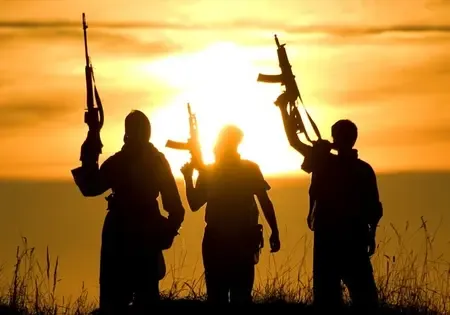
Concerns Rise as Khalid bin Walid Camp of Hizbul Mujahideen Reopens

Synopsis
Recent intelligence suggests that the Hizbul Mujahideen is attempting to revive its operations in Jammu and Kashmir, raising alarms among security agencies. This potential resurgence is centered around the Khalid bin Walid camp in Pakistan, which has resumed activities despite previous setbacks.
Key Takeaways
Hizbul Mujahideen's potential resurgence poses security concerns.
Khalid bin Walid camp has resumed operations.
Local recruitment is a key strategy for revitalization.
ISI is focused on reinvigorating the group amidst increased security measures.
Monitoring of activities in Jammu and Kashmir is crucial.
New Delhi, March 30 (NationPress) Although the Hizbul Mujahideen seems to have diminished significantly, Indian intelligence agencies have intercepted signals suggesting a potential resurgence of the militant group. The leadership has remained under the radar for several years.
Most of the organization's operatives have been eradicated in Jammu and Kashmir. The crackdown initiated after the killing of Burhan Wani continued until the major commanders were eliminated in the region.
During Operation Sindoor, the Hizbul Mujahideen suffered substantial losses as their terror infrastructure was dismantled. This operation was launched by Indian forces as retaliation for the Pahalgam attack that resulted in the deaths of numerous innocent tourists.
An official from the Intelligence Bureau stated that while the Hizbul Mujahideen appears to be on the verge of collapse, the leadership has opted for a calculated silence to create the illusion that the group is no longer a threat. In truth, there have been silent efforts over the past few months aimed at reviving the militant organization for renewed operations in Jammu and Kashmir.
The official elaborated that the ISI finds it crucial to re-establish the Hizbul Mujahideen, as it has historically garnered considerable local support in Jammu and Kashmir. Although the ISI attempted to promote The Resistance Front, its impact has been limited, largely because it’s recognized as a splinter group of Lashkar-e-Taiba.
The ISI is optimistic that a revitalized Hizbul Mujahideen will attract local recruits, which has become essential as it seeks a homegrown militant faction. Due to the intensified crackdowns on terror networks in Pakistan, the ISI has struggled to infiltrate operatives into India. This challenge has been exacerbated by heightened security measures along the borders, including the Line of Control (LoC) and International Border (IB).
Officials have reported increased activity at the Khalid bin Walid camp in Guldheri Mohalla, Garhi Habibullah, Balakot, Pakistan. This camp, associated with the Hizbul Mujahideen, had been inactive following the Balakot airstrike conducted by the Indian Air Force (IAF), which targeted a Jaish-e-Mohammed training center.
According to recent intelligence reports, the Khalid bin Walid camp has resumed operations. The Hizbul Mujahideen members affiliated with this camp are adopting a low-profile approach, fully aware of the proximity of their location to IAF capabilities, leading to more discreet activities.
The reopening of this camp raises concerns for Indian security agencies, as it is not just any training facility; before the 2019 Balakot airstrikes, it was responsible for training around 100 militants annually. Notable figures like Wani and Riyaz Naikoo were among those trained at the Khalid bin Walid camp.
Additionally, the ISI has deployed some Lashkar-e-Taiba operatives to aid the Hizbul Mujahideen in training and recruitment efforts. The group has been actively seeking individuals who have crossed over from Jammu and Kashmir into Pakistan over the last few years, indicating a clear preference for local recruits rather than outsiders.
The Hizbul Mujahideen aims to avoid including Pakistanis in its ranks, fearing that this could diminish its local appeal. Historical data suggests that the group thrived under local leadership, particularly during Burhan Wani’s tenure. Thus, the Hizbul Mujahideen is striving to replicate its past successes from before 2016.
The decline of the Hizbul Mujahideen began after Burhan Wani was killed on July 8, 2016. Officials are closely monitoring the developments at Balakot, as well as the support network for this group within Jammu and Kashmir. It is critical to maintain stability in the Valley to prevent any resurgence of such groups as the Hizbul Mujahideen attempts to regain its footing.
Point of View
It is crucial to highlight the potential resurgence of the Hizbul Mujahideen and its implications for security in Jammu and Kashmir. The ongoing monitoring of their activities underscores the need for vigilance in maintaining peace in the region.
NationPress
19 Sept 2026
Frequently Asked Questions
What is the Khalid bin Walid camp?
The Khalid bin Walid camp is a training facility associated with the Hizbul Mujahideen located in Balakot, Pakistan, known for training militants.
Why is the Hizbul Mujahideen considered a threat?
The Hizbul Mujahideen is considered a threat due to its history of armed operations in Jammu and Kashmir, aiming to recruit locals for its activities.
What has led to the revival of the Hizbul Mujahideen?
Recent intelligence suggests a silent effort to revive the Hizbul Mujahideen, focusing on local recruitment and re-establishing its operational capabilities.
What is the role of the ISI in this situation?
The ISI aims to bolster the Hizbul Mujahideen as it remains the most influential group in Jammu and Kashmir, seeking to restore its operational strength.
How did Burhan Wani's death affect the Hizbul Mujahideen?
Burhan Wani's death in 2016 marked the beginning of a decline for the Hizbul Mujahideen, significantly impacting its recruitment and operational capacity.