HP CM Office Dedicates 33/11 kV Sub-Station to Sujanpur Region
Synopsis
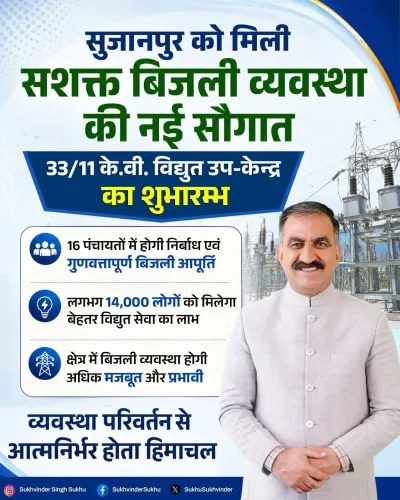
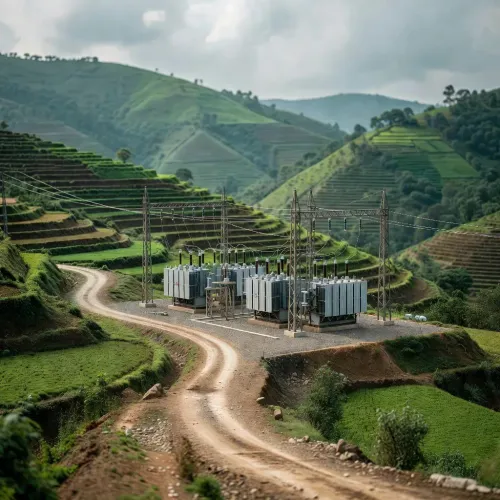
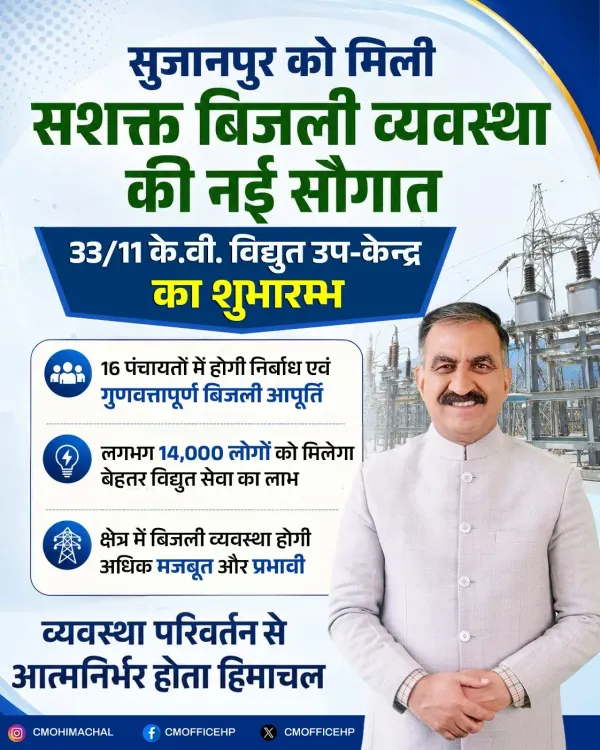
The Chief Minister's Office of Himachal Pradesh dedicated a new 33/11 kV electricity sub-station at Patalandar (Ansla) in Sujanpur on 9 July 2026, promising uninterrupted power to around 14,000 people across 16 gram panchayats in the hilly region.
Key Takeaways
The CMO Himachal Pradesh dedicated the 33/11 kV sub-station at Patalandar (Ansla) on 9 July 2026 .
The sub-station is designed to serve approximately 14,000 residents in the Sujanpur region .
A total of 16 gram panchayats in the Sujanpur area will receive improved and uninterrupted electricity supply.
The project aligns with Himachal Pradesh's policy of expanding its 33 kV and 11 kV distribution network to address last-mile supply gaps.
The initiative is consistent with central schemes like the Deen Dayal Upadhyaya Gram Jyoti Yojana aimed at rural electrification infrastructure.
Reduced feeder length from the new sub-station is expected to lower transmission losses and stabilise voltage for rural consumers.
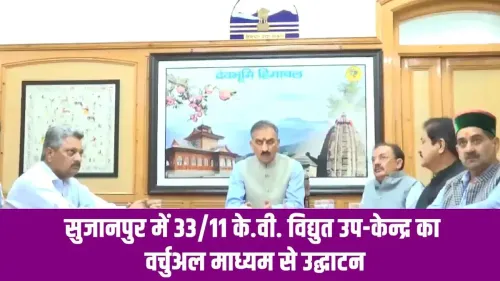
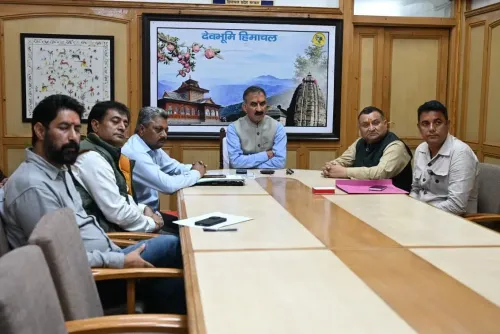
The Chief Minister's Office of Himachal Pradesh on Thursday, 9 July 2026, announced the dedication of a new 33/11 kV electricity sub-station at Patalandar (Ansla) in the Sujanpur region, aimed at delivering uninterrupted power supply to rural communities across 16 gram panchayats.
Context
The post, shared on the official CMO Himachal Pradesh handle, states: 'Sujanpur kshetra ke bhaion-bahnon ki seva hetu 33/11 kV vidyut up-kendra, Patalandar (Ansla) samarpit hai' — meaning, 'This 33/11 kV electricity sub-station, Patalandar (Ansla), is dedicated to the service of the brothers and sisters of the Sujanpur region.' The announcement specifies that approximately 14,000 people across the area's 16 gram panchayats will benefit from improved and uninterrupted electricity supply.
Sujanpur is an assembly constituency and rural region in Hamirpur district, Himachal Pradesh, characterised by dispersed habitations spread across hilly terrain. Residents in such areas have historically faced voltage fluctuations and outages owing to long radial feeder lines that stretch over difficult topography.
Policy Backdrop
Himachal Pradesh has been incrementally expanding its 33 kV and 11 kV distribution network as part of state power sector augmentation programmes and in alignment with central schemes such as the Deen Dayal Upadhyaya Gram Jyoti Yojana (DDUGJY), which has been the primary policy vehicle for rural electrification infrastructure since the mid-2010s. The state's approach has focused on last-mile supply reliability rather than new generation assets, given its already substantial hydropower generation capacity.
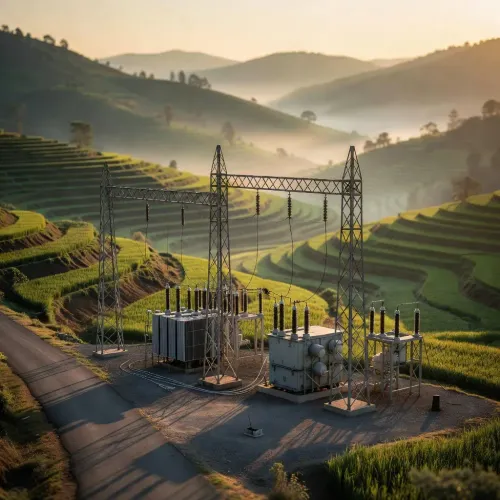
Commissioning sub-stations of this type is a standard intervention for Himalayan state utilities: a dedicated 33/11 kV sub-station reduces feeder length, lowers transmission losses, and stabilises voltage at the consumer end — particularly important for agricultural pump-sets, small businesses, and households in remote panchayats.
Stakeholders and Impact
The primary beneficiaries are the estimated 14,000 rural residents of 16 gram panchayats in the Sujanpur segment. For these communities, reliable electricity underpins daily livelihoods — from lighting and domestic appliances to small-scale commerce and irrigation. Reduced outages also lower dependence on diesel generators, cutting informal energy costs for households.
The move is consistent with a broader pattern across Himalayan state governments, which have been commissioning distribution sub-stations to address chronic supply quality problems rather than waiting for large-scale grid upgrades. Local panchayat bodies and the Himachal Pradesh State Electricity Board (HPSEB) are the key institutional actors responsible for the sub-station's ongoing operation and maintenance.
What's Next
Attention will now turn to whether the commissioning of the Patalandar (Ansla) sub-station delivers measurable improvements — specifically, a reduction in transformer failures, consumer complaints, and outage duration in the Sujanpur segment. The state's annual power plan lists several similar sub-station projects, and the progress of those proposals will indicate the pace of rural electrification consolidation across Himachal Pradesh.
As the state continues to balance its hydropower surplus with distribution-side weaknesses, targeted sub-station investments like this one represent the critical last link between generation capacity and the rural consumer — a gap that policy-makers across hill states are under pressure to close.
Point of View
A constituency that has historically been a bellwether. The 16-panchayat coverage figure also reflects a deliberate aggregation of beneficiaries to maximise political visibility. More broadly, it underscores that rural electrification in India has shifted from 'connection' metrics to 'quality of supply' metrics — a harder, costlier, and more politically rewarding frontier.
NationPress
9 Jul 2026
Frequently Asked Questions
What is the 33/11 kV sub-station at Patalandar (Ansla) in Sujanpur?
It is a newly dedicated electricity distribution sub-station in the Sujanpur region of Himachal Pradesh, designed to step down power from 33 kV to 11 kV for local distribution, reducing transmission losses and improving voltage stability for rural consumers.
How many people will benefit from the Patalandar sub-station in Sujanpur?
According to the Chief Minister's Office of Himachal Pradesh, approximately 14,000 people across 16 gram panchayats in the Sujanpur region are expected to receive improved and uninterrupted electricity supply.
Which district does Sujanpur fall under in Himachal Pradesh?
Sujanpur is an assembly constituency located in Hamirpur district of Himachal Pradesh.
What central scheme supports rural sub-station projects in Himachal Pradesh?
The Deen Dayal Upadhyaya Gram Jyoti Yojana (DDUGJY) has been a key central scheme supporting rural electrification infrastructure, including distribution sub-stations, in Himachal Pradesh since the mid-2010s.
Why are 33/11 kV sub-stations important for hilly states like Himachal Pradesh?
In hilly terrain, long radial feeder lines cause voltage fluctuations and frequent outages. Dedicated 33/11 kV sub-stations reduce feeder length, lower transmission losses, and stabilise voltage — directly improving power quality for remote rural households and small businesses.