HP CM Office: Himachal Cherry, Plum Hit Oman Markets
Synopsis
The Chief Minister's Office of Himachal Pradesh announced on 3 July 2026 that the state's first consignment of cherries and plums has reached Oman, marking a new chapter in the state's push to diversify its horticulture exports beyond domestic markets into the Gulf.
Key Takeaways
The Chief Minister's Office of Himachal Pradesh confirmed the first consignment of Himachal cherries and plums has reached Oman as of 3 July 2026 .
The development marks the opening of a new Gulf export corridor for Himachal Pradesh's temperate-fruit sector.
The move aligns with India's Agricultural Export Policy 2018 , which targets diversification of horticultural export markets.
APEDA and state horticulture missions have been key institutional enablers of this export push toward Gulf Cooperation Council nations.
Himachal Pradesh's fruit growers stand to benefit from improved farmgate prices through reduced dependence on domestic wholesale markets.
Future volume, value, and phytosanitary protocol updates will determine whether this becomes a sustained trade corridor.
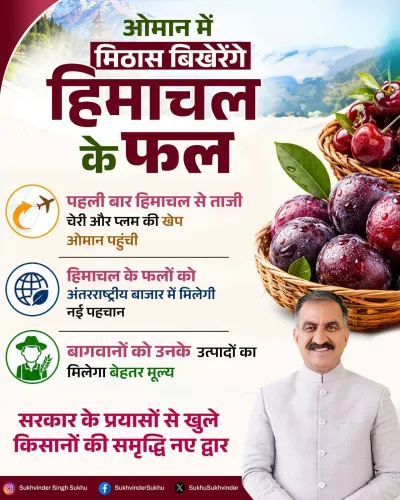
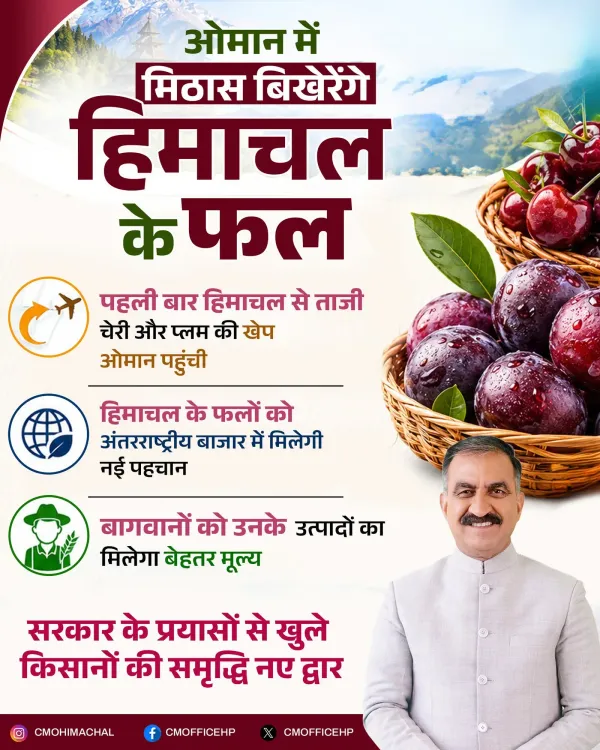
The Chief Minister's Office of Himachal Pradesh announced on Friday, 3 July 2026 that the first consignment of Himachal Pradesh's cherries and plums has reached Oman, marking a significant milestone for the state's horticulture sector and its growers.
The post, shared in Hindi, reads: 'गुणवत्ता और मेहनत को दुनिया हमेशा स्वीकार करती है' ('The world always recognises quality and hard work. When excellent products find new global markets, the scope of opportunities expands on its own and new doors of progress open for horticulturalists. The first consignment of Himachal's cherries and plums reaching Oman is a joyful and proud step in this direction.')
Context
Himachal Pradesh's temperate Himalayan belt — spanning districts such as Shimla, Kullu, Kinnaur and Lahaul-Spiti — has long been the backbone of India's domestic supply of cherries and stone fruits. Until recently, these fruits were sold almost entirely in domestic markets, with limited penetration into international trade. The arrival of the first export consignment in Oman signals a deliberate push to change that equation.
The announcement comes during the peak summer harvest window, when Himachal's cherry and plum yields are at their highest. Reaching a Gulf market at this stage requires coordinated cold-chain logistics and compliance with phytosanitary standards — both of which have been areas of active investment by the state.
Policy Backdrop
India's Agricultural Export Policy 2018 set an explicit goal of diversifying export destinations for horticultural produce and raising its share in overall agricultural exports. Himachal Pradesh's state horticulture missions, active since the mid-2000s, have focused on quality improvement and market-linkage infrastructure for temperate fruits, aligning closely with this national framework.
APEDA (Agricultural and Processed Food Products Export Development Authority), the central government agency that promotes and regulates agri-exports, has been a key institutional player in opening Gulf Cooperation Council markets to Indian fresh produce. India's broader strategy has included improved logistics corridors and stricter quality grading to meet international buyer requirements. The Oman consignment fits squarely within this multi-year policy arc.
Gulf nations, including Oman, have emerged as priority destinations for Indian fresh produce under expanding bilateral agricultural trade arrangements. West Asia's demand for premium fruit, combined with India's improving cold-chain infrastructure, has made this corridor increasingly viable for perishable, high-value crops.
Stakeholders and Impact
The most direct beneficiaries are Himachal Pradesh's fruit growers — estimated to number in the hundreds of thousands across the state's horticulture-dependent districts. Access to export markets typically translates into better farmgate prices, reducing growers' dependence on domestic wholesale intermediaries and seasonal price crashes.
Beyond individual farmers, the development carries implications for ancillary sectors: cold-storage operators, logistics providers, packaging units, and quality-testing laboratories all stand to gain from a sustained export pipeline. For the state government, successful export diversification strengthens the case for continued investment in horticulture infrastructure.
What's Next
The immediate question is whether this inaugural consignment translates into a regular, commercially viable trade corridor. Volume and value data from subsequent shipments, and any formal updates to India-Oman bilateral trade protocols on phytosanitary and quality standards, will determine how durable this market opening proves to be.
If Oman proves receptive, it could serve as a template for expanding Himachal's temperate-fruit exports to other Gulf Cooperation Council nations. For India's broader agricultural export ambitions, the success of high-value, perishable horticultural produce in West Asian markets would represent a meaningful proof of concept — and a model other hill states could seek to replicate.
Point of View
The optics are useful: it positions the administration as a facilitator of farmer prosperity rather than a passive observer of market forces. Viewed against India's broader West Asia outreach, the development also underscores how agricultural diplomacy is increasingly woven into bilateral trade frameworks with Gulf nations. The real test, however, will be whether institutional support sustains the cold-chain and quality infrastructure needed to make this corridor commercially durable beyond a symbolic first shipment.
NationPress
3 Jul 2026
Frequently Asked Questions
Which Himachal Pradesh fruits have been exported to Oman?
Cherries and plums grown in Himachal Pradesh have been exported to Oman in what the Chief Minister's Office described as the state's first such consignment to that country.
Why is Himachal Pradesh exporting fruits to Oman?
Oman and other Gulf nations have emerged as priority markets under India's Agricultural Export Policy 2018, which seeks to diversify export destinations for high-value horticultural produce beyond traditional markets.
What is APEDA's role in Himachal Pradesh fruit exports?
APEDA, the central government's agricultural export promotion body, facilitates market access, quality standards compliance, and bilateral trade protocols that enable Indian states like Himachal Pradesh to export fresh produce to Gulf countries.
How does fruit export help Himachal Pradesh farmers?
Export market access typically raises farmgate prices for growers by reducing dependence on domestic wholesale intermediaries, which can help stabilise incomes during peak harvest seasons.
What needs to happen for Himachal Pradesh's Oman fruit exports to continue?
Sustained exports will depend on maintaining cold-chain logistics, meeting Oman's phytosanitary standards, and potentially formalising bilateral trade protocols between India and Oman for fresh horticultural produce.