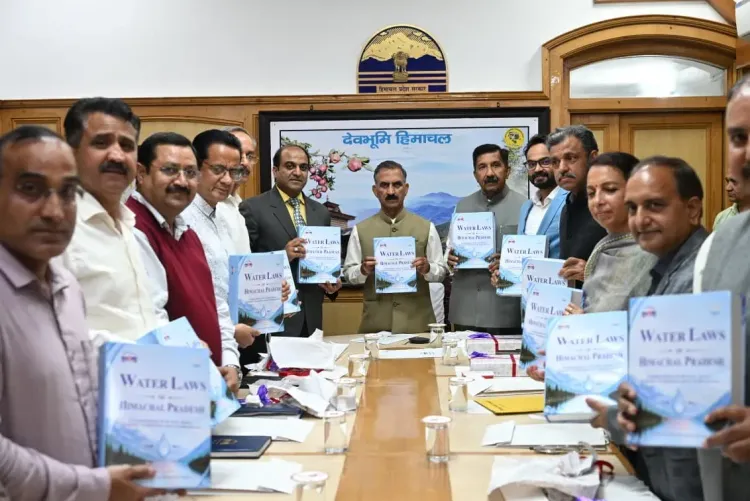
HP CM Office releases 'Water Laws of Himachal' compendium
Synopsis
Himachal Pradesh's Chief Minister's Office released 'Water Laws of Himachal' on 9 July 2026, a first-of-its-kind single-volume compilation by the Jal Shakti Department covering all major acts, rules, policies, technical manuals and circulars governing water in the state.
Key Takeaways
The Chief Minister's Office of Himachal Pradesh announced the release of 'Water Laws of Himachal' on 9 July 2026 .
The compilation is the first comprehensive single-volume water law reference in the state's history.
It was prepared by the Jal Shakti Department of Himachal Pradesh.
The volume consolidates major acts, rules, policies, technical manuals, and administrative circulars related to the department.
Primary beneficiaries include department officials, farmers, irrigators, and legal practitioners .
The move aligns with the spirit of National Water Policy 2012 , which urged states to consolidate water legislation.
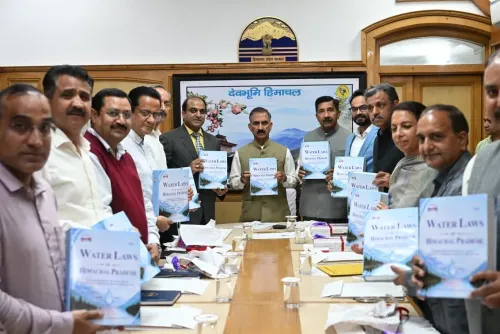
The Chief Minister's Office of Himachal Pradesh announced on Thursday, 9 July 2026 the release of 'Water Laws of Himachal' (Vॉटर लॉज ऑफ हिमाचल), described as the state's first comprehensive single-volume compilation of water-related legislation, prepared by the Jal Shakti Department of the state government.
The post stated: 'Aaj Water Laws of Himachal sankalan ka vimochan kiya' — 'Today the Water Laws of Himachal compilation was released.' The volume brings together major acts, rules, policies, technical manuals, and administrative circulars related to the department under a single cover, making it the first such consolidated reference in the state's history.
Context
The Jal Shakti Department of Himachal Pradesh oversees water resources, irrigation networks, and related regulatory functions across the state. Until now, practitioners, officials, and legal professionals had to navigate scattered legislative instruments spread across multiple documents to understand the regulatory framework governing water use. The new compilation consolidates all these into one accessible reference volume.
The release was formally announced through the official Chief Minister's Office account, indicating institutional endorsement at the highest level of the state government.
Policy Backdrop
India's National Water Policy 2012 had encouraged states to update and consolidate water legislation to facilitate integrated resource management. Many Indian states have periodically produced sector-specific legal compilations to improve administrative clarity and ease of access for officials, courts, and citizens.
Himachal Pradesh, as a Himalayan state, faces distinctive water governance challenges shaped by its major river systems, dependence on hydropower, and the pressures of climate variability on glacial and snowmelt-fed water sources. Codifying the regulatory framework in a single volume addresses a long-standing gap in administrative infrastructure.
Stakeholders and Impact
The compilation is expected to benefit a broad range of users: Jal Shakti Department officials who administer water allocation and infrastructure, farmers and irrigators who depend on clearly defined water rights, and legal practitioners who advise on water-related disputes and regulatory compliance.
By placing acts, rules, policies, technical manuals, and administrative circulars in a single reference, the volume reduces the administrative burden of locating applicable law and is likely to improve consistency in enforcement and decision-making across the department's field offices.
What's Next
Observers of Himachal's governance will watch whether the 'Water Laws of Himachal' compilation is made available in digital form and whether a mechanism is established to issue updated editions as new legislation or circulars are added. A precedent set here could prompt similar consolidation exercises in other resource-heavy departments such as forest, revenue, or hydropower.
If the state moves toward digitising and regularly updating the volume, it would align Himachal Pradesh with best practices in regulatory transparency and could serve as a model for other Himalayan states grappling with complex, multi-layered water governance frameworks.
Point of View
Not just headline infrastructure. In a state where water allocation disputes and hydropower regulation are perennial flashpoints, a single authoritative reference volume can reduce discretionary interpretations at the field level. The move also fits a broader national pattern of states strengthening regulatory infrastructure ahead of anticipated climate-driven water stress. The real test, however, will be whether the compilation is digitised, kept current, and genuinely used by district-level officials rather than remaining a ceremonial publication.
NationPress
9 Jul 2026
Frequently Asked Questions
What is the 'Water Laws of Himachal' compilation?
'Water Laws of Himachal' is the first comprehensive single-volume reference prepared by the Himachal Pradesh Jal Shakti Department, consolidating all major water-related acts, rules, policies, technical manuals, and administrative circulars of the department into one book.
Who released the Water Laws of Himachal compendium?
The compilation was released by the Chief Minister's Office of Himachal Pradesh on 9 July 2026 and was prepared by the state's Jal Shakti Department.
Why is the Water Laws of Himachal compilation significant?
It is the first time Himachal Pradesh has brought all water-related legislation, rules, and circulars into a single reference volume, improving regulatory clarity for officials, farmers, and legal practitioners.
What does the Jal Shakti Department of Himachal Pradesh do?
The Jal Shakti Department of Himachal Pradesh is responsible for managing the state's water resources, irrigation networks, and related regulatory functions, including implementing water allocation and supply schemes.
Will the Water Laws of Himachal be available digitally?
The official announcement did not confirm digital availability; observers expect the state to consider digitising and regularly updating the compilation to maximise its usefulness across field offices.