HP CM Office: Rs 1,500/month aid, free power for 3.5 lakh women

Synopsis
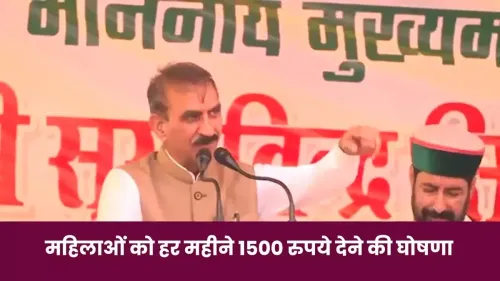
The Chief Minister's Office of Himachal Pradesh has announced Rs 1,500 monthly financial aid, 300 free electricity units for beneficiary families, and a pension hike from Rs 1,050 to Rs 1,500 for women above 59 — covering 3.50 lakh eligible women across the state.
Key Takeaways
Rs 1,500 per month in direct financial assistance for eligible women beneficiaries.
300 units of free electricity every month for beneficiary households.
3.50 lakh women across Himachal Pradesh are set to benefit from the scheme.
Pension for women above 59 years raised from Rs 1,050 to Rs 1,500 per month — a roughly 43 percent increase.
The package is framed around women's dignity and economic self-reliance ( aatmnirbharta ).
Eligibility criteria and disbursement mechanisms are subject to official government orders yet to be released.
A monthly cash transfer, a pension hike, and 300 units of free electricity — the Chief Minister's Office of Himachal Pradesh has announced a sweeping welfare package aimed squarely at women across the state, with 3.50 lakh eligible women set to benefit.
What the package promises: cash, power, and a pension boost
The announcement lays out four concrete commitments. Beneficiary families will receive Rs 1,500 per month in direct financial assistance, alongside 300 units of free electricity every month. Women aged above 59 years will see their pension nearly double — rising from Rs 1,050 to Rs 1,500 per month. The CMO's post frames the drive as a push for women's 'samman aur aatmnirbharta' (dignity and self-reliance).
3.50 lakh beneficiaries and the scale of the commitment
The figure of 3.50 lakh eligible women gives the announcement its weight. In a hill state where geography and seasonal employment already constrain household incomes, a predictable monthly transfer of Rs 1,500 can meaningfully supplement budgets for food, healthcare, and transport. The free electricity component adds a further layer of relief for low-income households where utility bills routinely eat into thin margins.
Indian states have long supplemented the National Social Assistance Programme with state-specific top-ups, and Himachal Pradesh has a documented history of state-funded social security for elderly residents. This announcement follows that pattern — but the simultaneous move on electricity subsidies and the scale of the pension revision mark it as a broader, more integrated welfare push than a routine annual revision.
The pension revision: from Rs 1,050 to Rs 1,500
The pension increase for women over 59 years is the sharpest single number in the package. A jump of Rs 450 per month — roughly a 43 percent rise — matters most to elderly women in rural Himachal Pradesh who have no other fixed income. For many, this pension is the primary buffer against dependence on family members. Raising it to parity with the monthly cash transfer signals a deliberate policy choice to treat elderly women as a distinct, priority cohort.
Official government orders detailing eligibility criteria, disbursement timelines, and budget provisions are awaited, and will determine how quickly the benefits reach intended recipients on the ground.
For a state that markets itself on both tourism and governance quality, putting 3.50 lakh women at the centre of a welfare announcement is a signal — and now the implementation will have to match the promise.
Point of View
But the bundling of a cash transfer, a utility subsidy, and a pension revision into a single women-focused package signals a more integrated political strategy than routine welfare revision. With assembly cycles always on the horizon in Indian states, gender-targeted welfare expansions have become a competitive arena, and Himachal Pradesh is signalling it intends to hold ground on that front. The real test will be implementation fidelity — whether the 3.50 lakh beneficiary figure is backed by updated rolls and whether the electricity subsidy reaches households that are already connected to the grid. If the disbursement machinery delivers, this package could set a new baseline expectation for women's welfare in the state.
NationPress
14 Nov 2026
Frequently Asked Questions
How much monthly financial aid will women get under the Himachal Pradesh scheme?
Eligible women will receive Rs 1,500 per month as direct financial assistance under the scheme announced by the Himachal Pradesh CMO.
How many women will benefit from the Himachal Pradesh welfare scheme?
The scheme is expected to benefit 3.50 lakh eligible women across Himachal Pradesh.
What is the new pension amount for elderly women in Himachal Pradesh?
Women above 59 years of age will receive a pension of Rs 1,500 per month, increased from the earlier Rs 1,050 per month — a rise of Rs 450.
How many free electricity units will beneficiary families get in Himachal Pradesh?
Beneficiary families under the scheme will receive 300 units of free electricity per month.
When will the Himachal Pradesh women welfare scheme benefits be disbursed?
The CMO's announcement does not specify a start date; official government orders detailing eligibility, disbursement timelines, and budget provisions are yet to be released.