HP CM Sukhu doubles SR stipend, cuts duty hours to AIIMS Delhi level

Synopsis
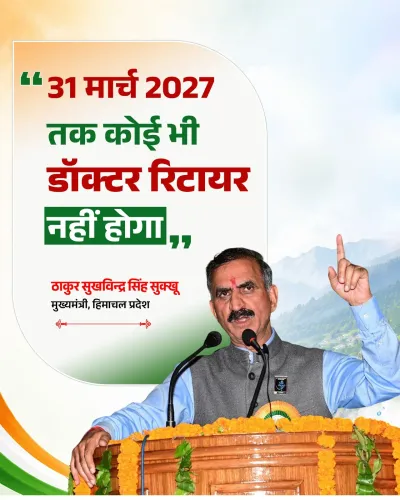
Chief Minister Sukhvinder Singh Sukhu announces Himachal Pradesh has halved senior residency duty hours from 24 to 12 and doubled the stipend from ₹65,000 to ₹1.30 lakh, achieving parity with AIIMS Delhi — a significant shift in resident doctor welfare.
Key Takeaways
Himachal Pradesh has reduced senior residency (SR) duty hours from 24 hours to 12 hours .
The monthly SR stipend has been raised from ₹65,000 to ₹1.30 lakh — a near doubling.
CM Thakur Sukhvinder Singh Sukhu says the revised stipend is now at par with AIIMS Delhi .
The reform targets government medical colleges across Himachal Pradesh .
The move addresses longstanding concerns over resident doctor welfare, retention, and working conditions in state-run medical institutions.
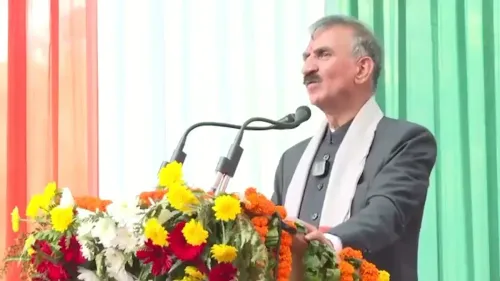
A single policy shift just rewrote the terms of service for every senior resident doctor in Himachal Pradesh's government medical colleges. On Tuesday, 27 October 2026, the Chief Minister's Office of Himachal Pradesh quoted Chief Minister Thakur Sukhvinder Singh Sukhu announcing that the state has slashed senior residency duty hours from 24 hours to 12 hours and doubled the monthly stipend from ₹65,000 to ₹1.30 lakh — explicitly pegging it to the benchmark set by AIIMS Delhi.
From ₹65,000 for 24-hour shifts to ₹1.30 lakh for 12-hour ones
The Chief Minister's statement was direct: 'पहले एसआरशिप के दौरान 24 घंटे काम करने के बदले 65 हजार रुपये स्टाइपेंड मिलता था' ('Earlier, during senior residency, ₹65,000 was paid in exchange for working 24 hours'). The revision is not incremental — it is a structural overhaul on two axes simultaneously. Working hours are cut by half; compensation is doubled. The net effect for a senior resident is roughly four times better pay-per-hour.
The AIIMS Delhi comparison matters politically and practically. AIIMS Delhi is India's gold-standard central medical institution, and state medical colleges have historically struggled to retain post-graduate talent precisely because they could not match central-institute conditions. By explicitly anchoring Himachal Pradesh's revised stipend to that benchmark, CM Sukhu is signalling that the state intends to compete for — and retain — trained medical talent.
Why resident welfare has become a state-level priority
Across India, the condition of medical residents has been a flashpoint for years. Marathon 24-to-36-hour duty shifts, well below-market stipends, and inadequate support infrastructure have triggered repeated strike actions by resident associations in states ranging from Maharashtra to West Bengal. National Medical Commission guidelines attempt to set minimum standards, but enforcement has been uneven, leaving individual states to act — or not.
Himachal Pradesh, a relatively small Himalayan state, runs several government medical colleges that feed into a district hospital network serving a geographically dispersed population. For these institutions, attracting doctors who could otherwise seek better-compensated positions in metro cities or central institutes is a persistent challenge. The revised stipend directly addresses that gap.
What the AIIMS parity pledge signals for other states
When a state government publicly invokes AIIMS Delhi as its benchmark — not merely as an aspiration but as a achieved standard — it raises a competitive bar for neighbouring states. Similar revisions have occurred elsewhere, but the explicit parity claim is a sharper political statement than a routine hike. It sets a measurable, public test: Himachal Pradesh has named the target, and it can now be held to it.
Whether the revised pay and hours roll out uniformly across all government medical colleges in the state, and whether implementation keeps pace with the announcement, will be the real measure of this reform. Resident doctors watching from other states will be watching closely too.
For Himachal's senior residents, the arithmetic is now unambiguous: half the hours, twice the pay. The state has drawn its line.
Point of View
' the government has given itself a measurable, publicly accountable standard. The timing also fits a broader Congress-governed-state pattern of positioning welfare reforms as electoral differentiators. The harder test will be uniform implementation across all state medical colleges, where administrative capacity and funding pipelines have historically lagged behind policy announcements.
NationPress
28 Oct 2026
Frequently Asked Questions
What is the new stipend for senior residents in Himachal Pradesh?
The new monthly stipend for senior residents (SRs) in Himachal Pradesh government medical colleges is ₹1.30 lakh , up from the earlier ₹65,000, as announced by CM Sukhu.
How many hours do senior residents work per shift now in HP?
Senior residents in Himachal Pradesh now work a maximum of 12 hours per shift, reduced from the previous 24-hour duty cycle.
Is the HP senior residency stipend now equal to AIIMS Delhi?
Yes, CM Sukhu explicitly stated that the revised stipend of ₹1.30 lakh is at par with the stipend paid to senior residents at AIIMS Delhi .
Who announced the senior residency reform in Himachal Pradesh?
Chief Minister Thakur Sukhvinder Singh Sukhu announced the reform, with the statement shared by the official Chief Minister's Office of Himachal Pradesh on 27 October 2026 .
Why is senior residency duty-hour reform important for doctors in India?
Senior residents in government medical colleges have historically worked exhausting 24-to-36-hour shifts at below-market pay, driving talent toward central institutes or private hospitals. Reducing hours and raising stipends improves welfare, training quality, and retention in state healthcare systems.