HP CM Office Backs Dairy Farmers, Vows Full Income Benefit
Synopsis
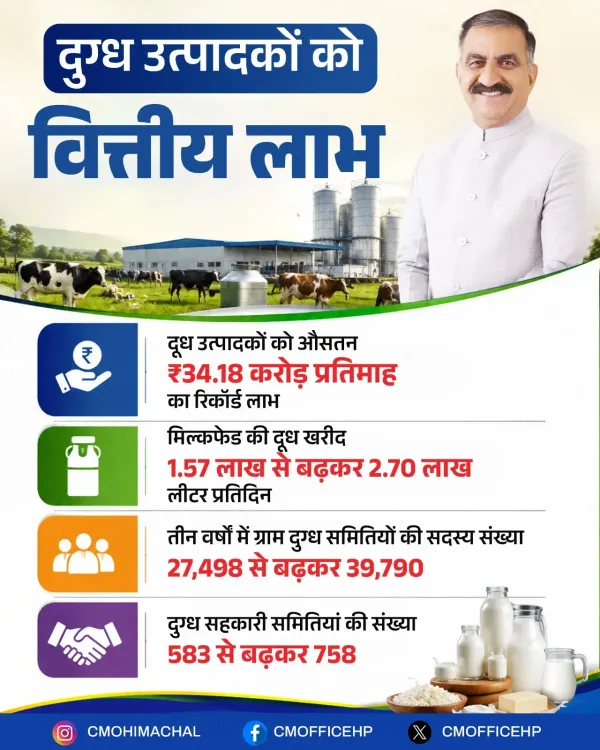
The Chief Minister's Office of Himachal Pradesh on 1 June 2026 declared that cow and buffalo milk production underpins rural prosperity, and pledged that the state government will ensure dairy farmers and animal rearers receive the full returns of their labour.
Key Takeaways
The Chief Minister's Office of Himachal Pradesh posted on 1 June 2026 reaffirming the government's commitment to dairy farmer welfare.
The post describes cow and buffalo milk production as the foundation of both farmer livelihoods and the broader rural economy .
The government stated it is working to ensure milk producers receive the full benefit of their labour, implicitly targeting middlemen margin capture.
Himachal Pradesh's dairy sector is anchored by the Himachal Pradesh Milk Federation and supported by central schemes such as the Rashtriya Gokul Mission .
Dairy contributes approximately 4–5 percent of agricultural GDP nationally and provides critical income stability for smallholders in hill districts.
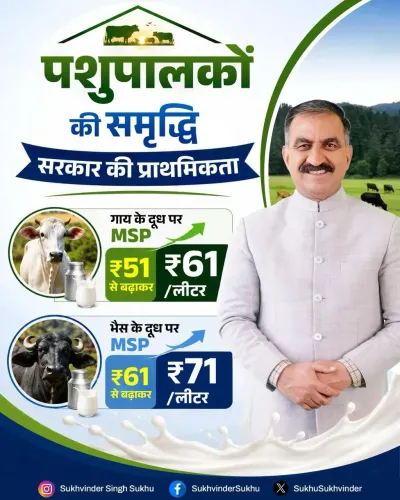
Upcoming state budget allocations for milk chilling plants and procurement price revisions will be key indicators of policy follow-through.
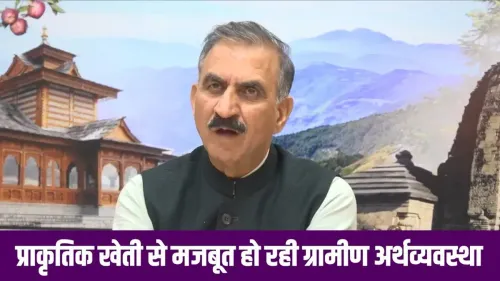
The Chief Minister's Office of Himachal Pradesh, on Monday, 1 June 2026, reaffirmed the state government's commitment to ensuring that milk producers — both cow and buffalo rearers — receive the full benefit of their labour, framing dairy output as the backbone of both rural livelihoods and the broader village economy.
The post, shared from the official CMO account, stated in Hindi: 'Gaay-bhains ke doodh ka utpadan kisanon aur pashupalkon ki aajivika ke saath-saath gramin arthvyavastha ki samridhi ka bhi aadhar hai.' ('The production of cow and buffalo milk is the foundation not only of the livelihood of farmers and animal rearers, but also of the prosperity of the rural economy.')
Context
Himachal Pradesh is a predominantly hilly state where flat arable land is scarce and dairy farming has long served as a critical supplementary income source for rural households. Districts such as Kangra, Mandi, and Shimla have historically supported significant cattle and buffalo populations. For smallholders in these regions, milk sales often provide a more stable daily cash flow than seasonal crop harvests.
Chief Minister Sukhvinder Singh Sukhu, who has led the state since December 2022, has made farmer income and cooperative strengthening a stated priority of his administration. Monday's post from his office signals a continued policy emphasis on the dairy sector as the government approaches budget planning for the next fiscal cycle.
Policy Backdrop
India's dairy sector has been shaped by decades of cooperative infrastructure built under Operation Flood (1970–1996), which created village-level dairy cooperatives across the country — including in Himachal Pradesh — to connect small producers directly with urban consumers and reduce dependence on private middlemen. The model helped retain a greater share of the final milk price within producer communities.
More recently, the central government's Rashtriya Gokul Mission (2014) provided dedicated funding to states for indigenous cattle breed improvement and higher per-animal milk yields, complementing state-level procurement and processing investments. The National Dairy Development Board, established in 1965, has assisted the Himachal Pradesh Milk Federation in building chilling, processing, and logistics infrastructure that underpins the cooperative supply chain.
Nationally, dairy contributes roughly 4–5 percent of agricultural GDP and acts as a buffer for smallholders against the volatility of crop-based income — a pattern that Himachal Pradesh's policy approach closely mirrors.
Stakeholders and Impact
The primary beneficiaries of stronger dairy policy are the state's dairy farmers and small animal rearers — many of whom hold only marginal landholdings and depend on milk income to meet daily household expenses. Any upward revision in procurement prices or expansion of milk chilling infrastructure directly improves their net earnings.
The CMO's statement that 'our government is ensuring that milk producers receive the full benefit of their hard work' points specifically at the longstanding problem of margin capture by intermediaries — a concern that cooperative models are designed to address. Strengthening the Himachal Pradesh Milk Federation's reach into remote villages would be a concrete mechanism for delivering on this commitment.
What's Next
Policy watchers will look closely at the state government's upcoming budget allocations for milk chilling plants and any revision of procurement prices by the Himachal Pradesh Milk Federation in the coming fiscal cycle. An increase in per-litre procurement rates or investment in cold-chain expansion would translate the CMO's statement into measurable economic relief for producers.
If the administration follows through with structural investment — rather than limiting action to price support alone — the dairy sector in Himachal Pradesh could serve as a model for other hill states seeking to diversify rural income beyond agriculture.
Point of View
Rather than announcing a specific scheme or price hike, suggests the government is building narrative momentum before a concrete policy announcement. For a hill state where flat farmland is limited and cash incomes are precarious, dairy policy carries outsized electoral and economic weight.
NationPress
15 Oct 2026
Frequently Asked Questions
What did the Himachal Pradesh CM Office say about dairy farmers?
The Chief Minister's Office of Himachal Pradesh stated on 1 June 2026 that cow and buffalo milk production is the foundation of rural livelihoods and the village economy, and that the government is committed to ensuring dairy farmers receive the full benefit of their labour.
Who is the Chief Minister of Himachal Pradesh in 2026?
Sukhvinder Singh Sukhu has been the Chief Minister of Himachal Pradesh since December 2022 and his administration has consistently emphasised farmer income support and cooperative strengthening.
How does dairy farming help rural economy in Himachal Pradesh?
Dairy farming provides a stable daily cash income for smallholders in hill districts like Kangra , Mandi , and Shimla where arable land is limited, supplementing seasonal crop income and buffering households against agricultural volatility.
What is the Himachal Pradesh Milk Federation?
The Himachal Pradesh Milk Federation is the state cooperative body that procures milk from village-level cooperatives, processes it, and markets dairy products — working in coordination with the National Dairy Development Board to support producer prices.
What central schemes support dairy farmers in Himachal Pradesh?
The Rashtriya Gokul Mission , launched in 2014, provides central funding for indigenous cattle breed improvement and higher milk yields, while the infrastructure legacy of Operation Flood (1970–1996) underpins the cooperative procurement network in the state.