CM Sukhu fixes MSP for cow, buffalo milk to aid HP dairy farmers
Synopsis
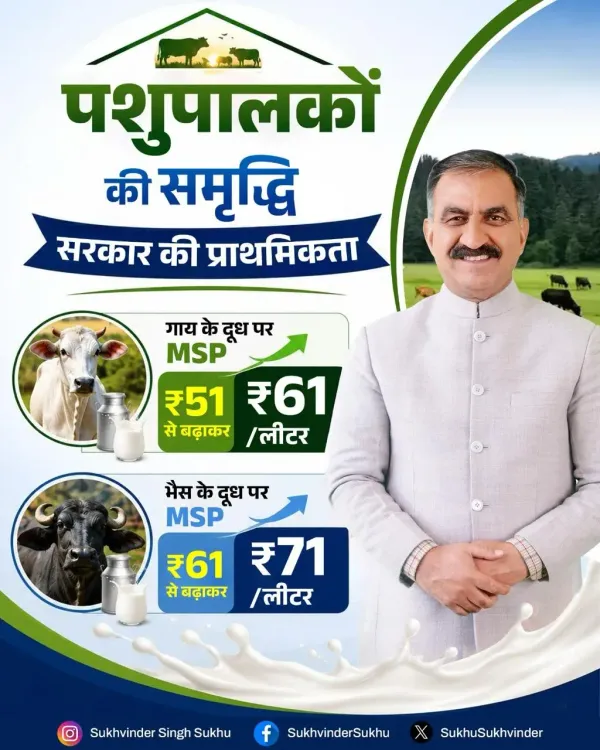
Himachal Pradesh CM Sukhvinder Singh Sukhu on 23 May 2026 fixed the MSP for cow milk at Rs 61 per litre and buffalo milk at Rs 71 per litre, aiming to stabilise incomes for thousands of rural dairy farming families and boost animal husbandry across the hill state.
Key Takeaways
CM Sukhvinder Singh Sukhu announced a minimum support price for milk in Himachal Pradesh on 23 May 2026 .
The MSP for cow milk has been set at Rs 61 per litre .
The MSP for buffalo milk has been set at Rs 71 per litre .
The move is aimed at protecting dairy farmers from market price volatility and strengthening the rural economy.
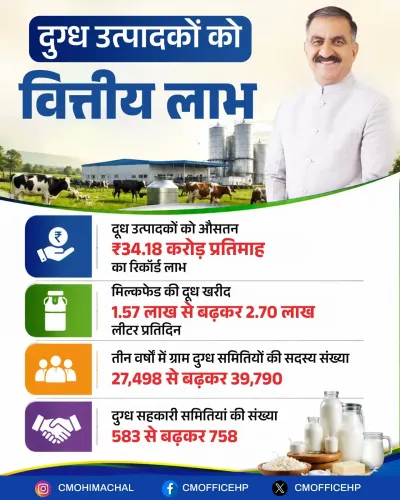
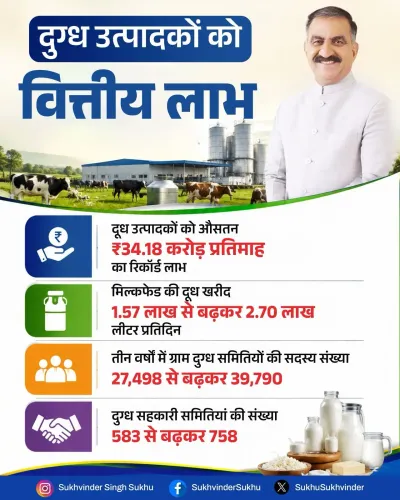
Dairy farming is described as the primary livelihood for thousands of rural families in the hill state.
Implementation will depend on rollout through state dairy federations and cooperative networks.
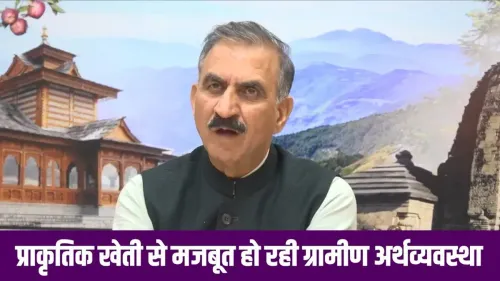
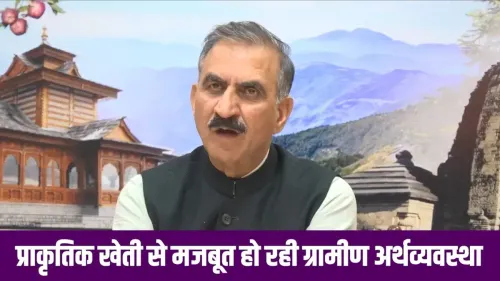
Himachal Pradesh Chief Minister Sukhvinder Singh Sukhu on Saturday, 23 May 2026, announced a minimum support price for milk to protect the incomes of dairy farmers across the state, setting the procurement rate at Rs 61 per litre for cow milk and Rs 71 per litre for buffalo milk.
Context
Posting in Hindi on X, CM Sukhu stated: 'हिमाचल प्रदेश में दुग्ध उत्पादन हजारों ग्रामीण परिवारों की आजीविका का मुख्य आधार है' ['Milk production is the primary livelihood of thousands of rural families in Himachal Pradesh']. He framed the MSP revision as a 'big step in the interest of farmers', adding that the government's goal is to strengthen the rural economy and make farming households financially resilient.
Himachal Pradesh is a hill state where seasonal constraints limit crop agriculture, making animal husbandry — particularly dairy — one of the most reliable income sources for rural households. The MSP mechanism shields producers from price volatility in open markets by guaranteeing a floor procurement rate.
Policy Backdrop
State-level milk procurement pricing in India traces its institutional roots to Operation Flood, launched in 1970, which built cooperative dairy structures that still underpin how states set and disburse procurement rates. Successive state governments across the country have periodically revised these rates to offset rising feed and input costs.
The dairy sector contributes substantially to India's agricultural GDP and is a significant employer in non-urban areas. Himachal Pradesh's hilly terrain makes large-scale mechanised crop farming difficult, giving animal husbandry an outsized role in the state's rural economy relative to the national average.
Stakeholders and Impact
The primary beneficiaries are dairy farmers and rural households across Himachal Pradesh who sell milk through state cooperative and procurement channels. A guaranteed floor price reduces the risk of distress selling during periods of market oversupply — a recurring concern in hill states where cold-chain logistics can be limited.
The revised rates also carry a supply-side signal: by making dairy more remunerative, the government aims to encourage greater investment in cattle and buffalo rearing, potentially lifting overall milk production volumes in the state. This aligns with the broader national pattern of using MSP as both an income-support and a production-incentive tool.
What's Next
The practical impact of the revised MSP will depend on how swiftly the rates are operationalised through Himachal Pradesh's state dairy federations and cooperative networks. Observers will watch for follow-up notifications from the Animal Husbandry Department and whether complementary measures — such as veterinary support, fodder subsidies, or cold-chain investments — are announced in the next state budget.
If implemented effectively, the price revision could serve as a model for other hill states grappling with the same challenge of making rural livelihoods more resilient in terrain where conventional agriculture faces structural limits.
Point of View
Targeting a constituency — rural dairy farmers — that is both economically vulnerable and electorally significant in a state where the party holds a thin majority. By anchoring the revision to a floor price rather than a subsidy, the government avoids recurring fiscal pressure while still projecting farmer-welfare credentials. The move fits a wider pattern of state governments using dairy MSPs as a low-cost, high-visibility instrument to signal rural intent ahead of budget cycles. The real test will be whether the price signal translates into measurable gains in milk production and farmer income, or remains a procurement guarantee that reaches only a fraction of actual producers.
NationPress
19 Sept 2026
Frequently Asked Questions
What is the new MSP for milk in Himachal Pradesh 2026?
The Himachal Pradesh government has set the MSP at Rs 61 per litre for cow milk and Rs 71 per litre for buffalo milk , as announced by CM Sukhvinder Singh Sukhu on 23 May 2026.
Who announced the milk MSP in Himachal Pradesh?
Himachal Pradesh Chief Minister Sukhvinder Singh Sukhu of the Indian National Congress announced the revised milk minimum support prices on his official X account on 23 May 2026.
Why is milk MSP important for Himachal Pradesh farmers?
In Himachal Pradesh , the hilly terrain limits large-scale crop farming, making dairy a primary income source for thousands of rural families. An MSP protects farmers from distress selling when market prices fall.
What is MSP for milk and how does it work?
A milk MSP is a government-fixed minimum procurement price that guarantees dairy farmers will not receive less than a set rate per litre when selling through state cooperative or procurement channels, shielding them from market volatility.
How does the Himachal Pradesh milk MSP compare to the national dairy policy?
State-level milk MSPs complement national dairy policy by addressing local cost structures and terrain-specific challenges. Himachal Pradesh's revision follows a broader Indian pattern of states periodically raising procurement rates to offset rising feed and input costs.