HP CM Office: Milk procurement up 72%, dairy farmers earn Rs 34 cr/month
Synopsis
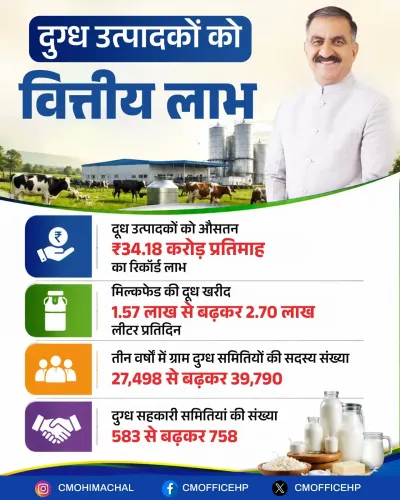
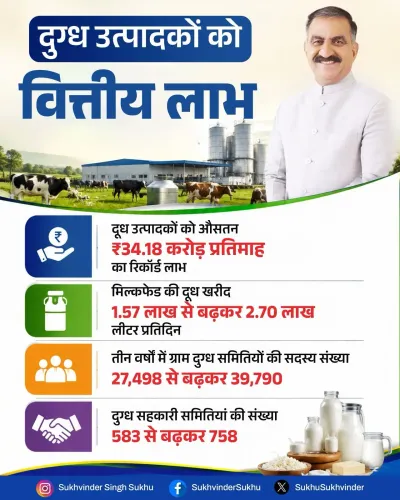
The Chief Minister's Office of Himachal Pradesh has shared dairy sector data showing daily milk procurement up 72 per cent to 2.70 lakh litres, cooperative membership risen to 39,790 farmers across 758 village committees, and monthly producer earnings at Rs 34.18 crore.
Key Takeaways
Daily milk procurement in Himachal Pradesh has risen from 1.57 lakh litres to 2.70 lakh litres , a jump of approximately 72 per cent .
Milk producers are collectively earning an average of Rs 34.18 crore per month through the cooperative network.
Membership of Gram Dugdh Samitis has grown from 27,498 to 39,790 , an increase of over 12,000 farmers .
The number of village milk producer committees has risen from 583 to 758 , expanding geographic coverage across the state.
The figures reflect the continued scaling of Milkfed HP , the state's apex dairy cooperative body, in a region where terrain limits conventional crop farming.
The Chief Minister's Office of Himachal Pradesh shared a set of dairy sector metrics on Monday, 1 June 2026, highlighting significant growth in milk procurement volumes, cooperative membership, and monthly earnings for milk producers across the state.
Context
The post lists four headline figures: milk producers are earning an average of Rs 34.18 crore per month; daily milk procurement has risen from 1.57 lakh litres to 2.70 lakh litres; membership of Gram Dugdh Samitis (village milk producer committees) has grown from 27,498 to 39,790; and the number of these committees has increased from 583 to 758. The figures represent an approximately 72 per cent jump in daily procurement and a 44 per cent rise in cooperative membership.
No base date or comparison period is specified in the post, but the metrics are presented as evidence of progress under the current state government's push to strengthen rural dairy infrastructure.
Policy Backdrop
The data points to the expanding reach of the Himachal Pradesh State Cooperative Milk Producers Federation (Milkfed HP), the apex body that manages procurement, processing, and marketing through village-level cooperatives. The cooperative dairy model in Himachal Pradesh traces its lineage to Operation Flood, launched nationally in 1970, which established the framework for state-level dairy federations.
Himachal Pradesh is a predominantly hilly state where terrain constraints limit conventional crop agriculture, making livestock and dairy a critical supplementary income source for rural households. Expanding the cooperative procurement network directly raises the floor income for small and marginal farmers who otherwise sell milk at lower prices to private traders.
Stakeholders and Impact
The primary beneficiaries are the 39,790 members of the Gram Dugdh Samitis spread across 758 villages, who now have a formal channel to sell milk at cooperative rates. The aggregate monthly payout of Rs 34.18 crore translates to a direct cash infusion into rural households, particularly significant in districts where horticulture incomes are seasonal.
The expansion also strengthens the cooperative structure itself: more committees mean wider geographic coverage, reducing the distance farmers must travel to the nearest collection point. Larger procurement volumes improve the economics of processing and cold-chain infrastructure, which benefits the entire supply chain.
What's Next
The broader dairy cooperative pattern across northern and Himalayan states suggests the next phase typically involves investment in processing capacity — chilling centres, pasteurisation plants, and value-added product lines — to convert raw procurement growth into higher per-litre returns for farmers. Observers will watch Himachal Pradesh's state budget allocations for dairy infrastructure and any potential tie-ups with the National Dairy Development Board (NDDB) for technical or financial support. Sustained growth in membership and procurement will depend on whether the state can offer competitive procurement prices and timely payments as the cooperative network scales further.
Point of View
Where the White Revolution's cooperative model has historically underperformed relative to the plains. A near-doubling of daily procurement and a 44 per cent rise in membership within a single policy cycle signals institutional momentum, not just incremental growth. The political calculus is transparent: in a state where rural constituencies are decisive, direct monthly cash flows to over 39,000 farming households carry significant electoral weight. The key test ahead is whether processing infrastructure and procurement pricing can keep pace with supply growth, or whether the cooperative risks becoming a victim of its own expansion.
NationPress
25 Sept 2026
Frequently Asked Questions
How much milk is being procured daily in Himachal Pradesh under the cooperative network?
Daily milk procurement has risen to 2.70 lakh litres , up from 1.57 lakh litres , according to figures shared by the Chief Minister's Office of Himachal Pradesh.
How much are dairy farmers in Himachal Pradesh earning per month through cooperatives?
Milk producers are earning an average of Rs 34.18 crore per month collectively through the state's cooperative dairy network.
What are Gram Dugdh Samitis in Himachal Pradesh?
Gram Dugdh Samitis are village-level milk producer committees that serve as the primary collection points in Himachal Pradesh's cooperative dairy network, managed under Milkfed HP .
How many Gram Dugdh Samitis are there in Himachal Pradesh now?
The number of Gram Dugdh Samitis has grown from 583 to 758 , while membership has risen from 27,498 to 39,790 farmers.