HP CM Office Chairs Meet on Land Diversion for 2,183 Roads

Synopsis
The Chief Minister's Office of Himachal Pradesh chaired a Forest Department meeting on 19 June 2026 to process land diversion proposals for 2,183 roads built without Forest Conservation Act clearance, acting under Forest Rights Act provisions and Himachal Pradesh High Court directions.
Key Takeaways
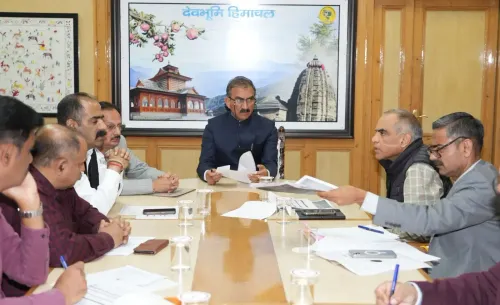
The Chief Minister's Office of Himachal Pradesh chaired a Forest Department meeting at the Secretariat on 19 June 2026 .
The meeting addressed land diversion proposals for 2,183 roads constructed without prior approval under the Forest Conservation Act (FCA), 1980 .
The exercise is being carried out under provisions of the Forest Rights Act (FRA), 2006 and in compliance with directions from the Himachal Pradesh High Court .
Processed diversion proposals must be submitted to the central Ministry of Environment, Forest and Climate Change for final clearance.
The outcome will directly affect forest-dwelling communities and rural road users dependent on these roads for basic connectivity.
Subsequent High Court hearings are expected to monitor the state's compliance with prescribed timelines.
The Chief Minister's Office of Himachal Pradesh on Friday, 19 June 2026, announced that a meeting of the state Forest Department was chaired at the Secretariat to address land diversion proposals for 2,183 roads built without prior clearance under the Forest Conservation Act (FCA), 1980. The move follows provisions of the Forest Rights Act (FRA), 2006 and directions issued by the Himachal Pradesh High Court.
Context
The official post, in Hindi, states: 'आज सचिवालय में वन विभाग की बैठक की अध्यक्षता की' ('Chaired a meeting of the Forest Department at the Secretariat today'). It further notes that under FRA provisions and in compliance with High Court directions, the meeting took up the question of land diversion for 2,183 roads constructed without the mandatory FCA, 1980 approval. These roads represent a long-standing legacy of rural infrastructure built in forested terrain without statutory forest clearance.
The Forest Conservation Act, 1980 requires prior central government approval before any forest land is diverted for non-forest use, including road construction. The Forest Rights Act, 2006 — a landmark central legislation — was enacted to recognise the rights of forest-dwelling Scheduled Tribes and other traditional forest dwellers over forest land and resources, and its provisions have been invoked in several states to regularise pre-existing infrastructure.
Policy Backdrop
India's Forest Conservation Act has mandated central clearance for all non-forest use of forest land since its amendment in 1988. Himalayan states, including Himachal Pradesh, have faced a persistent tension between the connectivity needs of remote hill communities and the conservation obligations imposed by this law. Thousands of village roads and link roads in such states were laid over decades — often under emergency or administrative necessity — without formal FCA diversion approvals.
The Forest Rights Act, 2006 introduced a framework that, among other provisions, allows for community-level recognition of rights, and has been interpreted in certain judicial and administrative contexts to facilitate the processing of diversion proposals for such legacy linear infrastructure. The Himachal Pradesh High Court has issued directions requiring the state to process these cases in a time-bound manner while maintaining statutory safeguards, making judicial oversight a key driver of the current exercise.
Stakeholders and Impact
Forest-dwelling communities and rural road users across Himachal Pradesh stand to be directly affected by the outcome of this process. For many villages in remote areas, the roads in question are the only surface links to markets, schools, and health facilities. Regularisation through the prescribed legal route would provide these roads with formal status, potentially enabling maintenance funding and upgrades.
The Himachal Pradesh Forest Department is the nodal state agency responsible for processing the diversion proposals and submitting them to the central Ministry of Environment, Forest and Climate Change for final approval. State forest officials will need to compile and verify documentation for each of the 2,183 cases, a substantial administrative undertaking given the scale and the mountainous terrain involved.
What's Next
The immediate next step is the preparation and submission of processed diversion proposals by the state to the central government. Subsequent hearings before the Himachal Pradesh High Court are expected to monitor compliance with the timelines set in its earlier directions. The outcome of this process will set a precedent for how the state handles similar legacy infrastructure cases in its extensive forest cover in the future.
How swiftly the state completes the documentation and how the central environment ministry processes the proposals will determine whether thousands of rural communities in Himachal Pradesh gain legally secured road connectivity — or continue to depend on infrastructure that remains in a statutory grey zone.
Point of View
183-road diversion issue signals that judicial pressure from the state High Court is producing administrative action on a problem that has been deferred for years. The scale — over two thousand roads — underscores how deeply rural connectivity in Himalayan states has historically outpaced the capacity of statutory clearance frameworks. By anchoring the regularisation process in FRA provisions, the state is threading a legal needle that balances tribal and community rights with conservation obligations under the FCA. The success of this exercise will be closely watched by other hill states grappling with similar backlogs of unauthorised linear infrastructure in forest areas.
NationPress
19 Sept 2026
Frequently Asked Questions
Why does Himachal Pradesh need to regularise 2,183 roads?
These roads were built in forest areas without prior approval under the Forest Conservation Act, 1980, which is mandatory for any diversion of forest land. The Himachal Pradesh High Court has directed the state to process land diversion proposals for all such roads under Forest Rights Act provisions.
What is the Forest Rights Act and how does it apply here?
The Forest Rights Act, 2006 is a central law that recognises the rights of forest-dwelling Scheduled Tribes and other traditional forest dwellers over forest land. Its provisions are being used alongside the FCA process to regularise pre-existing roads that serve forest communities in Himachal Pradesh.
What is the Forest Conservation Act, 1980?
The Forest Conservation Act, 1980 requires prior approval from the central government before any forest land can be diverted for non-forest use, including road construction. Roads built without this clearance are technically in violation of the law.
What happens after the Himachal Pradesh Forest Department processes these cases?
The state must submit the processed diversion proposals to the central Ministry of Environment, Forest and Climate Change for final approval. The Himachal Pradesh High Court will continue to monitor compliance at subsequent hearings.
Who is affected by the forest road diversion issue in Himachal Pradesh?
Forest-dwelling communities and rural residents who depend on these 2,183 roads for access to markets, schools, and health facilities are directly affected, as are state forest officials responsible for preparing and submitting the diversion documentation.